Astrobiology is at its core an interdisciplinary endeavor. But frustratingly, there is still not enough cross communication between astronomers, biologists, chemists, stellar and solar physicists or geologists to bridge the yawning chasms between these scientific subgenres. That's why the recent Origins 2026 conference in Paris was so important.
It's a point that's not lost on longtime astrobiologist Lisa Kaltenegger, an invited Origins conference speaker who braved a week of unbearable heat at Parisâ Sorbonne University to listen to presentation after presentation, while asking pertinent questions after almost every talk.
Kaltenegger then gave an excellent overview of the state of astrobiology and the prospects for characterizing the 45 rocky exoplanets that astronomers have thus far identified as lying in their stellar systemâs habitable zones.
Currently, twenty percent of all red M-dwarfs are thought to harbor rocky planets within their habitable zones. Those are the regions around the star where rocky planets could maintain liquid water on their surfaces.
But it doesn't mean that the planet is habitable; it also doesn't mean that outside of the habitable zone you cannot be habitable, Lisa Kaltenegger, Director of the Carl Sagan Institute at Cornell University, told me in Paris.
Each of these rocky planets is a puzzle piece of how planets are born, evolve and function. Yet Earth scientists have a big gap in our understanding of our own home planet.
Thatâs in part because the further we go back in time, the harder it gets to tease out the most important effects that changed our planet, says Kaltenegger, author of the 2025 book âAlien Earths: The Search for Life in the Cosmos.â But finding extrasolar rocky worlds around stars with different ages could fill in the gaps in our knowledge and tell us how rocky planets work and evolve, she says.
But few of these potentially habitable planets have been observationally characterized.
We only have so much time on NASAâs James Webb Space Telescope because as a multipurpose telescope, itâs also observing black holes and galaxies, says Kaltenegger.
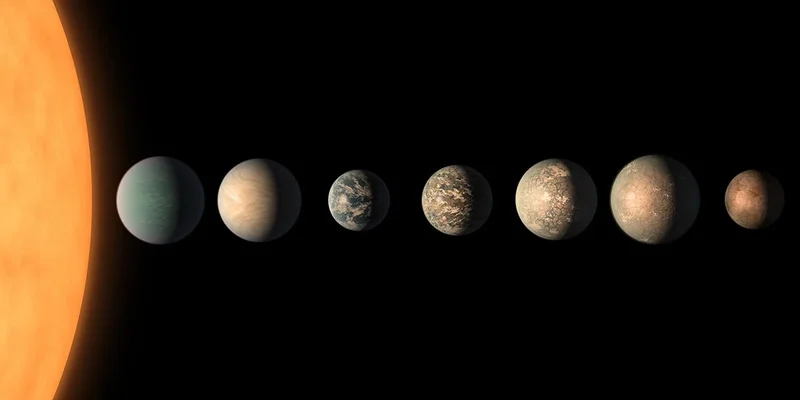
Now, the extrasolar science community has prioritized Webb observations of Trappist 1, a cool red M-dwarf that orbits a red dwarf star some 40 light years away in the constellation of Aquarius and harbors seven earth-sized planets. Three are thought to be potentially habitable.
Red M-dwarfs are the most ubiquitous stars in the cosmos.
Extrasolar planet hunters love these small red stars --- which roughly range in size between about a tenth to half the mass of our own Sun. Thatâs because orbitally close-in rocky planets are simply easier to detect as they transit across the faces of these small parent stars.
Partly as a result, Kaltenegger has decided to focus on what is currently possible: looking for biosignatures around such small red dwarfs. Such transit observations with the Webb telescope can thus reveal atmospheric biosignatures like oxygen in combination with methane.
But to reveal surface colors like vegetation, we need a next generation of telescopes.
Yet directly imaging rocky exoplanets in the optical spectrum wonât truly be possible until the European Southern Observatoryâs (ESO) Extremely Large Telescope, a 39-meter behemoth, sees first light in the Atacama Desert in 2030. Or when NASA fully funds and launches its Habitable Worlds Observatory (HWO), very tentatively scheduled for launch sometime in the 2040s.
Eight out of ten stars that host exoplanets are small red dwarfs, says Kaltenegger. If I put my kitchen basil plant under a red sun, it's probably going to die even faster than if I don't water it, she says.
But sulfur bacteria can thrive under red light with shades from yellow all the way to purple, leaving the door open for lots of different bio pigments that could be dominant under a different colored sun.
The Need For Creative Thinking In The Search For Exo-Life
I sometimes worry that we're too narrow-minded in our searches because looking at Earth through time presents very different environments, says Kaltenegger. In the distant past, days were much shorter, there were less continents, there were different surface biota and a completely different atmosphere, she says.
In such a context, one could even argue that Earth has had many different versions of itself. So, how can we be sure that the biosignatures that we detect are indicative of life?
If you do not understand the planet and its geology, you will not understand whether the signatures you see are actually due to life or not, says Kaltenegger. I need to see more than just the oxygen and methane biosignature pair; I first need to figure out if biosignatures could be made from geological sources or from photochemistry, she says.
Again, another line of evidence could be reflected light bounced off biological substrates; e.g., colors from bio pigments on the planetâs surface. To that end, Kaltenegger and colleagues at Cornell have created a âcolor catalog of life,â with some 300 different sample bio pigments of how life might appear to us at such great distances.
Why should we worry about any planet circling a star light years away?
To better understand how our planet works and how to actually safeguard it better, says Kaltenegger. Let's say, we find 50 other extrasolar earths older than ours, it gives us a glimpse into our possible future, she says.
Lisa Kaltenegger giving her invited presentation at the Origins 2026 conference in Paris. Credit: Bruce Dorminey
Assuming that a lot of these planets have large amounts of Sulfur Dioxide (SO2) in their atmospheres, that could be a prime motivator in figuring out how to rid our own Earth of this gas, or other gasses that might pose a future threat to humanity.
But the quest for certainty in extrasolar planetary science is always going to be limited by vast cosmic distances.
We can only get reflected, emitted, or transmitted light to tell us whether there's a biosphere that transformed a given planet completely, says Kaltenegger. A lot of life might be there, but we may be blind to most of it, because those signatures could be made by geology alone, or itâs chemistry that we canât interpret, she says.