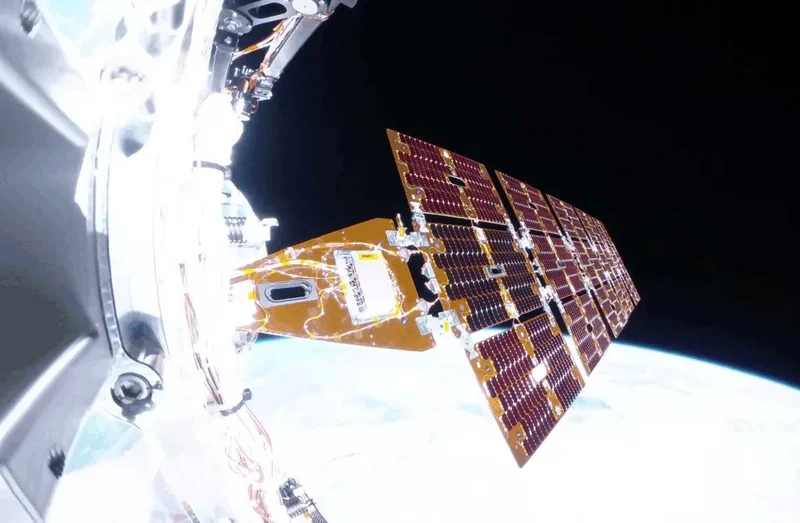
WASHINGTON — A spacecraft launched nearly a month ago in a high-risk bid to boost the orbit of a NASA astrophysics satellite is suffering from attitude control problems that could jeopardize its mission.
In a July 28 update posted on social media, Katalyst Space Technologies said its Link spacecraft, launched July 3, was in a “multi-axis spin” caused by attitude control issues that also affected spacecraft communications.
“During commissioning, the Katalyst team encountered a series of technical issues related to attitude control of the spacecraft,” the company stated. “Over the last 72 hours, the LINK spacecraft has been in a multi-axis spin, causing a temporary loss of communications and subsequent bus reset.”
The company said that two of the three reaction wheels on Link, used for attitude control, were not functioning and that the spacecraft’s reaction control system thrusters were only partially working.
Link launched into low Earth orbit on a Pegasus XL on a mission to rendezvous and dock with NASA’s Neil Gehrels Swift Observatory, or Swift, spacecraft. That gamma-ray observatory is in a decaying orbit and will reenter late this year or early next year without intervention. NASA awarded Katalyst Space a $30 million contract last September to attempt a reboost mission.
Katalyst has provided few updates on the status of Link since its launch. In a July 15 statement, the company said it completed initial post-launch checkouts, including getting the spacecraft into a stable attitude.
The company said then there had been some problems during the commissioning process. “Early in commissioning, mission operations identified attitude control and communications anomalies during flight operations,” it stated. “The team implemented flight software patches and operational updates that restored reliable communications and enabled three-axis stabilized attitude control, allowing LINK to accurately point and orient itself in space.”
In a July 24 update, the company said it had started testing the spacecraft’s electric thrusters, performing two burns to raise the spacecraft’s altitude by about 2 kilometers. Those tests, it said, were designed “to prepare for the longer, multi-hour burns it will execute in the rendezvous phase.”
Katalyst Space said that other key subsystems on Link, including communications, propulsion and robotics systems needed to grapple Swift, were working properly.
“Over the coming days, Katalyst will work to reduce the body rates using the gimbaled electric propulsion thrusters and stabilize the spacecraft. We have already begun this series of burns and are seeing the intended effect,” the company stated.
It then plans over the next few weeks to update the spacecraft guidance, navigation and control systems “to reflect the current spacecraft configuration” and, after testing, begin its approach to Swift. “The mission remains active and we continue to believe that with these changes, LINK has a viable path to rendezvous with Swift,” the company stated.
Before the launch of Link, NASA said that efforts to raise Swift’s orbit needed to begin before the spacecraft’s altitude fell below 300 kilometers. Swift is currently at an altitude of about 350 kilometers, and at a prelaunch briefing NASA said the agency expected Swift to reach the 300-kilometer altitude threshold in October.