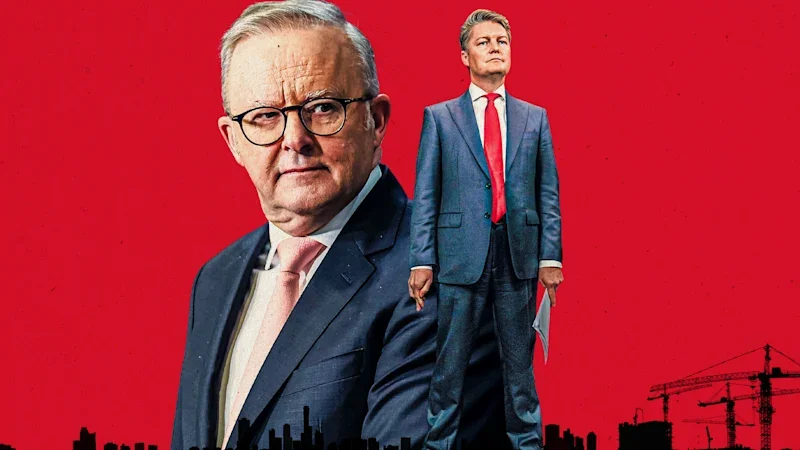
It’s worth remembering that the Andrews-Allan government wasn’t always a bad one. In its first term ending in 2018, it could plausibly argue that it was one of the most effective administrations in the country, whatever one thought of its agenda.
So much so that Labor leaders across the country took notes from Daniel Andrews. Andrews’ online communication style (think: “Because it’s the right thing to do”), big outlays on infrastructure, and action-man, centralised style of government were all picked up by peers.
Andrews and Allan lucked out with a uniquely dysfunctional opposition. Their opponents’ ineptitude, coupled with hubris and corrosive governing practices, turned Victorian Labor into an outfit that’s now talked about by Labor ministers in Canberra and Sydney as what not to be.
Premier Ben Carroll took the unusual step of name-checking his predecessors on Tuesday. New party leaders are rarely so explicit, blunt or personal when taking the mantle. “I am not Daniel Andrews. I am not Jacinta Allan,” he said, in a sign of how severely public opinion had turned against his predecessors.
Victoria’s Labor government has been in power nearly a decade longer than Albanese’s, so its problems are by nature more severe. Albanese’s political judgement and cautious mindset, and the checks and balances that exist at a federal level, should avoid the worst of Victoria’s excesses.
What, then, are the lessons for a dominant Anthony Albanese in how to avoid the disease that has afflicted Victorian Labor?
Just like in Spring Street, Albanese’s opponents are in a state of upheaval.
Albanese’s handling of this year’s budget showed signs that habits from Victoria might have spread north.
Business groups protested for months about Labor’s tax changes. Treasurer Jim Chalmers was left feeling bruised that his package of productivity reforms barely featured in public debate, which was instead dominated by criticism of its capital gains tax changes for businesses.
Labor could hardly be surprised that it wasn’t given the benefit of the doubt, however. It scorned business leaders, economists and the media by failing to consult on any of its key measures. Andrews was an early adopter in freezing out stakeholders that were not part of the Labor family.
After a series of crab walks in direct response to public feedback, Albanese described critics of his budget as “barely coherent”. The statement carried a strong whiff of Andrews, who often dismissed the concerns of public health figures and economists during the pandemic.
The prime minister has similarly taken to rubbishing the views of leading public policy experts Chris Richardson and Saul Eslake when they questioned if Labor’s first home buyer deposit scheme would push up prices.
In her resignation statement, Allan noted that the “big business lobby” gave no credit to the productivity gains from billions of dollars spent on new rail and road projects. She has a point. Victorian Labor’s economic management has been widely panned, and for good reason. But on a per-person basis, its debt position is not significantly worse than some other states.
In both Melbourne and Canberra, Labor has taken to reflexively attacking commentators, businesses and anyone who doesn’t agree with their approach, casting them as ideological enemies. A style premiers Peter Malinauskas and Chris Minns in South Australia and NSW respectively have consciously avoided.
That closed-shop culture extends to how Albanese’s internal critics say he runs his caucus. One senior Labor source told this masthead last week about an occasion last year when a minister was told after a cabinet meeting that it would be best to sort out a policy argument before cabinet. Open discussion inside the cabinet room was best avoided, the minister was told.
Albanese’s internal sceptics, who are not plentiful, complain that decisions are increasingly made in small groups.
In Victoria, Andrews pushed out ministers (Gavin Jennings, Jill Hennessy, Jenny Mikakos, Philip Dalidakis) who acted as counterweights. Jennings in particular was a rare voice who worried about the state’s financial troubles, which eventually spiralled. What was left was a group of ministers who acted as yes-people, led by Allan who was anointed Andrews’ successor and stuck to the formula.
Albanese’s budget is under serious strain but not as badly stretched as Victoria’s. The state’s approach of offering unions and other Labor-friendly stakeholders whatever was needed to win their support should be avoided at a federal level.
Some in federal Labor were hoping Allan clung onto the leadership. They hoped that she would lose the November election and that the Coalition’s Jess Wilson would govern in minority with the support of One Nation, proving to the nation that the parties were in cahoots.
Now, the Albanese government is left in a bind on how to deal with a looming royal commission into Big Build corruption, sparked single-handedly by the work of reporter Nick McKenzie and the bravery of his sources.
The federal government is right to say construction sites are governed by state authorities. This is fundamentally a Victorian problem. But Albanese, who booted John Setka out of the Labor Party, has ploughed $6 billion into the Suburban Rail Loop. Some of Albanese’s own ministers and federal Labor MPs from Victoria worry the project is a waste. Carroll has expressed private criticism of the project, too.
Federal Labor abolished the Australian Building and Construction Commission when it came to power in 2022. It understandably viewed the body as a Coalition attempt at union-busting. But it offered little in its place, as the CFMEU continued to run riot.
Albanese could take the passive approach and handball the issue to Victoria. Or he could seize the moment and make federal funding contingent on reforming the deeply corrupt construction sector, proving that probity means more than loyalty among Labor governments.