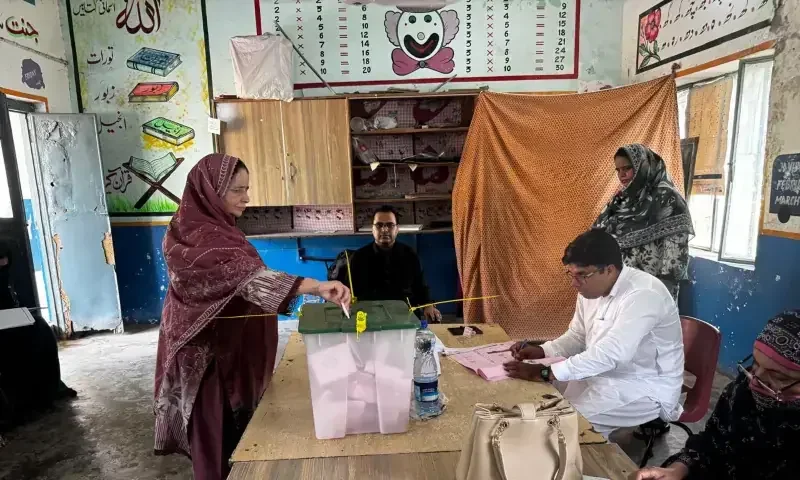
CONSIDERING the political unrest that has rocked Azad Jammu and Kashmir in the recent past, free and fair general elections are essential to finding a democratic solution to AJK’s issues. Which is why the current three-phase exercise, which began on Monday with votes being cast in Mirpur division, should be conducted with absolute integrity — and without any phase of the electoral process influencing the outcome of the next. The next phase is scheduled for Aug 2, covering Muzaffarabad division and 12 refugee seats, and the last round of voting will be on Aug 10 for Poonch. This is the first time that general elections in AJK are being held in phases. As per the preliminary results, the PML-N appears in pole position, with its main contender the PPP in second place. While a more complete picture will emerge after the consolidated results are in, there are concerns that the announcement of results in the first phase will impact voters’ choices in the subsequent rounds. This paper is of the opinion that even if the security situation mandated phased polls, the results should have been announced when the entire exercise was complete. The AJK election commissioner has said that the ongoing polls are “the most difficult” in the region’s history. These concerns are valid, as, despite the beefed-up security, clashes have been reported in Rawalakot between the now banned Joint Awami Action Committee and law enforcers, while reports of irregularities in some places have also emerged. Nevertheless, elections in Muzaffarabad division will be held on schedule, according to the election chief. While AJK’s election laws may require the immediate announcement of results, the authorities should amend the proviso of immediately declaring results — especially since the decision to hold phased polls came just days before the election, with perhaps little thought given to how initial trends can sway voters in later rounds. In Pakistan, elections are not held in phases and therefore immediately announcing results are hardly an aberration — especially when controversial electoral authorities have good reason for the exercise to be perceived as transparent. A free, fair and transparent election can lead to a lowering of temperatures, and prove a democratic solution to AJK’s unrest which centres on both political and economic issues. Sadly, trust deficit has figured prominently in these polls. The PTI, which formed the government in 2021, has boycotted the exercise because it believes that in the present circumstances, fair polls are not possible. The opposition TTAP alliance has also raised questions, while independent candidates backed by the banned JAAC were not allowed to contest as per reports. It is then quite clear that, apart from fair polls, the next government must engage all AJK’s political forces to address common challenges. Published in Dawn, July 29th, 2026
AJK elections