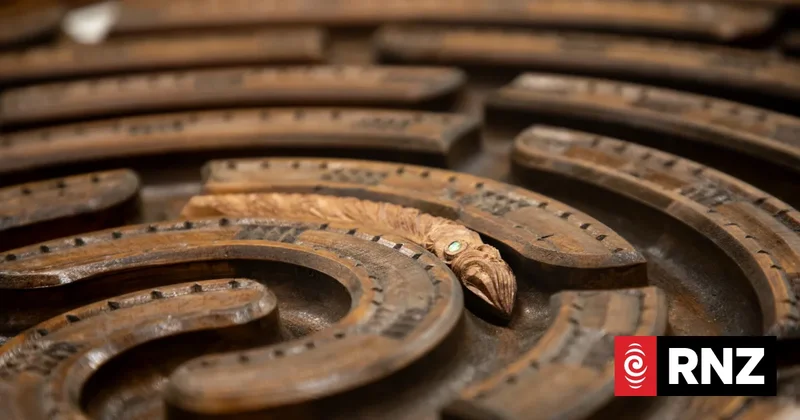
New exhibition tracing evolution of Māori carving over 700 years
He Toi Whakairo: The Art of Māori Carving opens at Te Papa next month, with 147 taonga from the 1300s to the modern day.
Visitors to Te Papa's latest exhibition spanning 700 years of Māori carving will be able to trace an artform and culture in motion from the Pacific to modern Aotearoa.
He Toi Whakairo: The Art of Māori Carving opens on 29 August, with 147 taonga spanning from the 1300s through to contemporary pieces commissioned specifically for the exhibition.
Co-curator Jana Pātete (Ngāti Koata, Ngāti Kuia) told RNZ you can see the Pasifika influence coming through in the style of the oldest whakairo in the exhibition, linking back to Māori origins in Te Moana Nui a Kiwa.
"Looking at the evolution of whakairo, you can really see how we started with our Pasifika influences and then over time changed and evolved to creating a very distinct whakairo of our own."
Co-curator Dougal Austin (Kāti Mamoe, Kāi Tahu, Waitaha) explained that by showing contemporary and traditional whakairo together people will see whakairo is very much a living practice.
"This is a living art form, and we're a living culture, a living people. And we didn't want to do chronological, you know, earliest to most recent, we preferred to mix things up a bit and say like put a contemporary poupou next to one that's earlier."
Austin said the team has been working towards He Toi Whakairo for over a year and it is getting very exciting to see the exhibition space come together.
"There are some taonga we don't know when they were shown last... maybe 100 years ago, we don't know. But there will be quite a few that are either new or haven't been seen for quite some time."
When asked which taonga in the collection is his favourite Austin said while he likes them all but a Hei tiki named Ruatepupuke by Stacy Gordine was very special.
The name Ruatepupuke is a reference to the pūrākau (tale) recounting the origin of whakairo.
"Ruatepupuke went searching for his son who had been taken by Tangaroa, the atua of the ocean for an infringement, the son's infringement. So Ruatepupuke swam out to sea and he dove down and he was amazed to see under the water, Tangaroa's whare whakairo, a meeting house... and as he swam closer, he saw all the carvings and his son was turned to one of the carvings and it is said that they could actually talk.
"So he retrieved his son as one of the carvings and brought him back to shore and that was the origins of the knowledge of whakairo," he said.
Pātete also found it hard to pick a favourite but pointed to a tokotoko, or walking stick, which a spiral groove all the way around it.
"This was created by a vine being wrapped around as the branch grew and so it feels like a collaboration between the carver and nature. It feels very intentional because of the sizing and the gaps. Tokotoko are really powerful taonga."
Pātete said visitors will also be able to see the diversity and variety of whakairo application across the taonga, from agricultural taonga, weaponry, and adornment too.
The exhibition will also highlight the work of wahine carvers.
"We're really excited to be highlighting two amazing wāhine Māori kaiwhakairo artists. First, Stevie Houkāmau, who works in uku, in clay and also Ngaroma Riley, who we acquired many karetao from that we're excited to show," Pātete said.
Riley's self-portrait karetao (puppet) Kapahaka Queen will be shown alongside traditional examples of karetao.
"So karetao or marionettes, so they have many different purposes, often used as instructional devices," Pātete said.
A cord passed through holes in the karetao shoulders allows the puppeteer to move the arms which sees Kapahaka Queen swing her poi.
Pātete said when it comes taonga, textiles are most at risk, so while there are some surviving examples of pre-European karetao sometimes the binding for the arms or the legs of the karetao have worn away.
"We were very inspired by that whole idea of artistic excellence and how it can enhance mana and the dignity of our people. That whole idea underpins our thinking with this exhibition, and we do actually have a small display referencing the Te Maori exhibition and that proverb," Austin said.
In Te Papa's Visitor Experience Report for the 2024/25 financial year, 47 percent of overseas visitors expressed a desire for more exhibits and information on Māori and Pacific history and culture, many comments reflected a desire to understand more Māori culture and New Zealand's heritage.