Fifty years ago, India was in the midst of the Emergency. Prime Minister Indira Gandhi’s government had suspended civil liberties, censored the press and imprisoned tens of thousands of protesters.
Today, there is no formal declaration of emergency or suspension of fundamental rights under the constitution. But the parallels are hard to miss.
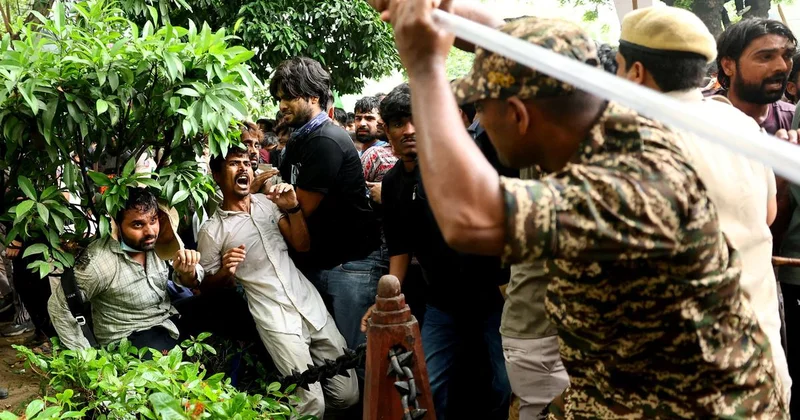
As we write this, a nationwide protest movement triggered by young people frustrated at the denial of their voices and the lack of opportunities has been met with brutal police action. A film about a human rights defender slain 30 years ago has inexplicably been taken off the streaming platform that had hosted it.
Provisions of the Foreign Contributions Regulation Act, introduced in 1976 during the Emergency, have been amended again to further tighten the state’s grip on civil society organisations that work to uncover high-level corruption, environmental degradation and human rights violations.
As during the Emergency, the state’s investigative agencies have been weaponised to go after dissidents, using the time-tested bogey of national security and fear of foreign influence to silence those not aligned with the ruling party.
Recent attacks on democratic dissent in India have not come out of nowhere. They fit a clear pattern of decline in civic freedoms under Prime Narendra Modi’s Bharatiya Janata Party government, which first came to power in 2014. Since then, human rights defenders, journalists and members of the political opposition have faced extreme forms of harassment through misuse of state powers.
This is why the Civicus Monitor, which measures civic freedoms around the world. has rated India as “repressed” since 2019, indicating systematic civic space restrictions. This seriously weakens the country’s claim of being the world’s largest democracy. Other countries in the same category include Cambodia, Colombia, Libya, Pakistan and Zimbabwe.
This month, India is also being placed on the Civicus Monitor’s watchlist, which highlights countries experiencing severe declines in civic freedoms. It takes its place alongside Bahrain, which is ruled by an absolute monarchy, Burkina Faso, which is in the grip of a military junta, and Ecuador and Georgia, where legislation has been weaponised to seriously undermine civil society efforts to promote accountability.
Persecution of human rights defenders
A key factor in including India on the watchlist is the continued judicial persecution of human rights defenders and protest leaders. They include Khurram Parvez from the Jammu and Kashmir Civil Society Coalition, who has been charged under the draconian Unlawful Activities Prevention Act. He had been imprisoned without trial since November 2021. The United Nations affirmed that he has been denied the right to a fair trial and that his detention was arbitrary.
Only in July was he finally freed on bail with strict conditions, and he still faces charges. He had been working to document alleged human rights violations by the security forces, including enforced disappearances and extrajudicial executions.
Others remain behind bars. In June, activists Umar Khalid and Sharjeel Imam, who led protests in Delhi against the controversial Citizenship Amendment Act, were again denied bail. They have been imprisoned without trial since 2020.
Journalists and critical media agencies are also facing significant forms of intimidation. In February, investigative journalist Ravi Nair was sentenced to a year in jail for defamation over social media posts critical of the Adani Group, which is seen to be close to the ruling party.
In April, the office of daily newspaper Asomiya Pratidin was attacked following critical comments by the chief minister of Assam. In the same month, police undertook an investigation into social media news outlet TeluguScribe under anti-terror legislation.
Sadly, for a country with proud democratic traditions born out of its inspiring struggle for independence, India ranks at a lowly 157 out of 180 countries covered by the Reporters Without Borders Press Freedom Index.
The Emergency that was imposed roughly a quarter of a century after India’s Independence offered significant lessons in courage and resistance as people from all walks of life rose up to defend cherished democratic ideals. They were shocked into action at the suspension of their fundamental rights and the failure of the country’s institutions to safeguard their rights. A mass movement followed.
A turning point
In the end, in the face of sustained public pressure, then Prime Minister Indira Gandhi’s government was forced to lift the restrictions. A period of intense restoration of democratic ideals and institutions followed. The Supreme Court issued several landmark decisions, including in the Kesavananda Bharati case reaffirming the rights-based underpinnings of the Constitution, including the primacy of fundamental rights and the separation of powers between the executive, legislature and the judiciary.
Some 50 years later, India is facing another turning point. Today, young people from across the country are uniting in the time-tested tradition of satyagraha under the umbrella of the Cockroach Janata Party. They are facing the extraordinary might of the state from Prime Minister Modi’s government and the ruling party, many of whose own members were once unjustly imprisoned for resisting the Emergency.
The protests, it seems clear, are a significant milestone in India’s journey as a democracy.
Mandeep S Tiwana is the secretary general of global civil society alliance, Civicus.
We welcome your comments at letters@scroll.in.