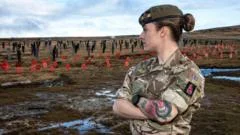
The BBC spoke to a number of servicewomen who asked to remain anonymous.
One described her body armour as "definitely not female and definitely not good".
Another said there was "none or barely any" female-specific kit available to her and that the body armour did not account for "busty women".
Issues around kit and clothing have persisted.
Ofsted, which inspects MoD training establishment as well as schools, said in October 2025 that for the "fourth consecutive year" women and smaller recruits were being issued with ill-fitting kit and clothing, external.
Its report said: "This renders them at a disadvantage because they often do not appear as well turned out as their peers, or because ill-fitting equipment, such as webbing or rucksacks, prevents them from participating fully in training."
It added "ill-fitting kit poses a very serious risk" in combat situations.
Dr Mary Keeling, from the Centre for Evidence for the Armed Forces, said she was aware a rollout of new female kit and equipment, as well as availability, had been "inconsistent" since Atherton's report.
She said there had been "good steps in the right direction" but progress had been slow, adding faster changes were needed as the MoD aimed to increase the number of women joining the forces.
Keeling said it was likely improve challenges in recruitment "if women feel welcome by making sure that appropriate kit and equipment are available".