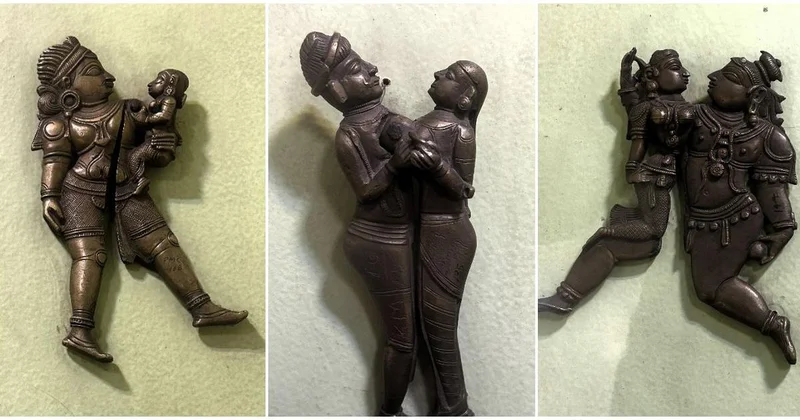
If you’ve ever wondered how Indians set the mood in centuries past, one potential answer is: cutting nuts – the areca kind.
That possibility is suggested by the existence of highly suggestive nutcutters preserved among exhibitions of antique domestic objects. A prime example is the display at the Raja Dinkar Kelkar Museum in Pune, arguably India’s largest collection of everyday artefacts from the early to late modern period in western and southern India. Housed since the 1960s in a traditional Puneri wada in one of the city’s old peth neighbourhoods, the museum’s curation of nutcutters – called adkitta in Marathi, sudi in Gujarati and sarota in Hindi – is especially noteworthy for its size, diversity and craftsmanship.
Alongside more respectable versions bearing animal and bird motifs or plain geometric designs sits a curious collection of erotic nutcutters. Made of brass and silver in Maharashtra, Gujarat and Rajasthan during the 18th and 19th centuries, these objects depict couples in a variety of amorous poses. Yet the Kelkar Museum’s risqué sarotas are not merely titillating curiosities but represent a pedigreed lineage of erotic imagery intertwined with the consumption of areca nuts as part of the sophisticated cultural practice of betel chewing.
Before exploring the meanings of this practice, it is worth briefly considering the masticant itself. In his 1951 article The Story of Pan Chewing, botanist M Gowda identifies the “chief constituents” of a paan or betel quid – what EM Forster memorably called “pan’s trinity” – as areca nut, betel leaf and quicklime. In her essay Betel Chewing in Kāvya Literature and Indian Art (2016), philologist Hermina Cielas elaborates on these ingredients. The flavour- and colour-enhancing lime paste is produced by heating mollusc shells and corals to a high temperature before grinding the residue and mixing it with water. The wrapping that gives the quid its name is the heart-shaped leaf of the betel vine. The pièce de résistance of this confection, the areca nut, is actually the seed of the areca palm tree, mislabelled as a nut because of its thick husk.
It is this fibrous seed that the sarota is designed to slice. As Dagmar Pospíšilová explains in a 2004 catalogue of early modern Indian nutcutters in Prague’s Náprstek Museum, the tool consists of two parts: “the lever with the cutting edge and the butt”. Brass versions, like many in the Kelkar Museum, were cast piece by piece in sand moulds, with the iron blade embedded during the casting process. Some traditional nutcutters were secured with a catch, the lever springing back upon release. The butt or handle, meanwhile, provided the decorative canvas. Craftsmen fashioned it into animals and birds – most commonly lions, horses, parrots and peacocks – as well as Hindu deities, fantastical creatures such as dragons and centaurs, and human figures ranging from mother with child to solitary individuals and embracing couples.
The design of the disporting lovers is provocatively apt because of how well it lends itself to the scission of the tool, the blades mimicking legs. In the Kelkar Museum, these erotic sarotas – some smooth, others engraved or adorned with tiny ghungroos – encompass a range of postures from close embraces to acrobatic coitus. While some couples are proportionally matched, in other examples the male figure is significantly larger, perhaps reflecting the hierarchical scaling convention used to signify divine or semi-divine beings. Drawing from a pre-existing vocabulary of religious art, these designs belong to an ancient formula in Indic iconography: the mithuna.
Erotic iconography
A semiotically rich and conceptually layered visual type, the mithuna, or “loving couple”, is what historian Prithvi K Agrawala described in his comprehensive 1983 study as “the Man-and-Woman motif that occurs and recurs under many contexts and representational assumptions in various phases of Indian culture, art and thought”. Inclusive of non-humans like animals and celestial spirits like vidyadharas, gandharvas and yakshis, one encyclopaedia entry notes that the mithuna couple “may be depicted standing, seated, or flying, and in various stages of intimacy” with the female figure richly adorned to connote youth and beauty. This framing corresponds with the imagery of the erotic nutcutters at Kelkar Museum, indicating the mithuna as their model.
Agrawala identifies the mithuna as an extraordinarily versatile motif whose meanings have multiplied since its emergence in the early Vedic period. It has variously represented a cosmological principle of duality, an archetype of sexual idyll, an apotropaic symbol against marital discord, a ritual allegory for spiritual liberation and an architectural device shaped by changing religious traditions. Yet despite these layered meanings, the motif’s most iconic representations of sexual union caused it to be linked in the popular imagination to fertility, sensual pleasure and abundance.
But how did this symbol of loving couples become bound to the mundane act of slicing areca nuts?
An answer lies in the long-standing association between paan and pleasure in India. While its medicinal virtues were recognised in treatises such as the Suśrutasaṃhitā and the Carakasaṃhitā, it was in the realm of the erotic that betel chewing truly left a mark. Situating the practice within urban and courtly life from around the 5th century BCE onwards, Cielas cites a range of literary works – most notably Vātsyāyana’s Kāmasūtra and Varāhamihira’s Bṛhatsaṃhitā – in which paan chewing takes on an erotic charge across a number of tropes of srngāra rasa or “mood of love and passion”. In Kalidasa’s Ṛtusamhāra, women carried betel rolls to their boudoirs; in Bhatti’s Rāvaṇavadha, betel-reddened lips symbolised unkissed wives; in the Amaruśataka, spilled betel juice on bedsheets mapped out sexual positions; and in the Caurapańcaśikā, the memory of a lover was inextricably bound to the flavour of betel juice on her mouth. Across these literary depictions, the betel quid – of which the areca nut is the chief ingredient – emerges as a symbol of romantic and sexual yearning, consummation, abandonment and other modalities of love.
Scholar Thomas J Zombruich classified these texts as kāmashāstric – “concerned with the practices that fostered the attainment of kāma, comprising not just sexual, but aesthetic pleasure”. In his essay From Mouth Fresheners to Erotic Perfumes: The Evolving Socio-cultural Significance of Nutmeg, Mace and Cloves in South Asia (2012), he neatly summarised the metaphorically loaded appeal of the paan, and implicitly the areca nut, as the signifier of sex:
“Besides the sexual overtones of orality during consumption of betel, its visual symbolism was coded in shape (betel leaf as yoni, areca nut as liṅgam), spatial arrangement (areca nut [seed/fruit] resting in the leaf [vulva, placenta]) and colour (lime as semen, red saliva as female sexual discharge/menstrual blood) and growth habits of the source plants (betel pepper vine entwining/embracing the palm trunk).”
Changing tastes
The symbolic associations extended beyond literature into painting. One genre in particular that brought the mithuna motif, śṛṅgāra rasa and an elaborate courtly idiom to converge unto the form of the betel quid is Ragamala. Art historian Klaus Ebeling defines these paintings as “visual representations of Indian musical modes previously envisioned in divine or human form by poets and musicians”. Their subjects are most often romantic or devotional scenes staged within stereotyped aristocratic settings. At their zenith in 18th-century western India – the very period in which the Kelkar Museum’s erotic nutcutters were produced – Rāgamālā paintings, particularly those emerging from post-Mughal Rajput ateliers, featured what Cielas identified as tāmbūla sevā, the ceremonial offering of betel as a ritualised and erotic gesture.
Placed in the same gallery as inkwells, locks, wick trimmers and other domestic implements, the Kelkar Museum’s nutcutters belong to a class of objects that transformed everyday utility into displays of refinement. Their makers lavished considerable attention on their surfaces. The figures on the sarotas are clothed and coiffed in various fashions, with intricate engraving suggesting textiles, hairstyles and jewellery. Cross-hatching, striations, teardrop motifs and undulating lines lend texture and depth, attesting to a relatively high standard of workmanship. Such craftsmanship reflects more than aesthetic ambition. As Cielas notes, betel chewing itself was “a sign of social status”.
Linguistic evidence indicates that neither the areca nut nor the betel leaf is native to the Indian subcontinent, both arriving from present-day Indonesia in the second millennium BCE. Betel chewing, Zombruich reports, took a thousand more years to emerge when “local trade networks across the Indian subcontinent and long-distance trade within the ‘Bay of Bengal interaction sphere’...brought Indo-Aryan speakers increasingly in contact with different betel chewing populations”. While a basic paan wasn’t a luxury object, the sort of premium quid consumed and plied in the noble and urbane settings of kāmasaśtric literature and Ragamala painting would have contained expensive and exotic spices and aromatics sourced from South East Asia through trade with the Spice Islands of Maluku.
The translation of sculptural motifs from ancient and medieval religious architecture into decorative utilitarian crafts like nutcutters speaks to a vibrant aesthetic. The make and metals of the erotic nutcutters of Kelkar Museum distinguish them as leisure objects of a superior class. From a boat-shaped pagdi to a ribbed topknot resembling a temple amalaka to a striped slickback reminiscent of mukhalinga sculptures, the stylistic features of the figures hint at influences from throughout Maratha territory. In a 1999 article, Maratha Painting, historian Kamal Chavan noted that the 18th and 19th centuries marked the zenith of Maratha art, with patronage extending across Maharashtra, Malwa, Gujarat, and Tanjore.
The Deccan plateau took its betel tradition seriously. As historian Daud Ali discusses in his essay The Betel-Bag Bearer in Medieval South India, rulers like the Chalukyas institutionalised the office of the betel-bag bearer, who mediated complex political negotiations by serving the king’s paan to feudatories, rivals and subordinates. In fact, while paans abound in Indian visual art, Ali draws our attention to the rare depiction of the areca nutcutter in a 17th-century mural in Madurai, commissioned by the Deccan-based Nayaka dynasty.
Paan is widely consumed even today, albeit with the class signification flipped. Sarotas hark back to a different age – not just before the mass production of quasi-sumptuary and household articles, but also before its own cultural economy shifted. As Gowda observed, once the Portuguese merchants introduced tobacco, the complex pleasures of the areca nut were relegated to the habit of tobacco.
All carcinogens being equal, for centuries in India, the areca nut encapsulated a deep and old cultural relationship between romance and leisure folded up in the heart-shaped betel leaf, and the erotic sarotas spoke to that imaginary. In her book Infinite Variety: A History of Desire in India, literary scholar Madhavi Menon observed that the areca nut “makes amorous advances possible”: “Supari is the hard core…one has to coax the supari in much the same way as Vatsyayana teaches us to coax a lover.” Echoing this intimate association, Zombruich turns to the Kāmasūtra’s betel chewer par excellence: the nāgaraka, the educated, wealthy man-about-town who, in the 300s BCE, kept paan at hand to inaugurate and conclude amorous assignations – with a little help from his ornate sarota.
All images by Kamayani Sharma.
Kamayani Sharma is an independent writer, researcher and podcaster based in New Delhi. This project was made possible under the Scroll x MMF Arts Writer Grant.
We welcome your comments at letters@scroll.in.