- Published
Formula 1 teams head off on their summer break this week after a hectic 11 races to start a new era of the sport.
F1 2026 has been full of storylines - controversy over new rules, a new star emerging, the rebirth of an old one, and calendar disruption caused by a war.
Even now, as they head off on holiday for a couple of weeks, the teams still don't know how many races are left this season.
But those so far have revealed plenty. Here are five things we have learned so far in F1 2026.
1. Antonelli is the real deal
Kimi Antonelli started his Formula 1 career in 2025 hyped as the next generational talent - but did not live up to that billing in his maiden season.
How that has changed in 2026.
This was supposed to be his team-mate George Russell's year.
Mercedes have delivered on the expectation they would be the team to beat with eight wins and 10 pole positions in the first 11 grands prix, and Russell dominated his rookie team-mate in 2025.
But Antonelli took a gargantuan step in development over the winter and, while Russell started the season strongly with a win, the Italian soon took control.
Initially, the competitive picture between the two was slightly clouded by some poor luck for Russell in the opening races of the season.
But, as time has passed, it has become increasingly clear that Antonelli is dominating his team-mate so far this season in the best car.
While Russell has floundered a little, less comfortable with the car, and is still afflicted by bad luck, pace seems to flow from Antonelli so easily. Along with devastating pace, his driving is decisive, committed and cool.
The 19-year-old will be tough to stop in the second half of the season.
2. The new rules were poorly thought-out
This year's F1 championship introduced the biggest rule change in the sport's history, with new aerodynamic and engine regulations.
While the chassis rules have generally been a hit - even if the cars are a little slower than last year - the new engines most definitely have not.
The nominal 50-50 split between internal combustion and electrical power (more like 53-47 in reality) combined with the architecture of the engines, has left them energy starved.
And when the battery is empty, the cars have only about 540bhp - less power than a Formula 3 car, but with loads more grip.
The need to constantly charge the battery has neutered many of the best corners on many of F1's greatest tracks, reducing them to what Fernando Alonso has called "charging stations".
The flip side is the energy starvation has led to some interesting battles, known as "yo-yo racing", with cars swapping positions repeatedly over a number of laps.
But the drivers point out this is artificial, and that overtakes are often happening simply because one driver suddenly has 350kW (470bhp) more than the other.
As four-time champion Max Verstappen says: "Sometimes people say: 'Ah yeah, but this was a great race.' I say: 'Yeah, but it's not really realistic the way we are racing.'
"And then you arrive to some tracks and you're driving on not a lot of horsepower for F1 standards. And it's a little bit painful, which I could see coming already for years. So, it's then, of course, not the most exciting.
"At one point I'm also a little bit fed up with repeating myself, because it's already hard enough just having to drive it."
The drivers - especially Verstappen and Fernando Alonso, but most of the others, too - were very vocal about this from very early in the season. The sport as a whole recognised there was a problem, and has reacted.
Tweaks to the rules to lessen the problem were made after just three races, and the engine split will be modified to become 60-40 by 2028, with an intermediate step for next year.
That will significantly reduce these issues, but not eradicate them completely.
F1's governing body the FIA was warned repeatedly in the years leading up to 2026 that this energy starvation issue would happen.
This has left an easy target for FIA president, Mohammed Ben Sulayem, to propose a return to naturally aspirated V8 engines for 2031.
It's an idea with distinctly limited support among F1's stakeholders. It lacks imagination and analysis, comes with its own set of problems, and is effectively turning the clock back 15 years.
The issue is not hybrid engines or turbos per se; it is the lack of energy recovery possibilities.
It's a situation F1 forced on itself by removing the MGU-H, which recovered energy from the turbo and exhaust, and not allowing recovery from the front axle.
The sport needs to take a pause, intelligently and rigorously analyse what it wants from its engines in the future.
Then it needs to come up with a package that satisfies the manufacturers, has road-relevance, embraces concerns about the climate crisis, does not create a noise-hazard threat to some of the sport's most high-profile races, is cheaper, allows the drivers to almost total access to full power, and gives a facility for overtaking.
3. The real Hamilton is (mostly) back
Lewis Hamilton's career reached its lowest point in 2025, during a maiden season with Ferrari the seven-time champion himself described as a "nightmare".
Hamilton's struggles - in the context of a difficult final season at Mercedes in 2024 - raised all sorts of questions.
He has admitted he doubted himself at times last year.
Hamilton said: "There were definitely moments that I was like: 'Sheesh, maybe it is true that, you know, when you get to a certain point, you lose it.'"
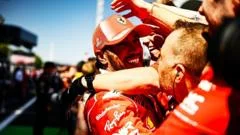
Those comments came in the wake of his victory at the Spanish Grand Prix - the zenith of a first half-season that has definitely proved he has not "lost it".
Hamilton, 41, is rejuvenated this year - back to something close to his best - and the battle with team-mate Charles Leclerc - pretty much entirely one-sided in 2025 - is neck and neck.
He's even sort-of in the championship fight - in second place, 50 points behind Antonelli.
Is this down to the new cars behaving more to his liking than the ground-effect ones of the past four seasons, assiduous work behind the scenes to integrate himself more closely with Ferrari, or the team accommodating some of his preferences into the car design this year?
Perhaps it's a combination.
Even, as his former team boss Toto Wolff has said, "maybe the new girlfriend helps" - a reference to Hamilton's relationship with American media personality and businesswoman Kim Kardashian.
There is still some room for improvement - four penalties in the past three races is very much not Hamilton-esque. But his revival is a relief - for him, and all those who have witnessed his incredible career so far.
4. Aston Martin finally have some hope
On paper, Aston Martin have the ingredients to be title contenders - design legend Adrian Newey in charge, multiple championship-winning engine manufacturer Honda providing the power-units, the legendary Alonso in the cockpit, and ample funding from billionaire owner Lawrence Stroll and Saudi Arabian sponsorship.
But the first half-season of this much-vaunted package has been nothing less than an embarrassment.
Both car and engine were a long way from competitiveness at the start of the season, Stroll was almost in tears when the team's predicament became clear in pre-season testing, and they spent the first 10 races right at the back.
The final race before the summer break, however, provided real hope.
A massive upgrade package based on lessons learned in the early races - increasing downforce and reducing weight - has taken what looks like two seconds off the car's lap times.
Most importantly, the success of the package proved out the team's development tools, which for the past three years had produced upgrades that did not deliver what the team expected.
A new Honda engine is due for the next race - the Dutch Grand Prix on 21-23 August - with expectations it should edge the team forwards a little more.
After the team proved it could improve the car, a lot rests on that engine. "No pressure," as Alonso himself said with a smile after Hungary. It was both a joke and not a joke.
Alonso, 44, is out of contract at the end of the year, and wants to see evidence that Honda, which has finally brought all the expertise behind its championship-winning engines with Red Bull back into the F1 design team, is on the right path.
If it's a step forward, it should significantly increase the chances of Alonso staying for another year - although he still has to convince himself he can enjoy his racing with these engines he dislikes so much.
5. Williams have had a brutal reality check
For three years after taking over as Williams team principal at the start of 2023, James Vowles had been talking up 2026 as the year the team would make a giant leap towards their ambition of returning to winning ways.
A surprisingly strong 2025 - in which Williams finished fifth in the constructors' championship - seemed to be proof the team were not only on the right track, but even ahead of schedule.
This year, they have had a brutal reality check.
The car was late, overweight by about 25kg, and lacked performance. Williams' first half-season has proved them to be ninth fastest team and nearly 0.4secs on average slower than the team just ahead of them - Haas.
Only troubled Aston Martin and newcomers Cadillac have been slower - and Aston Martin's Hungary upgrade seems to have left Williams as the 10th best team.
And all that with the best engine on the grid - the Mercedes.
Drivers Carlos Sainz and Alex Albon are definitely not impressed - although they continue to say the right things in public.
Vowles has explained the complexities of producing a new car to a new rule set stress-tested the factory and exposed weaknesses that were previously not apparent.
But he said similar things when the 2024 car was late.
Vowles says he's "glad" they have gone through this and insists the team are now making progress.
"Never let a good crisis go to waste," he says. "The amount of changes we have made have put us into a very good situation in the future, and I don't think we would have made them if we'd partially succeeded this winter.
"So, as painful as it's been, I believe we had to go through it as well."