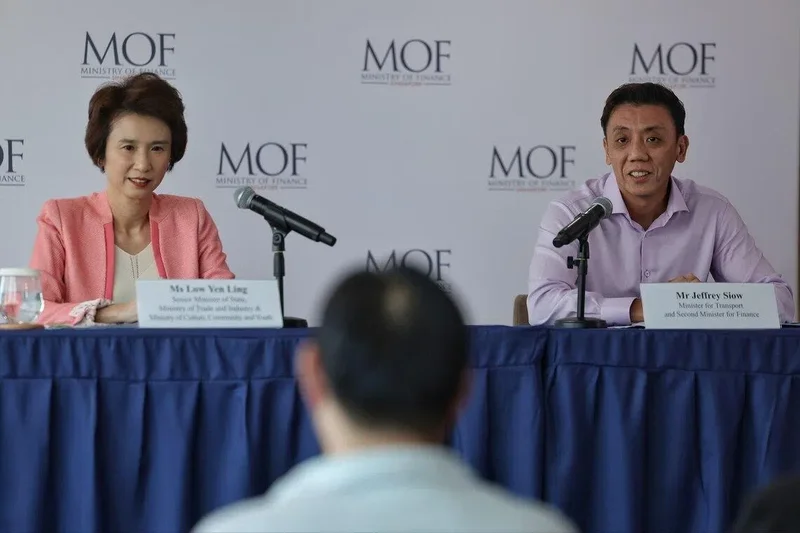
More CDC vouchers, support for businesses in additional $900 million support package
SINGAPORE – Households and businesses will get another $900 million in Government support to cushion the continued impact of high energy prices caused by uncertainty in the Middle East.
This includes $300 more in CDC vouchers for every household, as well as additional rebates in October and January 2027 to offset higher utility bills, Second Minister for Finance Jeffrey Siow announced on July 29.
Other measures include cash grants of at least $500 for every small-and-medium enterprise (SME) with a local employee and up to $1,200 rental support for stallholders in hawker centres and markets.
Siow said the world has avoided the worst case scenario of further escalation and severe shipping disruption in the Persian Gulf. But the situation remains fragile, and a durable ceasefire between the United States and Iran is proving difficult.
The Government expects global energy prices to remain elevated, which will translate to higher costs for petrol, diesel, electricity, as well as certain imported goods, said Siow, who is also Transport Minister, at a press conference at the Treasury building.
While Singapore’s economy has held up better than expected, the performance was uneven, he noted.
The economy grew 6.3 per cent in the first quarter of 2026, and advanced estimates showed 5.7 per cent growth in the second quarter. Siow said this was supported by strong investment in artificial intelligence, and that “we expect this momentum to continue.”
But businesses that are more exposed to supply disruptions and energy costs have come under greater pressure. SMEs, in particular, feel these cost pressures more acutely, he added.
Outlining the support for businesses, Senior Minister of State for Trade and Industry Low Yen Ling said hawkers selling cooked food will receive $1,200 while market stalls will get $600 over six months from September to February next year.
The Government will also increase its risk-share, or the share of a bank’s losses that it will absorb if a borrower defaults, from 50 per cent to 70 per cent in two financing schemes for businesses: the working capital loan scheme and the project loan scheme.
It will also expand the project loan scheme, which currently only applies to overseas projects, to domestic projects by local construction companies.
“This will make it easier for them to secure financing to manage higher costs amidst a challenging environment,” said Low.
Taken together with the earlier $1 billion package announced in April, Government support now amounts to around $2 billion, on top of schemes from Budget 2026, said Siow.
The previous support package brought forward CDC vouchers and increased the cost-of-living special payment for all Singaporeans. It also included $200 in cash for platform workers, private hire car drivers and taxi drivers, among other measures.
When the first package was introduced, the priority was to get the assistance out as soon as possible, Siow said in response to a question on why the latest round of support does not focus on larger businesses.
The Government’s objective then was to help businesses adjust to the sudden price shock, he added.
“Now that a bit of time has passed since the initial energy spike and the initial crisis, there’s an opportunity for us to be more focused and targeted in our measures,” he said.
That is why the focus for this second tranche is on companies which are more affected by supply chain disruptions and energy costs, including SMEs which have “less buffer” to cope with sustained cost increases, he said.
The two packages should be seen together, he added. “The first was really to prioritise speed, and the second package is a more focused one that looks at specific areas.”
Siow’s announcement of a second support package comes after the Monetary Authority of Singapore on July 27 said it would increase the rate of the Singdollar’s appreciation to combat inflation. MAS added that it expects Singapore’s imported costs to rise in the quarters ahead.
Households are also seeing higher energy prices. In June, the Energy Market Authority announced a 17 per cent increase in the electricity tariff for July to September. Town gas tariffs also went up by 7.1 per cent.
Asked why additional support is needed given that economic growth has been healthy, Siow said on July 29 that there is feedback from parts of the economy that help is needed.
There is also significant uncertainty about the next few months, he said, and it is difficult to tell if the situation will deteriorate or if the good economic performance will continue.
“We don’t know if the investment in AI, for instance, will continue to be sustained,” he added.
On funding the support package, Siow said ministries and agencies will work within the Budget that has been approved for 2026. But if there is a need to seek a supplementary budget, the Government will do so later in the year, he said.
“We believe this is the right response given the economic conditions today,” he said, noting however that the global situation remains fluid, and the Government is receiving regular feedback on the ground.
“If the circumstances change, we stand ready to respond.”