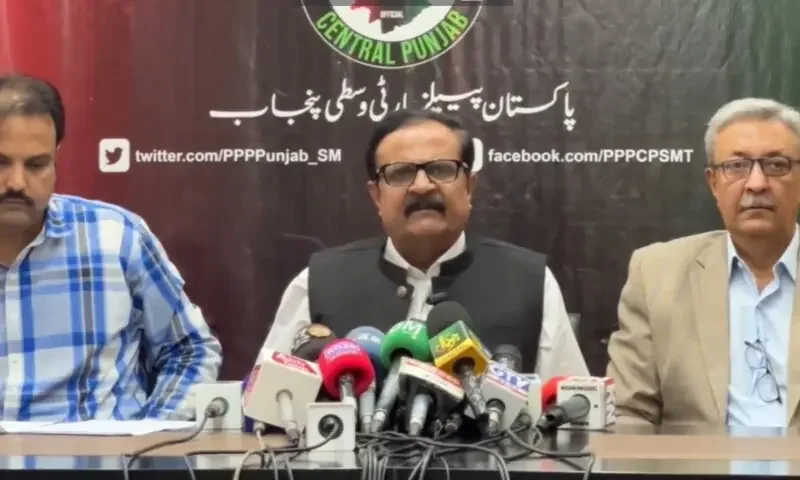
The PPP on Wednesday once again levelled rigging allegations against the PML-N in the first phase of the Azad Jammu and Kashmir elections and assailed the AJK Election Commission for allowing it to happen. The PML-N won nine out of a total seats up for grabs in Monday’s election, according to provisional results. The polls are being held in three phases over security concerns. On Tuesday, the coalition partners in the Centre traded barbs, with Bilawal Bhutto-Zardari’s party alleging widespread rigging and Punjab Chief Minister Maryam Nawaz urging the PPP to accept its defeat and move on. Addressing a press conference in Lahore on Wednesday, PPP Central Punjab General Secretary Hassan Murtaza claimed that the rigging had “exposed the commission’s role and the robbery of the PPP’s mandate in broad daylight”. He alleged that “such rigging had never been seen before in Pakistan”. “In Charhoi, from where Chaudhry Yasin was contesting, 30 polling stations were held hostage, and when the polling time ended, polling agents were not allowed to sit together,” he claimed. Murtaza added that in Javed Badhanvi’s constituency, similar tactics were employed. “And on the day of polling, our worker Mukhtar Younis was martyred,” he said. He added that polling stations in Chaudhry Ikhlaq’s constituency were also taken hostage, and so were those in Chaudhry Pervaiz Ashraf’s constituency, where Murtaza claimed he was in “close competition”. Murtaza alleged that holding the elections in phases was done to “enable rigging”. Speaking about the role of the AJK Election Commission, the PPP leader likened its role to that of Punjab’s Crime Control Department. “It was deciding who is to be half-fried and full fried, whose polling agents to pick and what polling stations to seize,” he said, adding that “extending the voting time by one hour was done so they could get time to stamp votes for the PML-N”. “The AJK Election Commission played the role of a commissioned agent,” he remarked. He said that PPP leaders brought the issue to the commission’s attention and had urged it not to facilitate rigging. “We kept telling you that buses were being given away and the code of conduct was being violated and you only took notice when the whole of social media assailed you for it,” he said. He recalled that a day earlier, Punjab Chief Minister Maryam Nawaz made a statement over “how the PPP had nothing to show for itself”. At this, he said: “The past is witness that it was the PPP who got AJK the right to engage in parliamentary politics.” He added that during the PPP’s six months in power in AJK, the region’s then-premier Faisal Mumtaz Rathore had accepted 35 of the demands of the proscribed Joint Awami Action Committee (JAAC) “with one executive order”. However, he noted that there were two demands where the “federal government was involved or it required constitutional amendments”. He said that PPP leaders Raja Pervaiz Ashraf and Qamar Zaman Qaira were part of the negotiating team that “begged the protesters for two weeks so all stakeholders may be brought on board, but the group did not accept the request”. However, he held that JAAC’s refusal did not mean that the state should end the negotiating process altogether and the PPP’s proposal for a truth and reconciliation commission be dismissed. “If the state had shown some flexibility, the issue could have been resolved,” he added. The PPP has repeatedly called for the establishment of a truth and reconciliation commission amid protests in AJK. Over the past month, the regional administration and the JAAC have been at odds over various issues — most notably the committee’s demand to abolish the 12 seats in the region’s Legislative Assembly reserved for refugees from Indian-occupied Jammu and Kashmir who settled in mainland Pakistan after 1947, which has resulted in protests across the region. On Tuesday, PPP Chairman Bilawal Bhutto-Zardari demanded that the government and the protesters agree to establish the commission while addressing a gathering in Muzaffarabad. “All the state had to do was form a truth and reconciliation commission and task it with discerning the truth, and the protesters would have been asked to halt their protests until the commission presented its findings,” Bilawal said on Tuesday, but added that neither party had been willing to “back down”.
PPP assails AJK Election Commission for 'facilitating rigging' in first phase of AJK polls