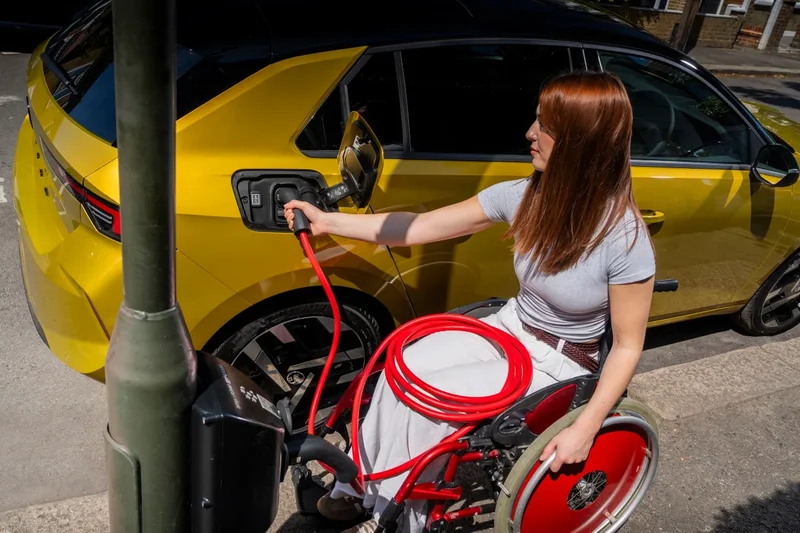
Making the switch to an electric car can be a challenge if you don't have a driveway, but for many disabled drivers it's an even bigger hurdle when it comes to public charging. New research suggests things are moving in the right direction, although there's still plenty of work to do.
Figures released by Vauxhall show that the number of UK councils providing accessible on-street EV charging has doubled over the past 12 months. But despite that progress, three quarters of local authorities still don't have any chargers that are specifically adapted for disabled drivers or meet recognised accessibility standards.
The figures come from Freedom of Information requests sent to councils across the UK. Of the 194 authorities that responded, 49 said they now have on-street charge points that have either been designed for disabled users or meet the British Standards Institution's PAS 1899:2022 accessibility standard. That's up from just 24 councils a year ago.
The number of chargers installed in disabled parking bays has also more than doubled since 2024, rising from 105 to 245. Vauxhall estimates that around 15 per cent of on-street chargers are now specifically adapted for disabled motorists, while 14 per cent meet the PAS 1899:2022 accessibility guidance.
However, the figures also reveal how uneven provision remains across the country. London is far ahead with 2,131 accessible on-street chargers, while the Northwest has just 43 and Scotland has only 14.
More than half of the councils that responded said they now take disabled and elderly residents into account when developing charging strategies, suggesting accessibility is becoming a bigger priority as more public charge points are installed.
Eurig Druce, Managing Director of Vauxhall & Group Managing Director of Stellantis UK, said, “It’s encouraging to see more councils recognising the importance of accessible on-street charging, with provision nearly doubling in the last year. But the fact that three-quarters of councils still do not provide chargers specifically adapted for disabled drivers, or chargers that meet recognised accessibility standards, shows how much further there is to go.
“As more people switch to electric vehicles, accessibility must be built into public charging from the start, not treated as an afterthought. Through Electric Streets of Britain, Vauxhall is helping drivers register where on-street charging is needed, including where disabled drivers require accessible solutions. If the UK is to bring everyone on the electrification journey, accessible charging needs to become the standard, so going electric is a practical and viable option for all drivers.”
The research is part of Vauxhall's Electric Streets of Britain campaign, which aims to improve charging for the millions of households that don't have off-street parking. Drivers can register their street if they want to see residential charging installed, including requests for accessible charging provision.
More than 12,500 streets have already been nominated through the campaign, with more than 500 people telling Vauxhall they require disabled access. The company says it shares that information with councils to help shape future charging plans.
Vauxhall has also been working to improve charging access in other ways. Earlier this year it partnered with Kerbo Charge to promote cross-pavement charging solutions, where a cable is routed safely through a channel built into the pavement rather than lying across it.
According to previous FOI research from the company, seven per cent of councils still allow drivers to use cable covers across pavements, while 42 per cent are expected to offer cross-pavement charging by the end of 2026.