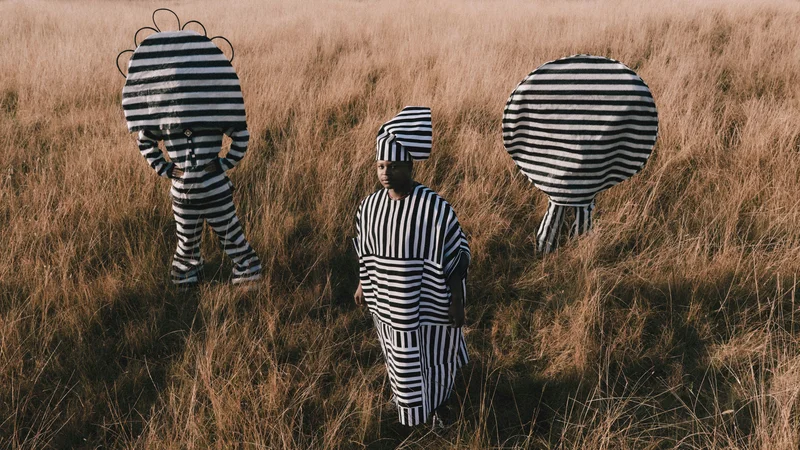
His music feels like a warm hug, his voice succour in these disharmonious times. If his artistry does not touch your heart and soothe what ails you, Iâm not sure what will.
Muneyi Masibigiri, who performs and records under the mononym Muneyi (pronounced âmoo-nayâ), creates the kind of sound that you feel deep in your soul, the emotional resonance of what he sings about something you experience before you feel the urge to wonder what the words mean.
With influences ranging from Oumou Sangaré, Ali Farka Touré and Sona Jobarteh, to Beyoncé, Sade and Thandiswa Mazwai, the soulful South African singer-songwriter won the 2025 Standard Bank Young Artist Award for music. Despite the incredible reception heâs received, none of the glory has dissuaded him from his artistic path.
His LinkedIn profile, evidently not updated in years, leads with the line, âeverything in the universe is singingâ. Itâs a sentiment that underscores the kind of full-hearted energy that he pours into his music, an acknowledgement that â as an artist â he gives every ounce of his being to create connection between himself and whoever is listening.
Born and raised by his resolutely old-school grandmother in Tshilapfene, a small Limpopo village outside Thohoyandou in what was, during apartheid, the so-called Bantustan homeland of Venda, Muneyi performs mostly in his mother tongue, and more specifically in his grandmotherâs tongue, a Tshivenda dialect that has to a great extent fallen out of fashion.
While some earlier songs heâd written were âeither pop songs or very alternativeâ and mostly in English, he says he made his debut album, Makhulu, as an homage to his grandmother (makhulu is Tshivenda for grandmother) and wanted it to be something that might resonate with her. âThatâs why I decided to sing in a way that she understands,â he says.
Though contemporary in what it aspires to say and in how it comments on the world, his music is simultaneously possessed of an ancient spirit; thereâs a lineage thatâs felt, a connection with the past and respect for artists from across the continent.
Again, itâs likely his grandmotherâs influence. âGrowing up we didnât have electricity, so my grandmother had one of those radios with the big batteries and most of what was being played on the radio was music from the rest of the continent.
âOnly when I visited my mom in Mamelodi in Pretoria that I was exposed to other music â my mom listened to Norah Jones, Thandiswa Mazwai and Simphiwe Dana, and youngsters in the house listened to Busta Rhymes, Beyoncé, Ciara and Jay-Z. So my influences were sort of an amalgamation. Perhaps because of my attachment to my grandmother, though, I always gravitated towards the more mature sounds.â
That gravitational pull greatly influenced where his own sound has landed. âI lean towards contemporary folk. Itâs a nostalgic African sound, while telling everyday stories and also the stories that my grandmother would recite. The melody, though, will feel very ancient.â
His grandmother has never truly seen Muneyi perform live. âThat breaks my heart,â he says. âSheâs only consumed my art through either a screen or by listening. Sheâs a difficult person to impress. Sheâs not a hater in the modern sense, and sheâs definitely not trying to be edgy, but she objectively doesnât like a lot of things. And she really, really loves my perspective.â
Itâs a perspective that is deeply personal, very honest, his songs drawn from a well of lived experiences. âThis is my context, my perspective that I am sharing,â he says. âAnd each time Iâve shared, people have resonated with what I have to say. Whether itâs five people, or itâs the 60,000 people on a listening platform, itâs great to be seen, to be heard, to be listened to.â
He measures his success in terms of the artistic freedom. He enjoys saying whatâs on his mind and in his heart â and to do so unapologetically and without feeling censored.
âFor me, success is having the ability to express myself in the way that I want to. Iâm not signed to a record label. No oneâs telling me what story to tell or how to tell it. The biggest success for me is that Iâm able to tell my stories.â
In May, he released his second album, Shumela Venda, which has a more politically outspoken edge, interrogating turbulent times in the fractured and contested territory in which he grew up.
The songs are to some extent Muneyi trying to understand historyâs entanglement with the violence of colonialism, the brutality of apartheid regime, and the ways in which â in a post-apartheid, democratic South Africa â so much of Vendaâs history has been erased. The album is a process of trying to figure things out, so asking questions rather than delivering a sermon.
âFor this album, I was leaning more towards protest,â he says. âA large part of South African music is informed by the protest music from the Sixties and the Seventies. And I love that sound. I think itâs a sound we should hang on to, even if weâre now protesting about different things.â
And then there is the inherently spiritual, nurturing aspect of his music. âMany African people believe that thereâs healing through sound. So some of what I make is what I like to call âAfro-psychedelicâ, where you just lean in towards yourself and get lost in the sounds and itâs essentially an escape. I love the idea of escaping sonically.â
Thereâs a chance to escape with him on 31 July and 1 August, when he will perform at Spier Wine Farm as part of the line-up of artists participating in The Routes of Sound, a music event curated by theatre-maker Brett Bailey.
Itâs a chance to catch some of the countryâs most incredible musicians in a refreshing format. Guests set off on a circuit, listening to a succession of diverse artists each performing in a different space on the farm, a glass of the estateâs wine accompanying each segment.
Muneyi says he jumped at the opportunity. âIt was an easy yes, because I want to be in spaces that are intentionally investing in the arts, putting genuine effort into preserving the arts or that actually have a cultural programme. We need more of these slow spaces of intentional art. So this is a really great opportunity.â
He says his performance will celebrate the âwinter slowness and the quietness of the farmâ and heâll be leaning into the intimacy, incorporating a lot of storytelling as a way of enhancing his connection with the audience.
âI love inviting people into my world, to share my context,â he says. âFor me, thatâs what breaks down the barriers and rids us of all the prejudices that we hold, the things that keep us apart.â
In addition to the cosy setting, warming fires and sharing of wine, Muneyi says thereâs a kind of artistic intimacy that heâll be sharing as well.
âI am completely by myself,â he says of the creative space he inhabits when performing. âIt feels like inviting people to watch me journal or watch me in my most intimate space. If I could choose, I would probably rather live-stream myself changing my clothes than sing and play in front of an audience. Thatâs how intimate it feels. It is me at my most vulnerable.
âI always say that I am sharing from the inside out. Iâm not really concerned with the audience and their needs and their desires and what they think theyâre there for or what they expect from me. I think I should leave that up to them entirely.
âI am, however, very concerned with checking in on myself in real time while sharing my songs. Because I would have written some of these songs five years ago â as a different person, going through very different experiences. When I sing those songs today, I donât want to feel like Iâm dragging myself into this moment in order to sing a song from my past. I want it to feel fresh and alive, while also being connected to what inspired me to create that song. So, performing is a check-in for me, a constant check-in.â
And while this very internal process of personal connection is happening, he says he is also âfeeding off the energy in the roomâ.
âItâs so real, how we feel,â he says. âThereâs an exertion of energy that I pick up on from the audience and though I donât let it sway me, itâs a great way to gauge how what Iâm doing is being received. Because Iâm sharing from the inside out â and hoping that, you know, people will get me.â DM
Muneyi will join The Routes of Sound line-up at Spier on 31 July and 1 August. Itâs the second of three non-consecutive weekends of diverse music performances curated by Brett Bailey at the Stellenbosch wine farm.
With Muneyi, the line-up includes Afrikaans duo RFKI and CJ Bergh, South African-Peruvian singer MANA with GÄbrielle Sieff, singer-songwriter Karla von Solms, indie duo Akeeda, and the Mishy Kope Band. The third and final weekend in the series happens on 21 and 22 August.