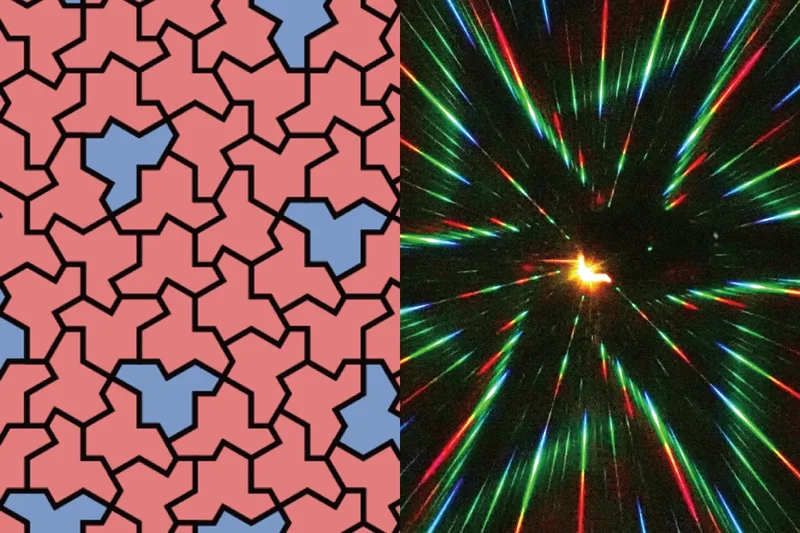
The “hat” tile is a mathematical wonder. Discovered by amateur mathematician David Smith in 2022, it can be used to cover every square inch of an endless bathroom floor (or any other surface) without ever repeating a single pattern.
Smith’s hat-shaped discovery emerged as a solution to something called the “einstein” math puzzle, which dates back to the 1960s. Its name is a pun on the German phrase “ein stein,” meaning “one stone,” and it has had nothing to do with the famous physicist Albert Einstein or physics in general—until now.
In a study published today in the journal Nature Communications, four researchers in Japan have examined the tile’s physical properties in search of answers to a new question: Could it be useful in the real world, not just in a mathematical wonderland of infinite surfaces?
On supporting science journalism
If you're enjoying this article, consider supporting our award-winning journalism by subscribing. By purchasing a subscription you are helping to ensure the future of impactful stories about the discoveries and ideas shaping our world today.
“We wanted to see whether this unique shape could also produce any unexpected physical phenomena,” says lead author Yuto Moritake of the University of Tokyo’s Institute of Industrial Science. “The diffraction measurement was a straightforward and easy way.”
Diffraction is the bending and spreading of waves encountering an obstacle or passing through a small opening; a subtype called “Bragg diffraction” occurs when one shines a laser onto a macroscopic object with a crystalline structure, yielding patterns of light from which microscopic properties can be inferred. In this case, Moritake and his collaborators turned a laser onto a thin film of silicon nitride that they’d etched with a pattern of tiny holes based on the hat tile’s distinctive shape.
The resulting pinwheel-like pattern of diffracted laser light had a distinct “handedness,” meaning it looks different when viewed in a mirror—something unusual in this type of etched, aperiodic structure. “This kind of handedness was unexpected initially,” Moritake says. But after studying the light pattern, he and his co-authors decided it must be caused by the asymmetry of the underlying hat tile.
Moritake and his colleagues hope that the tiling may offer a new way to manipulate the handedness of laser light itself, called its “polarization,” which is a crucial property for telecommunications, quantum cryptography, and more. Future optical devices, they say, could be premised on this mathematical curiosity, unlocking potential benefits that you don’t have to be an Einstein to appreciate.