- READ MORE: Gen Alpha's diet has the highest climate emissions
- See more Daily Mail on Google - save us as a Preferred Source
If you want to do your bit to save the planet, you might think that opting for organic free–range eggs would be the most eco–friendly choice.
However, a surprising study might make you rethink your next food shop.
Although it might make for happier chickens, scientists from the University of Oxford say that free–range organic farming produces more CO2, uses more land, and puts more pollution into our rivers.
Switching from 'business–as–usual' to 100 per cent organic farming would send emissions soaring by 60 per cent and double the amount of land used for farming.
If all the eggs in the UK came from free–range organic eggs, this would produce a staggering 2,316,000 tonnes of CO2 every year.
That is more than double the 1,184,000 tonnes of CO2 that would be produced by battery farming to provide the same amount of eggs.
Lead author Dr Harriet Bartlett told the Daily Mail: 'Our research shows there's no one–size–fits–all answer.
'Caged systems perform well for some environmental measures, but sustainability is about balancing a range of priorities.'
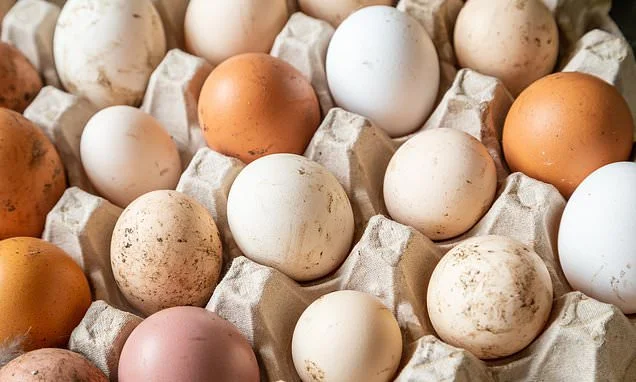
Free–range organic eggs might seem more environmentally friendly option, but experts say they produce almost twice as much CO2 than battery farmed eggs
In the UK, 63 per cent of all eggs come from chickens in free–range farms.
Free–range farms are legally required to provide at least four square metres of open space per bird that the chickens can access at any time during daylight hours.
A much smaller proportion of these birds are raised on organic farms, which are typically kept in smaller flocks, are fed on non–genetically–modified crops, and don't have the tips of their beak removed to prevent aggressive pecking.
Battery cages were banned across Europe in 2012, so battery hens now live in so–called 'enriched cages' that have to contain features such as an area for nesting and perching.
Despite those improvements, battery hens are still crammed in with up to 90 birds per cage and have a significantly lower quality of life than their free–range counterparts.
However, in their study published in Royal Society Open Science, the researchers point out that there are still some important trade–offs to consider.
Organic free–range farming is the most emission–intensive system, largely because of how difficult it is to keep the birds fed.
Organic birds require more feed per egg produced, and the organic crops needed to feed them have much lower yields than conventional crops.
The researchers compared various ways the UK could meet its demand for eggs. Changing from 'business–as–usual' to 'Fully free–range organic' would lead to a 60 per cent increase in CO2 emissions
That means free–range organic farming needs about 5.7 square metres of land for every kilogram of eggs, most of which is used for growing feed.
Since food crops are one of the biggest contributors to egg farming's carbon footprint, using more food per egg means these farming methods produce more emissions.
By contrast, free–range non–organic farming methods have a significantly lower carbon and land footprint.
Non–organic free–range farms produce just 2.21 kilograms of CO2 per kilogram of eggs, only 0.11 kilograms more than battery farming.
'Our results show that free–range non–organic systems perform much closer to caged systems than organic production for key environmental measures,' says Dr Bartlett.
'These findings suggest that free–range systems might deliver improvements in animal welfare while keeping environmental impacts relatively modest.'
Free–range chickens also have a significantly higher mortality rate than those kept indoors.
Free–range organic farms have a chicken mortality rate of eight per cent, compared to 2.5 per cent for those in enriched cages and 3.5 per cent for those raised in barns.
Chickens raised on battery farms need much less food per egg produced, giving them a larger carbon footprint
The researchers say that this is due to increased exposure to disease, predators, injury, and harmful feather pecking from other hens.
However, the researchers acknowledge that these findings are based on data from 2009 and 2010, and that free–range farming techniques have since improved.
Lead author Dr Oliver Martinic, an independent researcher from Croatia, told the Daily Mail: 'The goal should be to develop farming systems that provide good conditions for animals while also reducing their impact on the climate and environment.
'For cage–free systems, in particular, the focus should be on finding ways to combine high standards of animal welfare with efficient production and a lower environmental footprint.'