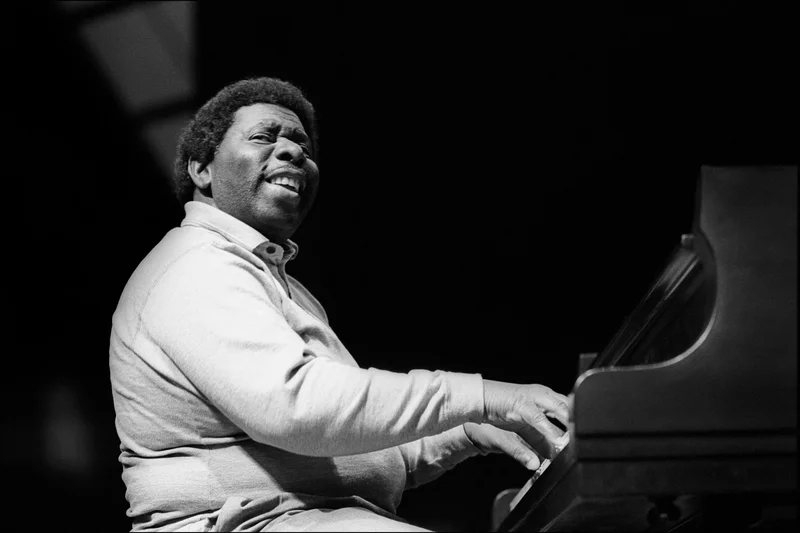
Jazz pianist Oliver Jones was a prodigy comfortable with his family’s Layton Brothers piano by the time he was three. At five, he boogie-woogied in front of an audience for the first time, at Montreal’s Union United Church, Canada’s oldest Black congregation.
Though instructed in classical music, he played gospel songs broadcast by a West Virginia radio station from memory. One afternoon, the child heard teenaged Oscar Peterson, who lived nearby, practicing through an open apartment window.
Mr. Peterson would develop into one of the greatest pianists to ever bebop and swing. His intimidating skill could either inspire one to play better or cause one to quit altogether. Mr. Jones, in elementary school at the time, was of the former mindset. He knocked on the door, which was answered by Mr. Peterson’s older sister and piano teacher, Daisy Peterson Sweeney.
“Can you teach me to play like that?” the precocious pianist asked. She could and did.
“I was hired by his parents and I immediately discovered his talent,” Ms. Sweeney said in Marthe Sansregret’s biography, Oliver Jones: The Musician, the Man. “Anything he would hear played, he would play it back. He used to copy what he heard from me, from Oscar, from anybody.”
Mr. Jones, a composer and fleet-fingered dazzler who combined keyboard fireworks with a bluesy swing, died after a long illness in Montreal General Hospital on July 22. He was 91. The title of his 1985 album Speak Low, Swing Hard could serve as a eulogy.
The quiet, serious man and gentle soul was unavoidably compared to Mr. Peterson because of the history and flashy musical style the two virtuosos shared. When Mr. Peterson’s health began to fail in the 1990s, the younger Mr. Jones took on the unofficial role of Canada’s jazz ambassador to the world.
“He had an innate ability to read a room,” said Jim West, his manager and the founder of Justin Time Records label, which released more than 20 of the pianist’s albums. “Just by looking at an audience for a few moments, he understood who he was playing for.”
He often played for appreciative crowds at Montreal International Jazz Festival, a landmark event on the global jazz calendar that grew in status thanks in part to Mr. Jones’s regular presence.
“He was a humble man,” said festival co-founder and former artistic director André Ménard. “Sometimes we had to remind Oliver how great he was.”
He was invested as an Officer of the Order of Canada in 1994. The Canadian Music Hall of Fame inductee won four Félix Awards and two Juno Awards (for 2008’s Second Time Around, as a trio, and 1985’s Lights of Burgundy, as a quintet). The pianist collaborated with singer Ranee Lee on a pair of albums.
“He had perfect pitch and his mind was a Rolodex of music,” Ms. Lee said. “There was a comfort in his company, on stage and off.”
Mr. Jones’s tour of Nigeria was the subject of a 1990 National Film Board of Canada documentary, Oliver Jones in Africa. Canada Post commemorated Mr. Jones on a stamp in 2013, part of a series that paid tribute to Black history. His parents, according to the pianist’s biography, were descendants of enslaved Africans forced to labour on the plantations of British-ruled Barbados.
“The stamp meant a lot to Oliver,” Mr. West said, “He told me at the time, ‘Man, if my parents could see this.’”
After a triple bypass surgery in 2015, Mr. Jones announced his official retirement in 2016.
The well-liked musician was a mentor. He taught music at McGill University in Montreal and Laurentian University in Sudbury, Ont. “I believe in giving back,” he told The Globe and Mail in 2013. “If I can instill in youngsters a similar passion for music, then I feel I have done what I was born to do.”
Oliver Theophilus Jones arrived into this world in Montreal’s Royal Victoria Hospital on Sept. 11, 1934, the fourth of four children of immigrants Oliver Wesley Jones and Jestina Louise Jones (née Burrowes). He was a mechanic with the Canadian Pacific Railway; she was a seamstress whose immigration papers assigned her the professional category of “domestic,” according to Mr. Jones’s biography.
He was raised in the city’s vibrant Little Burgundy neighbourhood, referred to at the time as the Harlem of the North. Mr. Jones’s craze for the piano was nearly matched by his passion for sports, especially hockey. Sensing he wasn’t talented enough to become the next Rocket Richard, he dreamed more realistically, about being an Elmer Lach or Toe Blake − the Rocket’s associates on the Montreal Canadiens’ famed Punch Line.
He was also a fan of Jackie Robinson, who in 1946 played for the Montreal Royals in the city’s Delorimier Stadium. One year later, Mr. Robinson became the first Black player in Major League Baseball as a member of the Brooklyn Dodgers. (In 1998, Mr. Jones wrote and performed the original score to the documentary film Season of Change, about Mr. Robinson’s summer in Montreal.)
By the time he was 12, Mr. Jones had performed at Café St-Michel, an important cabaret in the development of the Montreal jazz scene. Mr. Jones later told NPR he “saw a lot of what I wasn’t supposed to see − girlie girls and strippers."
What Mr. Jones wasn’t seeing was a lot of money as a teenager playing clubs and hotels in the Montreal area. In the early 1960s, he moved to Miami as calypso singer Kenny Hamilton’s bandleader. From there, a four-month residency with the Vegas-style revue in San Juan turned into a 16-year job, 40 weeks a year.
He was based out of the Americana Hotel in a Puerto Rico that was booming because clubs and casinos had relocated to the U.S. territory after the Cuban Revolution. The band also toured internationally with Bob Hope’s United Service Organizations shows.
“It was a wonderful time,” Jones told NPR. “Puerto Rico was really starting to flourish, so I was there during that heyday.”
Though the job paid the bills, the steady gig was artistically unsatisfying. The music was commercial, not jazz, often played on electric keyboard instead of piano. He later told The Globe and Mail he was a “cautious” person who missed out on opportunities.
“I don’t know if it was a lack of confidence in myself,” he said. “I remember I had a chance to be the pianist for the Supremes years ago, but I turned that down, not thinking that I was ready.”* *
In the early 1980s, he was ready to return to Montreal. Though Mr. Jones was in his mid-40s and hadn’t played jazz seriously in years, he found work in the Les Voyageurs cocktail lounge in the Queen Elizabeth Hotel in the afternoons, and Biddle’s Jazz and Ribs six nights a week. It was at the latter establishment where Mr. Jones, performing with drummer Bernard Primeau and club co-founder and bassist Charles Biddle, attracted attention.
“At 47, he proves worthy of the city’s lineage of hard-driving jazz pianists, with a little of Art Tatum in his playing, a little of Erroll Garner and, indeed, a little of every technically accomplished, swinging player of the 1940s,” Globe jazz critic Mark Miller wrote in 1982. “His first solo of any given evening at Biddle’s comes just after 10:30, and it develops from a lightly fingered act of musical levitation to a rocking, two-fisted conclusion. In a matter of minutes, the room is buzzing.”
The talk of the city’s jazz scene was spotted at the venue by Mr. West one night. “It was an incredible performance,” he said. “I thought it needed to be documented.”
A subsequent performance by the Oliver Jones Trio resulted in 1983’s Live at Biddles Jazz and Ribs, the first album released with the newly founded Justin Time Records. The set list included a jaunty version of Mr. Peterson’s 1962 composition Hymn to Freedom, written in honor of Martin Luther King Jr.
Mr. Jones and Mr. Peterson performed duets of Hymn to Freedom and the jazz standard Just Friends at the 2004 Montreal International Jazz Festival.
In 2005, he recorded the album Just You, Just Me with Ms. Lee. The singer visited Mr. Jones in the hospital in the months before he died. On one of the occasions, he asked her to sing the jazz standard Body and Soul.
Closer to his death, he requested In a Sentimental Mood by Duke Ellington and Manny Kurtz, recorded in the year after Mr. Jones was born. Ms. Lee said her friend mouthed the lyrics as she sang.
“In a sentimental mood, I can see the stars come through my room / While your loving attitude, is like a flame that lights the gloom.”
He is survived by his son, Richard Jones, and long-time partner Monique Leclerc.
You can find more obituaries from The Globe and Mail here.
To submit a memory about someone we have recently profiled on the Obituaries page, e-mail us at obit@globeandmail.com.