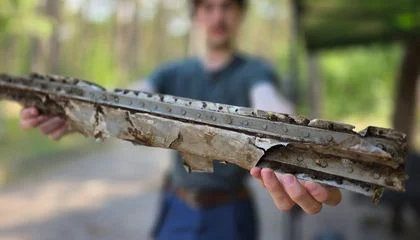
A berry-picker in Poland may have stumbled upon the wreckage of a World War II aircraft.
A resident of Świnoujście, a port city in the northwest part of the country on the border with Germany, was hiking through the forest in search of fruit when he stumbled upon a mysterious pit in an area of heavily disturbed ground. Nearby, he found various pieces of debris, including pieces of an aluminum structure and the remains of burnt ammunition.
The man brought one of the loose fragments to the team at the Museum of Coastal Defence - Fort Gerhard inside a well-preserved 19th-century Prussian coastal fort. Staffers quickly realized the fragment was “not random scrap metal,” Wiktor Czeszewski, a museum official, tells Euronews’ Tomasz Lezon.
“The nature of the sheet metal, the way it was riveted, traces of aircraft structures and burnt ammunition all suggested we might be dealing with the remains of an aircraft,” Czeszewski says.
Upon closer inspection, the ammunition appeared to be .303 British, which was used in the machine guns aboard British Royal Air Force aircraft during World War II. That was the first clue that the berry-picker might have stumbled upon an Allied plane wreck.
Next, experts thoroughly cleaned some of the pieces of debris. Their work revealed the symbol “T7” on a copper tube. After a bit of research, they found T7 in British Royal Air Force technical documentation. The code corresponded with a type of seamless copper tubing used in oil, fuel and gas systems, as well as other components.
The end fitting of the tube also appeared to be a specialized high-pressure, Avimo-type coupling used in British aircraft—including in parts of their Rolls-Royce Merlin engines. As Andrew Paul writes for Popular Science, the engines were developed in the early 1930s and became “synonymous” with well-known Allied fighter planes like the Avro Lancaster heavy bomber, the Hawker Hurricane and the Supermarine Spitfire.
Did you know? Lancaster bombers
A.V. Roe & Company, Ltd., also known as Avro, began producing the Lancaster bomber in early 1942. The 69-foot-long aircraft, which was equipped with four 1,460-horsepower Rolls-Royce Merlin engines, entered combat in April of that year. Seven crew members operated each aircraft, which could reach speeds of up to 280 miles per hour.
According to Encyclopedia Britannica, nearly all of the 7,377 Lancasters manufactured during World War II were used for nighttime bombing raids on German cities. The aircraft were also used to destroy German hydroelectric dams and sink a German battleship.
Museum officials became even more intrigued when they thought back to an artifact in their collection. In 2009, a fisherman had hauled in a 16-foot section of a Lancaster wing from the Baltic Sea, at a spot that’s a little more than half a mile from the newfound wreckage as the crow flies. Museum staffers linked the wing piece with three airmen who had targeted key German sites in the area toward the end of the war.
They wonder whether the Lancaster wing and the recently discovered wreckage might be connected.
“It could be the same aircraft,” Piotr Piwowarczyk, the museum’s director, tells Euronews, adding that, if the discoveries do turn out to be related, it’s likely that “the main part of the aircraft came down” in the forest.
Until they can gather more evidence, however, museum officials are holding off on making any definitive conclusions about the aircraft’s identity.
“We still have many questions and likely more than one surprise ahead of us,” Milan Litwinowicz, a museum official, tells TVP World’s Stanisław Kaleta.
In the meantime, they’ve secured the wreck site and have notified several institutions responsible for war graves.
“The site has to be examined professionally,” museum representatives tell Euronews. “We cannot rule out that crew remains are buried underground.”