- See more Daily Mail on Google - save us as a Preferred Source
Tehran considered attacking a seaport in Ukraine in revenge for strikes on an Iranian ship heading for Russia, but a flurry of diplomacy has calmed the situation for now.
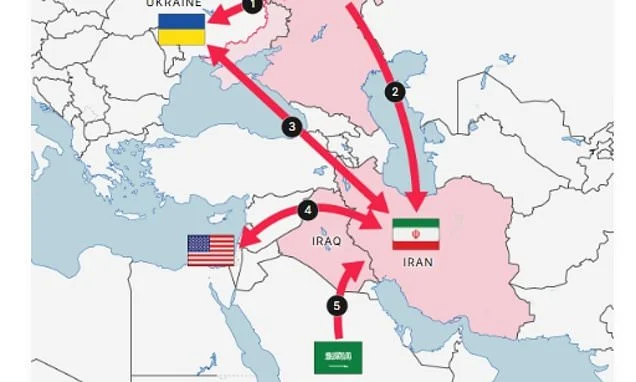
The incident is the latest example of how the two wars are beginning to merge in a sign of increasing global instability.
It comes after Ukraine, which has accused Iran and Russia of supporting each other’s military operations, struck an Iranian commercial cargo ship in the Caspian Sea on Saturday, killing a civilian sailor.
The Islamic Republic vowed to retaliate.
Some people briefed on intelligence said that they expected Tehran to fire a ballistic missile with a small warhead at Ukraine, to make a symbolic gesture but cause relatively little damage, according to The New York Times.
Other officials said the target was likely one of Ukraine’s Black Sea ports.
Any missile fired from Iran into Ukraine would be a dramatic escalation and risk triggering a wider conflict, given the tensions between the two nations over Tehran's alliance with the Kremlin.
Islamic Republic officials said they hoped the conflict would end with their retaliatory attack, but Western officials warned that it was hard to predict how Ukraine would respond.
Navy ships of Iran and Azerbaijan move during an exercise between Iran and Azerbaijan in the Caspian Sea (File photograph)
On Sunday, Abbas Araghchi, Iran’s foreign minister, called Kyiv's attack a violation of the UN charter aimed at dragging Europe into Tehran's war with Washington.
In a social media post, he said the incident 'CANNOT GO UNANSWERED'.
A US blockade of Iranian Persian Gulf ports has made Tehran's trade with Moscow across the Caspian Sea more vital.
The Caspian Sea has emerged as an important supply route for both overt and covert trade.
But on Tuesday, after Ukrainian diplomats intervened to ease tensions, Mr. Araghchi spoke by phone with his Ukrainian counterpart, Andrii Sybiha.
Following the exchange, Mr. Araghchi wrote in a post that Mr. Sybiha had described the attack on the cargo ship as unintentional.
'Iran does not seek escalation either, but made clear any attack on our citizens or interests is unacceptable,' Mr. Araghchi wrote.
'There must be restitution for losses.'
The Iranian foreign minister announced on his official webpage that he also spoke to Kaja Kallas, the top European Union diplomat, discussing 'ways to help decrease tensions in the region'.
The Ukrainian attack came after Zelensky said on Saturday he would share evidence with the US showing Russia is assisting Iran in targeting US bases in the Middle East through satellite surveillance.
Taking to X, the Ukrainian leader wrote: 'Since the beginning of July, we have recorded active Russian satellite surveillance of the Gulf states and US military facilities located there.
'These images subsequently appear in Iran. At the same time, there is a clear correlation between Russia's satellite imagery of these sites and Iranian strikes - both before the attacks, in preparation for them, and afterward, to assess the damage inflicted.'
The new developments follow months of speculation that the two conflicts are intertwining.
Iran has claimed it is not involved in Russia's war on Ukraine, although Kyiv has said Tehran is supplying drones to the Kremlin.
The Islamic Republic also called on European countries to hold Ukraine accountable.
The strike fuelled speculation in Tehran that it was intended as a warning that Iran's Caspian coastline is vulnerable and could be used as leverage in future negotiations with the US, according to the Financial Times.
Although the Caspian Sea lies more than 600 miles from the front line in Russia's war with Ukraine, Kyiv has steadily expanded its long-range drone capabilities, allowing it to strike targets deep inside Russian territory.
After inflicting heavy damage on Russia's oil infrastructure and contributing to fuel shortages, that capability is increasingly being viewed as a potential factor in the wider confrontation involving Iran.
Hamidreza Azizi, an Iran expert at the SWP Berlin think-tank, outlined several possible explanations for Ukraine's strike on the Iranian-linked vessel.
Writing on X, he said one possibility is that Kyiv wanted to reinforce its value as a strategic partner to Washington, which continues to supply crucial military support, including Patriot air defence systems.
According to Azizi, such an operation would not have been possible without approval from the US and its Western allies.
Another interpretation is that the US and Israel encouraged Ukraine to increase pressure on Tehran because they feared direct attacks on Iranian infrastructure could provoke retaliation against key economic assets across the region.
A third possibility, wrote Azizi, is that the strike was linked to threats made by Yemen's Houthi rebels against shipping in the Bab el-Mandeb Strait, a route that Saudi Arabia has relied on to export oil while avoiding the Strait of Hormuz.
US forces intercepted a surprise ballistic missile attack from the Islamic Revolutionary Guard Corps as tensions continued to escalate between America and Iran
The attack took place at approximately 5.45pm ET on US forces based in the Middle East, US Central Command confirmed
The US was able to thwart an Iranian attack on a base in Jordan Tuesday night as they worked with Saudi Arabia to strike bases in Iraq used by Tehran-backed militias.
The US-Saudi attack on the base in Northern Iraq left eight members of the Iran-backed militia dead, according to the Iraqi armed group’s command.
The attacks were the first military moves between the two nations since President Trump paused strikes to give diplomacy a chance.
Trump had met earlier in the day with Israeli Prime Minister Benjamin Netanyahu.
The Iraqi bases were used by Iranian militias to launch attacks in recent days, CENTCOM said.
Iraq’s Popular Mobilisation Forces called the attacks a 'highly dangerous escalation.'
The strike came after US forces said missiles from Iran's Revolutionary Guard Corps were intercepted in Jordan.
The attack in Jordan took place at approximately 5.45pm ET on US forces based in the Middle East, US Central Command confirmed.
'All Iranian missiles were successfully intercepted. US forces remain vigilant and at a high state of readiness,' CENTCOM said in a statement.
The US also warned that further attacks on American troops or Saudi Arabia's energy infrastructure risked additional action.
The US and Iran had experienced a brief period of calm, during which neither announced attacks for days following weeks of escalation over the Strait of Hormuz.