- See more Daily Mail on Google - save us as a Preferred Source
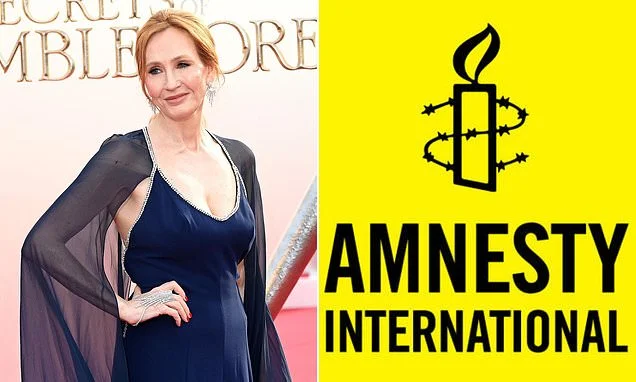
Harry Potter author JK Rowling has accused human rights charity Amnesty International UK of acting like a 'tyrant' and 'attacking female rape victims' as she issued a new legal ultimatum.
Ms Rowling has been at war with the NGO after it placed Beira's Place, a women-only sexual assault charity founded by the author in Edinburgh, on a list of more than 100 'anti-rights' organisations.
Amnesty later apologised, referred itself to the Charity Commission over the incident and said the list had been published in error without its usual checks.
But it later emerged Beira's Place had appeared in a second document alongside 50 other gender critical organisations entitled: 'Like a Snowball: the Growth and Impact of the Gender Critical Movement in the UK.'
It was mentioned in a list of 'GC groups identified' by the charity which were accused of rolling back LGBT+ and women's rights.
Ms Rowling, who has long caused controversy and backlash within the LGBT+ community over her views on the rights of transgender people, posted a series of scathing tweets yesterday in which she claimed Amnesty 'no longer champions freedom of speech and belief'.
'It has become the tyrant that persecutes those who don't espouse what it decrees acceptable beliefs,' she continued.
And in response to an X user who said 'it's amazing that you think you're the hero when you're trying to take down Amnesty International,' she wrote: 'It's amazing Amnesty International UK think they're heroes when they're attacking female rape victims for wanting a male-free support service.'
Harry Potter author JK Rowling has accused human rights charity Amnesty International UK of acting like a 'tyrant' and 'attacking female rape victims' as she issued a new legal ultimatum
Amnesty International produced a report of organisations it says are holding back LGBT+ rights - including Ms Rowling's Edinburgh rape centre Beira's Place
She previously pledged to fund legal action against the charity, and yesterday shared a new letter sent to the NGO in which she said the second report showed the characterisation of Beira's Place as gender critical was 'not a one-off'.
It read: 'It is accordingly clear that the report issued on July 8 was not a "one-off" or something which Amnesty had no oversight of but was in fact part of an on-going campaign to maliciously target our client with the aim of destroying its reputation and labelling the vulnerable service users who benefit from the support provided by Beira's Place as anti-trans bigots.'
The letter added that litigation would commence unless Amnesty International UK agreed to a list of 'remedies' demanded by the author.
These include the agreement that 'the defamatory allegations' against Beira's Place will not be repeated and a commitment from Amnesty to commission an external investigation into how the reports 'could contain such egregious falsehoods'.
Ms Rowling is also asking for a public letter of apology to be published on the charity's front page directed both towards staff and service users at Beira's Place, and to all the groups listed by the documents.
The author's charity describes itself as a 'safe and supportive sexual assault service for women in Edinburgh' which 'offers support, advocacy and information in a safe, women-only space'.
She previously described herself as 'burning with fury' over its inclusion in the Amnesty list and report. Ms Rowling founded Beira's Place in 2022.
Also featured in Amnesty's report was For Women Scotland, the campaign group whose legal action led the Supreme Court to rule that 'women' in equality law refers to biological females.
The ruling also found that this does not mean transgender people are entitled to the same rights as biological women, simply that they are protected under a different part of the legislation.
The head of Amnesty International UK, Kerry Moscogiuri, was urged to resign over the row.
The report by the global charity's British arm claimed gender-critical people – who believe someone's true gender is based on biology rather than how they identify – represent 'a movement against the rights of women and LGBTI people'.
Published in May and available on its website, it claims 'the growth and influence of the GC [gender–critical] movement' is 'worrying'.
It also cited figures highlighting the impact of transphobia - including in the media - on transgender people's mental health, with more than 90 per cent of those surveyed stating it had negatively impacted their treatment by strangers, family members, friends and colleagues.
Meanwhile the 'anti-rights' list was removed from Amnesty's website, with the charity saying it had not gone through the 'established internal review processes'. It also referred itself to the charity watchdog.
The Charity Commission watchdog said it was aware of complaints against Amnesty, saying: 'We are assessing the matters raised to determine what, if any, role there might be for us as charity law regulator.'
In relation to the 'anti-rights' list, a spokesperson for Amnesty International UK said: 'We regret that this briefing was uploaded to our website without going through the established internal review processes that are in place to ensure consistency, accuracy and alignment with Amnesty International UK's position.
'Its use of language does not reflect the position of Amnesty International UK which is why it was promptly removed. We are conducting a thorough review into how this serious issue occurred.
'We remain committed to defending human rights, including the rights of women and girls, and the rights of trans people.
'The rights of one community do not diminish the rights of another. Human rights protections are strongest when they apply equally to everyone.
'No community should be singled out for unfair treatment or denied their dignity and rights.'
Asked about the second report, they said: '"Like a snowball: the growth and reach of the gender critical movement in the UK" examines the role of mainstream media coverage in shaping public debate about trans issues in the UK.
'Among its findings, it reported that four major UK newspapers published nearly 17,000 articles on trans-related topics over a five-year period, equivalent to around nine articles per day.
'The report argues that trans people have become a highly contested subject in public discourse, while trans voices have often been underrepresented in that coverage.'
It is understood that CEO Ms Moscogiuri has agreed to meet with Sex Matters, which was also included in the charity's list, in contrast to her predecessor.
Sex Matters is a charity which supports legal action for those campaigning for single-sex spaces.