Lemme start with a quiz. When was the first Father’s Day celebrated? No Googling, please! I don’t think it’s an easy question for most teens to answer. Just take a guess. If your answer is 19 June 1910, give yourself a pat on the back.
Now for the second question. When is Father’s Day celebrated in India? Need a clue? It’s not on 19 June every year. Any guesses? Would another clue help? In 2025, it was celebrated on 15 June; in 2026, it was on 21 June; and in 2027, it will be observed on 20 June. Hard to figure out?
Some of you may have guessed it correctly. If your answer is “the third Sunday of June,” congratulations! You can feel proud of your general knowledge.
Now, read this text written about the origin of Father’s Day. As you read, try to identify whether the meanings of the words and phrases in bold are literal, figurative, or contextual. Some of them may have more than one meaning depending on how they are used in the passage.
A word study
Father’s Day is celebrated every year on the third Sunday of June to honour fathers and father figures for their love, guidance, and sacrifices. The observance was initiated by Sonora Smart Dodd in 1910 in Spokane, Washington. Inspired by Mother’s Day, she wanted to recognise her father, a Civil War veteran who had shouldered the responsibility of raising six children single-handedly after his wife’s death. His dedication became the foundation of a movement that later gained nationwide support.
Unlike Mother’s Day, Father’s Day faced an uphill journey before gaining widespread acceptance. Over time, public support increased, and the campaign gathered strength. In 1966, President Lyndon Johnson officially proclaimed the third Sunday of June as Father’s Day. In 1972, President Richard Nixon signed it into law, marking an important milestone in acknowledging the contributions of fathers.
Today, Father’s Day is observed in many countries across the world. It provides an opportunity for children to express heartfelt gratitude through gifts, greeting cards, and family gatherings. The day also reminds people of the immeasurable role fathers play in nurturing families and serving as a pillar of support in difficult times. Their guidance helps children navigate life’s challenges and move confidently toward the future.
Various customs mark the celebration. Families exchange cards, give gifts, share special meals, and enjoy outdoor activities that strengthen family bonds. Different countries also have unique traditions, such as wearing roses in the United States and donating blood in Thailand. These practises keep the legacy of fathers alive.
Figurative vs literal
Let’s look at the words and phrases in bold and explore their different meanings.
In the passage, the phrase shouldered the responsibility is used figuratively. It means ‘accepted and carried the burden of raising six children alone.’ Its literal meaning, however, is ‘carried something on one’s shoulders.’
The word foundation is also used figuratively. In the passage, it means ‘the basis or starting point of the Father’s Day movement.’ Its literal meaning is ‘the part of a building that supports the structure.’
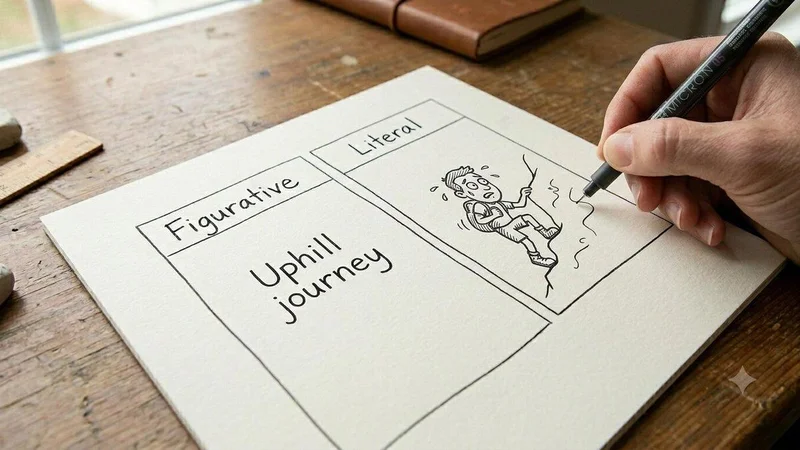
The phrase uphill journey has a figurative meaning as well. In the context of the passage, it refers to ‘a difficult struggle to gain acceptance and recognition.’ You can probably guess its literal meaning: ‘a journey that involves climbing a hill.’
Similarly, the words and phrases milestone, heartfelt gratitude, immeasurable role, pillar of support, navigate, and alive are used figuratively in the passage. Now it’s your turn. Can you identify the literal and figurative meanings of these highlighted words and phrases?
The terms Father’s Day and bond have contextual meanings. In the passage, the word bond refers to ‘a close emotional connection between fathers and children.’ Its literal meaning is ‘a tie, fastening, or formal agreement.’
Identification time
Here is a short anecdote that uses words with literal, figurative, and contextual meanings. As you read, identify the words and phrases that are used figuratively and try to guess what they mean in context.
When the new principal took charge of the school, she promised to build bridges between teachers and students. Some people laughed because there was not even a river near the campus. During the first meeting, she said that education should light a fire in young minds. A few weeks later, a small electrical fire broke out in the laboratory, but it was quickly put out.
The principal then launched a reading campaign called Open Doors. The old library had many wooden doors, but she was talking about opening opportunities for children. Soon, the campaign gathered momentum. In physics class, students learned that momentum is the product of mass and velocity, but in the staff room the same word was used to describe the growing enthusiasm for the project.
By the end of the year, everyone agreed that the school had become the heart of the community. Of course, nobody meant that the building was a real human heart.
The words and phrases used figuratively in the anecdote are build bridges, light a fire in young minds, Open Doors, gathered momentum, and the heart of the community. Before reading the explanations, see if you can guess their meanings from the context.
In the story, build bridges means creating understanding, cooperation, and positive relationships between teachers and students, whereas its literal meaning is constructing a bridge across a river, road, or other obstacle.
Similarly, light a fire in young minds refers to inspiring enthusiasm, curiosity, and a love of learning, while literally it means setting something on fire with flames.
The phrase Open Doors, the title of the reading campaign, figuratively suggests creating opportunities and possibilities for children, although its literal meaning is simply opening physical doors.
The expression gathered momentum means that the campaign gained strength, support, and progress over time; in its literal sense, momentum is a physics concept defined as the product of mass and velocity.
Finally, the heart of the community refers to the most important, active, and valued part of the community, whereas the literal meaning of heart is the organ that pumps blood through the body.
These examples show how words and phrases can convey meanings that go beyond their literal definitions and acquire richer significance in a particular context.
Here’s a quick challenge. Can you tell which sentence uses the word fire in a figurative sense and which uses it literally?
Education should light a fire in young minds.
A small electrical fire broke out in the laboratory.
Lemme end this piece with a beautiful quote: “A father is not just a parent; he is the lighthouse that helps us find our way when the sea of life grows rough.”
(Dr Albert P’Rayan is an ELT resource person and education columnist. Send your feedback to englishmatters2024@gmail.com)
Activity:
Here are some Father’s Day quotes that use figurative language. Identify the words/phrase and explain their figurative meanings:
1. A father is the anchor that keeps our family steady through life’s storms.
. A father’s wisdom is a compass that points his children toward their dreams.
. Like a mighty oak tree, a father stands tall, offering shelter and strength.
. Dad, your words planted seeds of courage that continue to bloom in my heart.
. My father’s hands built bridges over every obstacle in my path.
Hearty Congratulations!
For sending in their answers to the activity on The Collective Conundrum (June 14, 2026).
Published - June 30, 2026 03:44 pm IST