- READ MORE: British booze is getting weaker, researchers find
- See more Daily Mail on Google - save us as a Preferred Source
Beer firm Carling is watering down its lager to 3.4 per cent to help cut costs.
The Staffordshire-based brewers - known for advertising slogans such as 'I bet he drinks Carling Black Label' - previously offered an alcohol content of four per cent.
But the sharp reduction comes amid falling sales and rising costs, with the company potentially now benefiting from a reduction in taxes.
Lower duties apply to beers which have alcohol by volume, or ABV, between 1.3 per cent and 3.4 per cent.
Those levies amount to £9.96 per litre of pure alcohol, down from the equivalent £22.58 for drinks with ABV between 3.5 per cent and 8.4 per cent.
The new 3.4 per cent lager will be introduced from October onwards.
Carling's owner Molson Coors has insisted the drink would still deliver the same 'perfectly balanced and refreshing' taste.
The company said: 'Extensive consumer testing has shown that the 3.4 per cent liquid delivers the taste consumers expect from Carling - with the 3.4 per cent lager ranking higher for overall taste.'
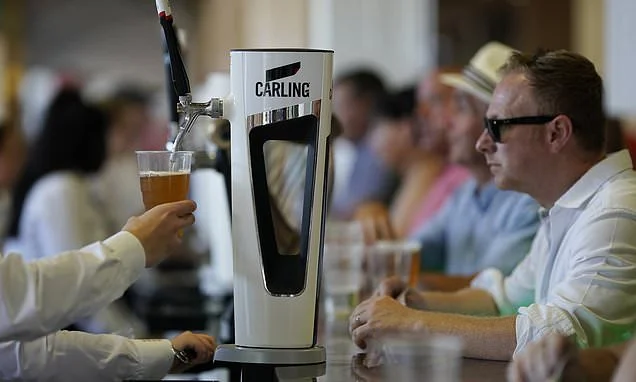
Beer firm Carling is watering down its lager to 3.4 per cent from this October in supermarkets
Carling's sales have dropped by 15.6 per cent to £232.8million during the past year, according to figures reported by the Grocer.
The move comes as a study earlier this month suggested British beer is getting weaker all round.
The latest change to duty rates came into force in August 2023 - with other brands including Amstel, Carlsberg, Fosters, Grolsch and John Smith's making similar cuts in ABV to below 3.5 per cent.
The average strength of a can of beer or bottle of wine has dropped by around one per cent since 2022, researchers say, with a sharp increase in the number of beers sold which contain less than 3.5 per cent alcohol.
That drop is equivalent to 14.2million pints of alcohol being drunk in the UK until the end of last year.
But while there has also been a five-fold increase in the number of low-strength beers being drunk, the effect is not entirely because Brits have become more abstemious.
The researchers suggest that new duty laws which encourage brewers to reduce their products' alcohol content to take advantage of lower taxes are partly to blame.
The study, by researchers from the University of Sheffield, looked at data on six million purchases of alcohol by 30,000 families to explore any effects the changes to the law in 2022 may have had on consumer behaviour.
The company's recently relaunched Carling Black Label version has an ABV of 4.7 per cent
Results show that overall, the average alcoholic content of all drinks before the tax and duty changes was stable at between 17.2 to 17.7 per cent. But after the changes, it dropped to 16.6 per cent at the end of last year.
The average alcohol content of beer fell from 4.5 per cent in 2022 to 4.4 per cent last year.
For wine, it dropped from 12.6 per cent to 12.3 per cent, and spirits from 36.5 per cent to 36.2 per cent over the same period.
The results also show a big increase in sales of lower strength beer. Previously, just three per cent of beer drunk in Britain was below 3.5 per cent, but by last year, that had risen to 18.1 per cent – nearly one fifth of the total beer market.
The changes will have 'clear implications for public health', the research team points out.
Alcohol is a leading risk factor for ill health and premature mortality, and more than 10,000 people died from alcohol-related causes in 2023 – the highest number on record.
Professor Colin Angus, Professor of Alcohol Policy at the University of Sheffield, who led the study, said the findings showed a 'clear appetite' for lower strength drinks.
'Lowering the strength of alcoholic products is likely to have a positive impact on public health as there is evidence from experimental studies that when drinking lower-strength drinks, we tend to drink less alcohol overall,' Prof Angus said.
'We estimate, under optimistic assumptions, that the fall in average product strength may reduce average alcohol consumption by 2.7 per cent since 2022.
'This would be a significant change, however alcohol-specific deaths remain around 25 per cent higher than they were just a few years ago in 2019, so we shouldn't expect that reformulation alone can tackle these high rates of alcohol harms.'
Writing about their study in Drug and Alcohol Review, the researchers said they could not be sure that the 2022 duty changes had caused alcoholic drinks to become weaker.
Overall, they found one in 20 boozy drinks had been reformed to contain less alcohol in recent years.
But they added that 'the clear timing association between the reforms and increased reformulation activity, strongly suggests that the reforms have played at least some role in driving an increase in reformulations'.
Carling did launch a new 'premium' version of Carling Black Label earlier this year, with an ABV of 4.7 per cent.
Brand director Ryan McLaughlin said: 'Across the grocery and convenience channels, we've seen a significant shift in the way shoppers engage with the lager category.
'Consumer expectations are evolving and our research shows that a balanced range including familiar, trusted favourites plays a notable role in shaping purchasing decisions.
'Through these changes and ongoing investment in our Carling brand family, we're giving our customers solid, trusted lager options from Britain's leading core lager brand.'