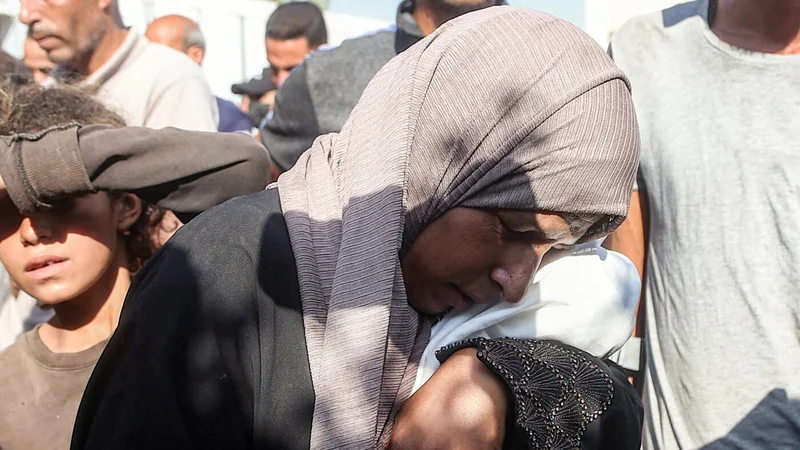
‘The war caused this’: Miscarriages soar in Gaza amid Israeli bombing and siege
A month after learning she was pregnant, Sahar al-Majdalawi began suffering agonising abdominal pain that left her screaming in distress.
It was her first pregnancy after seven years of trying to conceive, and the 34-year-old displaced Palestinian feared for her unborn baby.
With roads in Gaza destroyed and transport brought to a standstill by Israeli bombing, she was forced to walk for hours to the nearest hospital.
After hours walking through the darkness alongside her husband, she finally reached Al-Awda Hospital in the Nuseirat refugee camp in central Gaza.
"I was hit by severe cramps that felt like labour pains," Majdalawi told Middle East Eye.
"We had to walk so far because there was no transport despite my pain. The whole time, I was begging God to keep my baby safe."
'We had to walk so far because there was no transport despite my pain. The whole time, I was begging God to keep my baby safe'
-
Sahar al-Majdalawi, displaced Palestinian woman
Doctors performed an ultrasound shortly after she arrived. Moments later, they returned with the news she had feared.
"They said: 'The foetus is still in your womb, but there is no heartbeat,'" she recalled.
"At that moment, it felt as though my own heart stopped beating. I realised I had lost the dream I had waited years to fulfil."
Majdalawi's story is far from unique in the war-ravaged Gaza Strip.
Since Israel launched the two-year genocide in October 2023, miscarriages have risen sharply.
At the height of the war, miscarriage rates were around 300 percent higher than before October 2023, according to the International Planned Parenthood Federation.
The figure now stands at around 460 miscarriages per 1,000 births, compared with 140 per 1,000 births in 2022.
An alarming rise
Data from the Palestinian Ministry of Health shows 3,958 miscarriages were recorded during the first six months of 2026, a figure described as "shocking" by Dr Adnan Radi, head of the ministry's advisory committee and a senior consultant in obstetrics and gynaecology.
"Official statistics, whether from international organisations or the Ministry of Health, undercount the true scale, but there is an undeniable and sharp surge in miscarriages during the war years," Radi told MEE.
'Miscarriage rates have multiplied. The Ministry of Health indicated the rate could be as high as 70 percent of total births in certain areas, which is a tragedy'
-
Dr Adnan Radi, senior consultant in obstetrics and gynaecology
He believes hundreds of miscarriages go unrecorded because many women cannot reach medical facilities, while data collection across Gaza's sprawling tent camps has become virtually impossible.
"Although an exact number is hard to pin down, there is a consensus that miscarriage rates have multiplied. The Ministry of Health indicated the rate could be as high as 70 percent of total births in certain areas, which is a tragedy," he said.
While physicians cannot point to a single cause, Radi attributes the rise directly to the consequences of the war.
"Anaemia plays a critical role. Around 70 percent of pregnant women in Gaza are suffering from severe anaemia, compounded by widespread malnutrition," he said.
The Integrated Food Security Phase Classification (IPC) warned last week that around 67 percent of Gaza's population - an estimated 1.4 million people - faces critical or worse levels of acute food insecurity through December. It estimates that nearly 25,000 pregnant and breastfeeding women will require urgent nutritional support over the coming year.
Radi also pointed to infectious diseases, contaminated water, poor sanitation and exposure to toxic dust generated by thousands of tonnes of explosives dropped by the Israeli military.
"Although comprehensive studies are lacking, there is a clear link between environmental toxicity, malnutrition, anaemia and the rise in miscarriages and premature births," he said.
He added that toxic residues from bombardment could have lasting effects on future generations by altering the genetic landscape.
Pregnancy during war
Majdalawi was keen to understand from the hospital exactly what caused her to miscarry.
"Despite our efforts to find an explanation so we could prevent it from happening again, the doctor couldn't tell us why," she said.
'Deep down, I know the war caused this. I was displaced countless times, my body was completely exhausted, and I suffered five injuries in separate air strikes'
-
Sahar al-Majdalawi, displaced Palestinian woman
Without a clear medical explanation, Majdalawi believes her miscarriage cannot be separated from the conditions she has endured throughout the war.
"Deep down, I know the war caused this. I was displaced countless times, my body was completely exhausted, and I suffered five injuries in separate air strikes.
"I endured famine in northern Gaza, lost weight, and my health deteriorated," she added.
"On top of that came the psychological torment of losing our home when our neighbourhood was bombed."
Majdalawi and her husband now live in a tent in Nuseirat refugee camp after their home in Jabalia was destroyed. Returning to the area is impossible because it lies near the Israeli military's "Yellow Line".
Like nearly two million displaced Palestinians in Gaza, she struggles to cope with life inside a tent.
"My husband did everything he could to make life in the tent easier so my pregnancy would go smoothly," she said. "But there is only so much anyone can do.
"Imagine sleeping on a paper-thin mattress on uneven ground inside a flimsy tent baking in the summer heat. Sometimes I feel my heart will stop because of how hot it gets. My back aches constantly."
Although a ceasefire was declared in October, intermittent Israeli bombing and explusion orders continue, leaving many Palestinians in a constant state of fear.
"Not a day passes without the thunder of bombardment or the buzz of the quadcopter drones overhead," Majdalawi said. "Sometimes they even open fire. It keeps me in a constant state of psychological distress."
Access to nutritious food was another challenge during her pregnancy.
With unemployment exceeding 80 percent and poverty nearing 100 percent, according to the World Bank, most families rely almost entirely on food aid, largely consisting of rice, beans, lentils, pasta and canned meat.
"My husband lost his job because of the war, so we depend on charity kitchens for free meals. Buying fruit, vegetables or fresh meat regularly is impossible without money."
Premature births and defects
Miscarriages are not the only crisis confronting Gaza's maternity wards. Doctors say they are also seeing unprecedented numbers of premature births and babies born with severe congenital abnormalities.
"We have seen a sharp increase in premature births before 26 weeks of pregnancy," Dr Radi said.
'We have observed a drastic increase in severe foetal abnormalities'
- Dr Adnan Radi, Palestinian health ministry's advisory committee
The rise comes as hospitals face a critical shortage of neonatal intensive care (Nicu) beds, leaving premature babies with a far lower chance of survival.
In February, Unicef reported that nearly one in five newborns in Gaza required intensive care or thermal incubation due to maternal malnutrition, chronic stress and a lack of prenatal care.
Doctors are also reporting a rise in severe birth defects.
"In recent months, we have observed a drastic increase in severe foetal abnormalities," Radi said.
"In previous years, seeing a baby born without limbs or feet was an extremely rare occurrence. Now, it has become a recurring phenomenon in delivery wards."
As doctors struggle to save mothers and newborns, Majdalawi remains in her tent, haunted by the fear that she may never carry a pregnancy to term.
"I don't know when the day will come when I can hold my baby in my arms without the terrifying fear of losing them or seeing them born with deformities."