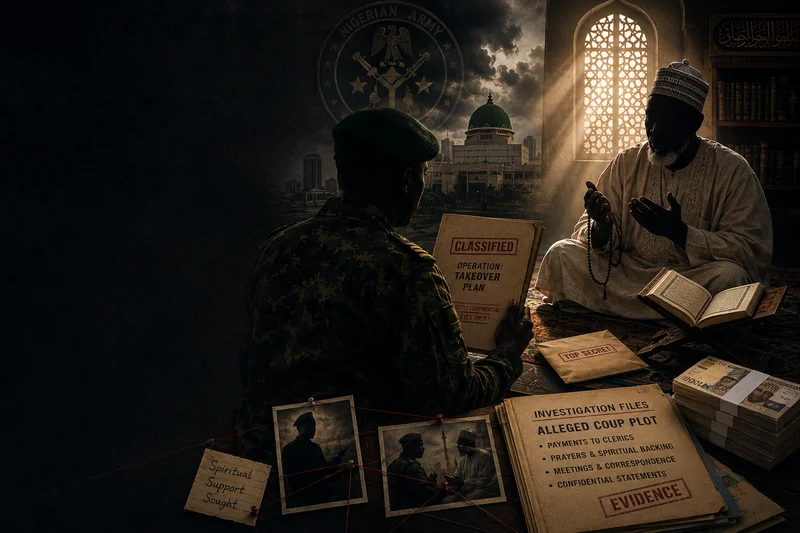
For months, Mohammed Ma’aji, a Nigerian Army colonel and alleged mastermind of last year’s failed coup, allegedly searched for more than weapons, money and military allies.
According to investigation records obtained by PREMIUM TIMES, he also sought spiritual backing from Islamic clerics as he allegedly worked to overthrow President Bola Tinubu’s government.
The records, which form part of the prosecution’s proof of evidence in the ongoing alleged coup trials before both a military-organised General Court Martial and civil Federal High Court in Abuja show that Mr Ma’aji repeatedly approached clerics for prayers, spiritual guidance and support for his plans.
But the clerics involved told investigators they made several attempts to stop what he repeatedly described as a planned “riot” against the government.
| | |
|---|
The alleged coup plot
On 22 April, the federal government arraigned six suspects before the Federal High Court in Abuja over an alleged 2025 plot to overthrow President Bola Tinubu.
The defendants are retired Major General Mohammed Gana, retired Navy Captain Erasmus Ochegobia Victor, Police Inspector Ahmed Ibrahim, Presidential Villa electrician Zekeri Umoru, Bukar Goni and Kaduna-based Islamic cleric Abdulkadir Sani.
They are standing trial on 13 charges of treason, terrorism, money laundering and failure to disclose information in a case marked FHC/ABJ/CR/206/2026, filed by the Office of the Attorney-General of the Federation.
The investigation began after the coup plot was uncovered by the Nigerian authorities in September last year, leading to the arrest of serving and retired military officers alongside several civilians.
As investigators questioned dozens of suspects, they uncovered what they believe was an extensive network involving military personnel, civilians and religious figures.
Among those questioned were two Islamic clerics who insist they never supported any attempt to overthrow the government.
Bukar Goni
One of them, Bukar Goni, told investigators that his relationship with Mr Ma’aji began shortly before any alleged coup discussions.
According to his statement, he first became acquainted with M.A. Usman, a major, while the officer was still at the Nigerian Defence Academy (NDA).
He said Mr Usman often sought prayers because he repeatedly failed the Staff and Command examinations required for promotion.
The cleric said he even introduced the officer to the Borno South senator, Ali Ndume, whom he described as someone who respected him because they came from the same constituency and because he serves as imam of Damba Modern Market Central Mosque.
It was through Mr Usman, he said, that he later met Mr Ma’aji.
Like Mr Usman, Mr Ma’aji allegedly complained about failing promotion examinations and asked the cleric to pray for him.
According to Mr Goni, when Mr Usman brought Mr Ma’aji to him, the colonel was in a state of professional despair. He had repeatedly failed his promotion exams to become a brigadier general and believed his bosses were intentionally failing him to kill his career.
Mr Goni told the colonel that what he needed was an animal sacrifice, known as “sadaka.”
Desperate to save his career, the colonel began sending money, ranging from N300,000 to N1 million at various times. Yet, the following year, the colonel failed his promotion again.
“He met me with tears,” the cleric told investigators.
“I consoled him and told him to depend on God and remain prayerful.”
According to Mr Goni, Mr Ma’aji became convinced that some people within the military would never allow him to rise.
He claimed Mr Ma’aji began talking about “boys” who wanted to stage what he repeatedly called a “riot.”
The cleric said he immediately discouraged the idea.
Realising the danger, Mr Usman secretly begged the cleric to use his spiritual influence to calm the colonel down and delay the violence. Mr Goni had managed to make the colonel postpone the strike twice, pushing it back to August.
To completely scare the colonel away from the risky plot, the cleric said he used a psychological trick. He told the colonel that within 20 days, he would have a specific dream.
The colonel later returned and confessed he dreamed that insects covered his legs, Mr Goni translated the dream as a divine warning: whatever physical action the colonel was planning would completely destroy him.
According to the statement, Mr Ma’aji appeared convinced and again agreed to abandon the alleged plan.
But the respite was temporary.
Months later, the thirst for a coup returned. The cleric said Mr Usman informed him that discussions about the planned uprising had resumed.
The statement also claims Mr Ma’aji later attempted to determine whether the cleric genuinely supported the alleged plan.
According to Mr Goni, Mr Usman warned him that Mr Ma’aji intended to send him a list to test where his loyalty lay.
Mr Usman allegedly instructed him on how to respond so that Mr Ma’aji would continue believing he remained supportive while efforts were made to discourage him from pursuing the alleged plot.
The cleric said the arrangement continued while he remained focused on offering prayers.
Millions of naira for prayer
During the investigation, Mr Goni admitted receiving substantial sums of money from Mr Ma’aji. He maintained that every payment related strictly to prayers and charitable activities.
According to his statement, Mr Ma’aji transferred about N10 million within 15 days for prayers.
He also received two separate transfers of N20 million.
Initially, he said he believed the money was meant to support the construction of his mosque, a project they had earlier discussed during his son’s wedding in Maiduguri.
When he could not reach Mr Ma’aji to clarify the purpose of the transfers, he began spending the money on the mosque project.
He told investigators that about N24.7 million had already been used to purchase land, while the balance remained available for development.
Throughout his statement, he insisted that every kobo received from the retired officer was for religious activities and charitable purposes rather than any political objective.
Abdulkadir Sani
The colonel sought spiritual help from other sources as well.
Abdulkadir Sani, an Islamic cleric based in Zaria, Kaduna State, stated that he first met Mr Ma’aji during a religious celebration at the Emir’s palace in Bida, where the colonel simply asked for general prayers.
Mr Sani, who is one of the six men facing charges in connection with the alleged coup, said their initial conversation was brief.
“He approached me, greeted me and asked me to pray for him,” he said.
“He didn’t mention anything like a coup.”
The discussion allegedly changed after a middleman identified as Adamu, whom the cleric said he had known for more than a decade, later visited him with what he described as a message from his superior.
That meeting, according to his statement, was when the alleged coup plan was first disclosed. The cleric said he immediately warned that the operation would fail.
According to him, he told those involved that two people within the group would eventually betray the conspiracy.
“I told him it won’t be successful because there are two people who will betray them,” he said.
Terrified by this spiritual prediction of sabotage, the colonel called the cleric back a few weeks later, asking for urgent prayers to stop the internal betrayal.
The colonel allegedly transferred N2 million into his bank account shortly afterwards.
Arrest after bank account was flagged
The cleric’s involvement eventually attracted the attention of investigators after his bank account was restricted.
According to his statement, he discovered the restriction while attempting to withdraw part of the money that had been transferred into the account.
He said he visited the Economic and Financial Crimes Commission (EFCC) to make inquiries after learning that the account had been flagged.
That visit, he told investigators, led to his arrest.
Claims to be tested in court
The accounts by the two clerics form part of the prosecution’s proof of evidence in the ongoing trial before the Federal High Court in Abuja.
They are among several statements obtained by investigators from military officers, police personnel and civilians questioned during the investigation into the alleged coup plot.
The statements remain allegations that are being tested in court.
All six defendants have pleaded not guilty, and challenged the admissibility of their statements.
Read the teaser story for the PREMIUM TIMES series of exclusive reports on the failed coup plot here, and subsequent exposés here, here, here, here, and here.