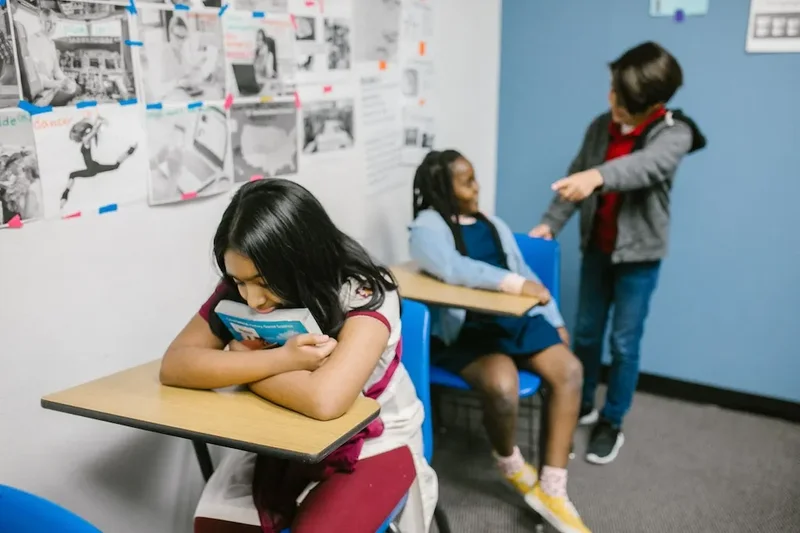
Bullying - also called acoso escolar in Spanish - is a problem that affects young people in schools across the world, but it can be particularly difficult to deal with when you’re in a different country from your own.
A recent video has surfaced on social media showing a group of teenage girls in Moguer in the Andalusia region attacking another girl, hitting her and calling her names, has caused outrage among parents and teachers and the question of bullying has once again reached news headlines.
View this post on Instagram
A report by the ANAR Foundation and Mutua Madrileña from the end of 2025 revealed the 12.3 percent of children in Spain suffered from being bullied at school, which is higher than the 9.4 percent recorded in 2024.
And Ana Morejón, spokesperson for the ColaCao Foundation, which aims to prevent bullying in schools, recently said that bullying effects two students per classroom in Spain.
Based on these figures, this means that there are nearly 220,000 students in Spain who are victims of bullying, and more than 74,000 bullies.
Insults, name-calling or teasing are the most common forms of bullying at schools in Spain.
Among the main reasons for bullying according to the ANAR Foundation are the physical appearance of the victim (56.5 percent) and the things they say or do (53.6 percent).
They also highlighted the fact that in 72.6 percent of cases, bullying is carried out in a group.
**READ ALSO: What are the laws on homeschooling in Spain? **
The Castilla y León Association Against Bullying and School Harassment (ASCBYC), has also identified a worrying trend in 2026, that even though kids are on summer holiday, the bullying hasn't stopped. It has carried on, online.
President of ASCBYC, Carmen Guillén said: "This summer is surprising me because it's not following the usual pattern of other summers". According to her, the flow of cases used to slow down significantly at the end of June, a trend that has been completely broken this summer.
It carries on through social media, messages and even video games.
Organisations such as Save The Children, UNESCO and Amnesty International have all reported that between half a million and three million Spanish children are bullied, far higher than the figures logged by Spain's Ministry of Education based on calls to its anti-bullying hotline 900 018 018.
According to Enrique Pérez Carrillo, head of Spain's Anti-Bullying Association (AEPAE), the official figures only reflect "the tip of the iceberg" and nine in every ten bullying cases in Spain "go unpunished" or unreported to educational authorities (Amnesty International figures).
"The current system is a type of institutionalised fraud that leaves the family and the victim completely defenceless; what usually happens is that parents give up and move their child to another school," Carrillo argued about the fact that school staff are allowed to be involved in the investigation process and tend to hide information from the Inspectorate of Education in order not to tarnish the school's reputation.
**READ ALSO: 11 things to consider when choosing a school for your child in Spain **
In just this past week, the regional Minister of Education and Vocational Training in Murcia, Víctor Marín, held a series of meetings with unions to create a new decree that will toughen sanctions related to school bullying.
It aims to implement a zero-tolerance policy against bullying and strengthen punishments for those who carry it out. Key changes include the elimination of minor offences and the replacement of the current 'serious' and 'very serious' offences.
Cyberbullying
The increase in the amount of bullying is closely linked to new technologies, which have given rise to cyberbullying, which "more difficult to control," according to the ANAR Foundation.
Their figures reveal that cyberbullying is more prevalent among 11- and 12-year-olds (64.7 percent) and more common in secondary school (57.4 percent) than in primary school. Cyberbullying incidents primarily target a single individual.
A total of 15.8 percent of students say that the cyberbullying situations they are aware of have been going on for more than a year, which represents an increase of 5.9 percentage points compared to 2024.
The OECD found that Spain's cyberbullying rates were the lowest of all its members, but cases are up in all countries.
WhatsApp continues to be the main means by which cyberbullying occurs in 66.4 percent cases, followed by Instagram and TikTok.
Galicia recently became the first region in Spain to try and tackle cyberbullying with the introduction of a draft Law on Comprehensive Measures against Harassment and Digital Violence. It is currently awaiting approval in the regional government.
What to do if your child is being bullied at school in Spain
If you know or think that your child is being bullied at school, there are several ways to help your child.
Spain's Anti-Bullying Association (AEPAE) is a useful resource which even includes a Q&A a page which allows parents to ascertain if it can be deemed as bullying. "If a child can definitely recall three incidents, there have almost certainly been more," AEPAE head Enrique Pérez Carillo explains.
You should talk to your child’s teacher and report it to the school, that way they can be aware of the situation and keep an eye out.
Keep an eye on out social media too. Be aware of what platforms your child is on and what accounts they have so that you can follow and know what’s going on.
You can also talk to the bullies to stop it from happening again. If you feel that your Spanish is not good enough, take a friend along who can help you out.
Child psychologist José Antonio Luengo told Spanish broadcaster RTVE that there's "an epidemic silence" regarding bullying, stressing that many children don't dare tell their teachers and parents, whereas most of their classmates are "spectators, incapable of saying anything, sometimes through fears of repercussions".
While the ColaCao Foundation revealed that 38 percent of victims suffer in silence.
As well as contacting the school, the advice is often to contact the parents of the bully to make sure they know what’s going on and talk to their child.
According to the parenting website parents.com you should also try to build your child’s confidence, teach them the correct way to react, go through role-play situations, help them think up appropriate responses and promote positive body language.