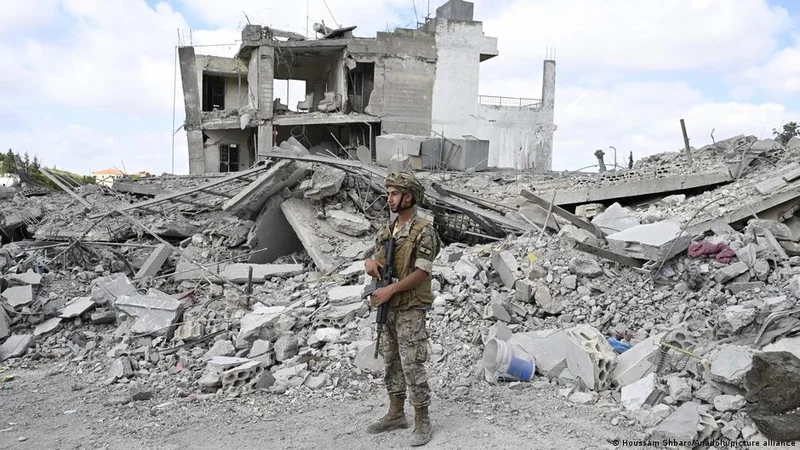
It has been just over a week since the so-called "pilot zone" plan was launched in Lebanon and the gap between the plan's ambitions and the reality on the ground remains stark.
According to the June 26 agreement between Lebanon, the US and Israel, the pilot zone plan is meant to see the Israeli military gradually redeploying out of parts of southern Lebanon it currently controls, which then allows the Lebanese army, or LAF, to move in.
After the armed wing of Lebanon's Hezbollah group fired rockets at Israel in March this year, Israel invaded Lebanon and now occupies a large swathe of the country’s south. The pilot zones are meant to end that. Once the LAF controls the zone, then Hezbollah can supposedly no longer operate from there. And once one zone has been secured, then the next will be actioned.
However there have been a number of troubling incidents already. The Israeli army shot at the vicinity of Lebanese soldiers as they approached one area last week and Israeli demolitions of homes and buildings in Lebanon continue, as do attacks with drones and bombs elsewhere in southern Lebanon.
The Israeli army's behavior jeopardizes the agreement from which the pilot zone plan originates, Lebanese President Joseph Aoun told the UN's human rights chief Volker Türk this week, when the latter visited Lebanon.
Pilot zone residents not impressed
Locals that DW spoke to, who live in the pilot zones, were also skeptical.
Hussein Kamaleddine, the mayor of Srifa, told DW he didn't understand why his village or the village of Froun had been made a pilot zone because Israeli soldiers had never even been stationed there.
"This is something that was forced upon us," Kamaleddine said. "It still doesn't make sense to us why these villages were considered pilot zones."
Other commentators have pointed out that lack of Israeli presence may be exactly why these towns were chosen as the first pilot zones: They don't directly impact northern Israel's security and it's a kind of soft launch for the plan.
Kamaleddine said he was happy to be back home in Srifa even though, he noted, he was surrounded by rubble. But he credited that homecoming to his community's resilience, not state support.
"Being back in Srifa now feels like a dream," he said. "But it's not thanks to the government. These so-called pilot zones are nothing but a scheme by the US and Israel."
Authorities from the village of Froun sent DW a written statement, expressing similar opinions. The town supported the LAF and that soldiers coming there had "preserved security and stability," they said.
But at the same time, they also completely rejected the pilot zone plan and described it "as serving the enemy [Israel] by prolonging its presence on Lebanese territory and creating a rift between the army and the people."
One of the major concerns about the pilot zone plan is that the LAF will be forced to confront Hezbollah fighters eventually, which could cause unrest, or even civil war. Hezbollah is thought to be as strong, or even stronger than, the Lebanese army.
Villages destroyed by Israeli army
Locals from another pilot zone village Zawtar al-Gharbieh (or West Zawtar) have been trying to get back home for several days now, mayor Abed Ezzeddine told DW.
And Israeli soldiers had definitely been there, Ezzeddine said. Almost all of the villagehas been destroyed.
"After seeing it, I can't describe it any other way: It's catastrophe upon catastrophe," Ezzeddine continued. "In principle, we cannot allow everyone to return at once, we're letting people in gradually. The plan is that once the army finishes clearing all the roads, God willing, everyone will be able to return."
The mayor has told other media this week that, despite being a pilot zone, the village doesn't feel safe. Another nearby village, Zawtar al-Sharqiyah (or East Zawtar) is still occupied by Israeli soldiers and the road going into his town runs through there, which makes it difficult to move around. When journalists from the Associated Press visited Zawtar al-Gharbieh this week, they heard explosions nearby and saw Israeli drones overhead.
How to tell if pilot zones work
Beyond the current problems on the ground, there are also major theoretical issues with the pilot zone plan.
"The framework Lebanon signed does not specify a withdrawal timetable and there is still no clarity on how disarming Hezbollah is defined, what the success criteria for disarmament are, and which party is responsible for determining whether these benchmarks are being met," explains Randa Slim, lead for the Middle East program at the US-based Stimson Center.
"Until the pilot zones include areas inside Israel's 'yellow line' and we see tangible evidence of Israeli forces withdrawing gradually from these areas, they serve, in my opinion, as Israeli smokescreens for an indefinite occupation in southern Lebanon," Slim argued.
This week Israeli prime Minister Benjamin Netanyahu seemed to confirm that, saying Israel would not be withdrawing soldiers from Lebanon anytime soon.
"I'm not sure many people have much confidence that the agreement is a pathway to a constructive endgame here, whether in terms of facilitating the disarmament of Hezbollah or advancing an Israeli withdrawal from Lebanon," Julien Barnes-Dacey, director of the Middle East program at the European Council on Foreign Relations, or ECFR, told DW. "The terms have been shaped by Israel and give Netanyahu the space to … facilitate the country’s ongoing occupation of southern Lebanon."
Positives about pilot zones?
It's a bad deal but now that Lebanon has signed it, it must make the pilot zones work, Michael Young, a senior editor at the Carnegie Middle East Center in Beirut, argued in a July 21 commentary for UAE-based media outlet The National.
The Lebanese government must insist locals be allowed to return to their homes. Without it, the scheme is useless, Young wrote. And if the LAF does manage to control the pilot zones they move into, "this could serve as leverage to compel the Israelis to widen the areas of Lebanese control, since it is unlikely Hezbollah would seek a confrontation with the Lebanese army," Young concluded.
Also still being debated is which neutral party could monitor whether the pilot zones have been successful. In late June, France and Italy said they would be willing to lead an "international coalition to support Lebanon."
But the Europeans "are not going to deploy forces so long as we keep seeing conflict conditions on the ground," the ECFR's Barnes-Dacey pointed out. "If Europeans want to make a real difference at this stage, they could focus on pressuring Israel to pull back militarily while stepping up support to strengthen the Lebanese government."
Edited by: Andreas Illmer