- READ MORE: Modern life may be pushing human minds beyond their limits
- See more Daily Mail on Google - save us as a Preferred Source
It might sound like the evil plan of a nefarious villain, but scientists now say that we need to halve Earth's population to save the planet.
Over the last 100 years, the world's population has ballooned from less than two billion to 8.3 billion people.
However, researchers say our planet cannot sustain this explosive growth for much longer.
Now, in a proposal that will remind movie fans of Thanos' plot in Avengers: Infinity War, scientists argue that the population needs to be 'eased' down to four billion by 2200.
However, rather than the instant destruction envisioned in that blockbuster hit, the scientists say that this could be managed as a gradual decline.
The researchers believe that most of the change could be brought about simply by providing women in low–income countries with family planning services.
If the global population could be reduced in the next 200 years, this could help ease humanity's burden on the environment and ensure there are enough resources to go round.
In their paper, published in the journal Sustainable Development, the researchers write: 'Easing to a smaller and sustainable population would not deprive additional billions of life but instead ensure that when they do arrive conditions will be good.'
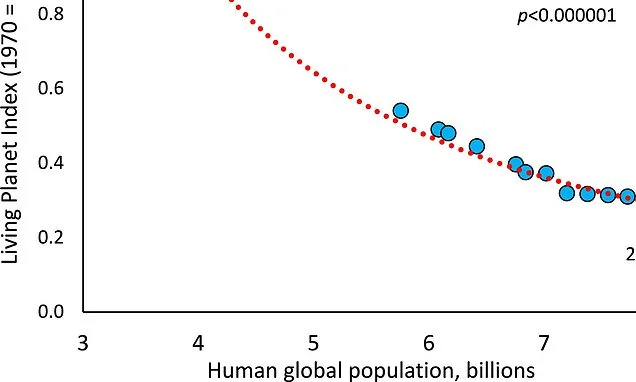
Scientists say that the world's population needs to be halved in order to avoid devastating consequences for the environment. Pictured: A graph showing human population against global biodiversity
This comes after research suggested that the number of people on Earth could hit a staggering 12.4 billion by the late 2070s
The researchers argue that global population growth presents the world with an impossible problem.
They point out that the total impact humans have on the planet is equal to everyone's individual contribution multiplied by the number of people on Earth.
With 'per capita' impact in terms of resource consumption and waste production showing no signs of falling, the only way to prevent humanity's impact from rising is to lower the population.
The researchers analysed the connection between Earth's population and various indicators of sustainability.
They found that in the past 50 years, in which the population has doubled, CO2 emissions have more than doubled, the world's biodiversity has more than halved, and energy use has tripled.
Likewise, in the same time, mineral extraction and pesticide use have more than quadrupled globally.
'Our collective impact upon the planet's ecosystems has become overwhelming and unsustainable,' scientists write.
To make matters worse, current projections suggest that the global population is only going to keep growing in the future.
Scientists say that population growth is the main cause of the main sustainability issues facing the planet, including CO2 pollution (pictured)
Conservative estimates suggest that the world's population could hit 11.4 billion by 2100, leading to dire consequences.
Based on current trends, this would create a world with 'nearly double the current CO2 emissions, energy and pesticide use, and quadrupled plastics waste'.
But the population could be even higher, as recent research from Flinders University suggests the number of people on Earth could hit a staggering 12.4 billion by the late 2070s.
While it might not be a palatable option, multiple groups of researchers now believe that this is absolutely essential to prevent the planet's finite resources from being totally overwhelmed.
The researchers say: 'Gently ending and reversing population growth and moderating per capita impacts is a pro–nature and pro–human strategy.
'It will ease pressure on natural resources, lessen poverty in high fertility regions by way of smaller family sizes, reduce pollution, reduce resource and immigration conflicts, and improve quality of life in densely populated areas.'
Unlike some population control strategies, such as China's disastrous 'one child policy', the researchers insist that this could be achieved without force or coercion.
Instead, they argue that empowering women to choose how many children they have will cause fertility to fall back towards or below the replacement rate.
Mineral extraction has quadrupled in the last 50 years, during which the human population has doubled. Scientists now say this growth is unsustainable
'When women are free to decide how many children to have, fertility rates tend to fall toward replacement level or below, often rapidly,' the researchers write.
Interestingly, there is some real–world data to back up these claims.
In Iran, for example, the introduction of family planning services caused the number of children per woman to fall from 4.08 in 1992 to just 1.94 in 2001, below the replacement rate of 2.1.
Likewise, South Korea managed to reduce its fertility rate from 4.07 to 1.92 in just 12 years after family planning services were introduced in 1972.
Currently, around 200 million women do not have access to any family planning services, leading to exceptionally high fertility rates that could be brought down with targeted intervention.
However, even if the population could be brought down without force, these methods would still prove controversial.
Economic growth is closely tied to the availability of a young, working–age population and falling birth rates threaten this supply.
In South Korea, for example, people aged 65 or older already account for 20.7 per cent of the population.
Experts say the population could be reduced to four billion by introducing better family planning services. In South Korea (pictured), better family planning halved the fertility rate in 12 years, but this created one of the world's most aged populations
According to the International Monetary Fund, further ageing could shrink the labour force by more than a quarter by 2050, leading to an average annual decline of 0.67 percentage point in potential growth.
If this trend were repeated on a massive scale, it could cause the relentless growth of the global economy to falter.
However, according to the researchers, this may be a price worth paying to save the planet.
The experts write: 'Ever–growing wealth and consumption are not ecologically sustainable, and the sooner our societies grapple with this inconvenient truth, the better.'