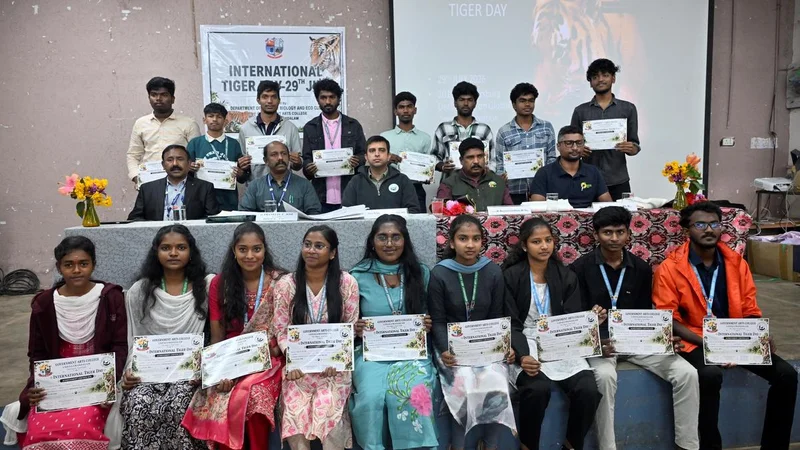
While the use of modern technology such as artificial intelligence (AI) and thermal imagery was very important in wildlife conservation, fieldwork remains key in protecting species such as the tiger, said Divisional Forest Officer (DFO-The Nilgiris) Kashyap Shashank Ravi in Udhagamandalam on Wednesday (July 29).
The DFO was speaking to students of the Department of Wildlife Biology from the Government Arts College in Udhagamandalam on the occasion of International Tiger Day. “There is no shortcut to fieldwork. As forestry students and as wildlife biology students you have to have very strong legs, very strong eyes and very strong nose and ears,” he said, urging students to adopt traditional knowledge for use in fieldwork.
“That knowledge is available with some of our tribal people, indigenous people. Let us try to be in contact with them as they know wildlife biology better than us. They have been living in the forest with the wildlife for centuries. So, let us work with them and understand conservation from their point of view also,” he added.
B. Ramakrishnan, head of the department of wildlife biology at the college, said that the college was the only government college in the country that offered a bachelor’s degree in wildlife biology as a course.
Mr. Ramakrishnan spoke about how the failure of the southwest monsoon was affecting even the upper Nilgiris, saying that reservoirs were drying even in the upper rivers. “So climate change and global warming are already having a major impact on the ecology,” he said, adding that protecting forests and wildlife was the only remedy for mitigating the effects of climate change on human populations, and ensuring availability of clean air, food and water.
Published - July 29, 2026 07:03 pm IST