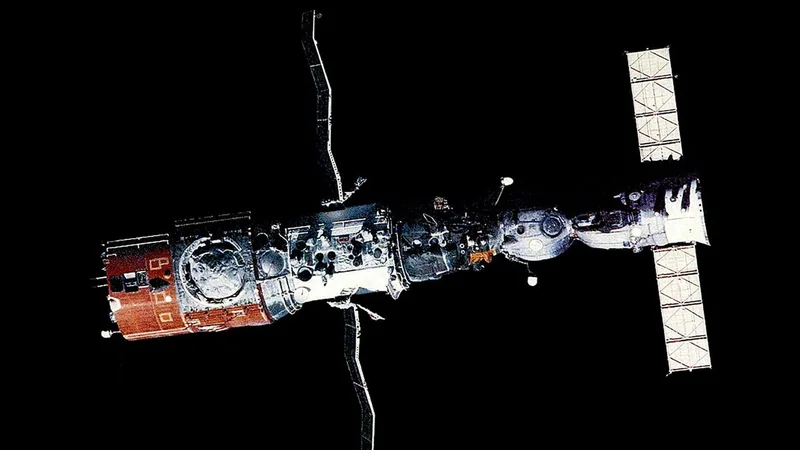
On July 29, 1982, the Salyut 6 space station fell out of space and safely burned up in Earth's atmosphere along the way.
Salyut 6 was the eighth space station the Soviet Union had built for its Salyut program. It spent almost five years in orbit and supported five different crewed cosmonaut missions. While aboard Salyut 6, those cosmonauts made astronomical observations and studied the effects of spaceflight on the human body.
Though the aging space station was still considered fully functional in 1982, a mold problem in the crew quarters led the Soviets to abandon the orbiting lab. They intentionally sent it plunging toward Earth, where it would burn up in the atmosphere before hitting the ground.
Why it mattered
Launched in 1977, Salyut 6 marked an evolution of space station design for the then-Soviet Union. It was the USSR's first to have two docking ports, which allowed longer missions by Salyut cosmonauts since an uncrewed Progress cargo ship could periodically resupply a crew.
That second docking port could also be used by a visiting crew, flying on a short trip to Salyut 6 on a new Soyuz and returning home on the host crew's original capsule. (The U.S. Skylab station also had two docking ports.)
Salyut 6 also had an airlock for spacewalks and has been hailed as the first "second generation" space station. The longest mission to Salyut 6 lasted 185 days, a record at the time in 1981.
The advancements demonstrated on Salyut 6 can be seen in routine use on the International Space Station today. The ISS has multiple docking ports for visiting crews, crew handovers and automated cargo ships. It has multiple airlocks for spacewalks (depending on if they are U.S. or Russian-led) and regularly hosted missions of at least 6 months in duration. The longest mission to the ISS by an American was 371 days, a record set in 2023 by NASA astronaut Frank Rubio.
Want more space history? Check out our__ ____ full On This Day In Space video archive on YouTube__.
Hanneke Weitering is a multimedia journalist in the Pacific Northwest reporting on the future of aviation at FutureFlight.aero and Aviation International News and was previously the Editor for Spaceflight and Astronomy news here at Space.com. As an editor with over 10 years of experience in science journalism she has previously written for Scholastic Classroom Magazines, MedPage Today and The Joint Institute for Computational Sciences at Oak Ridge National Laboratory. After studying physics at the University of Tennessee in her hometown of Knoxville, she earned her graduate degree in Science, Health and Environmental Reporting (SHERP) from New York University. Hanneke joined the Space.com team in 2016 as a staff writer and producer, covering topics including spaceflight and astronomy. She currently lives in Seattle, home of the Space Needle, with her cat and two snakes. In her spare time, Hanneke enjoys exploring the Rocky Mountains, basking in nature and looking for dark skies to gaze at the cosmos.