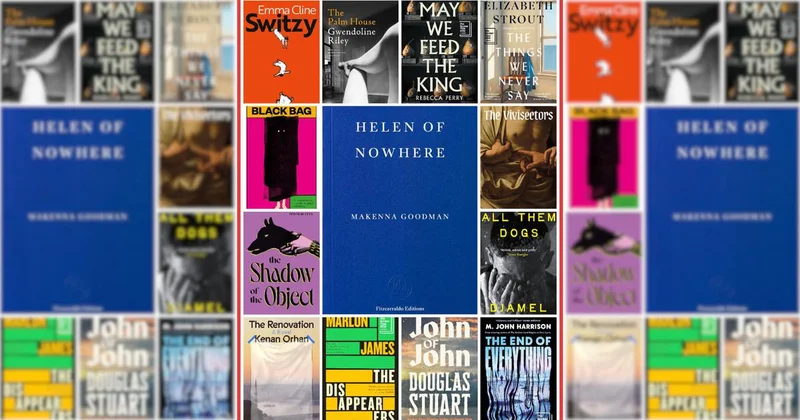
The Booker Prize announced its 2025 longlist of thirteen titles on Tuesday. The longlisted authors represent seven countries and three continents. Past winners Marlon James and Douglas Stuart and previously shortlisted author Elizabeth Strout are on this year’s longlist, alongside ten authors who are longlisted for the first time – including three debut novelists.
Should either James or Stuart win this year, they’ll join an elite list of four authors who have won the Booker Prize twice: JM Coetzee (1983 and 1999), Peter Carey (1988 and 2001), Hilary Mantel (2009 and 2012) and Margaret Atwood (2000 and 2019).
The shortlist will be announced on September 22, and the winner, on November 9. The winner will receive £50,000, while the shortlisted authors will each receive £2,500.
This year’s jury is chaired by writer Mary Beard, and she’s joined by writer and educator Raymond Antrobus; musician, writer and broadcaster Jarvis Cocker; journalist, editor and critic Rebecca Liu; and Booker Prize-shortlisted novelist Patricia Lockwood.
Announcing the longlist, Beard said, “Great books have never been written to a single formula. We are confident that our longlist of books has something for everyone. There’s the funny and the unsettling (and in some cases the funny and unsettling); there’s dystopian fantasy and domestic drama; there’s the gritty and the magically mysterious; there are some that will please and some that may shock.”
Here’s a quick guide to this year’s longlist (all information has been sourced from the publishers).
The Shadow of the Object, Chloe Aridjis
Flora is visiting home in Mexico when the family dog leaps up and bites her hand. She winds up in hospital where she undergoes several surgeries under anaesthesia and meets Wilhelmina, an elderly German woman with pneumonia, who collects pre-cinema toys and instruments. The two of them embark on a series of dream-like conversations in the hospital corridors. Wilhelmina puts on a magic lantern show for Flora, leaving her spellbound.
When things take an unexpected turn, Flora finds herself entrusted with an important mission. She returns to London, where she resumes her job polishing silver at a jewellery shop, and strikes up a strange friendship with Wilhelmina’s son, Max. As Flora dips in and out of her imagination, she is increasingly aware it’s not only the magic lantern that projects, and her perception of reality is subtly altered.
Switzy, Emma Cline
A private plane cuts through the winter night, somewhere over Greenland. David, a retired executive, sits back in his leather seat, playing solitaire on his phone. Click. Click. Drag. Click. In his pocket is a notebook filled with urgent reminders – but he can no longer read his own handwriting.
He’s travelling with his assistant. There will be a stopover in London, dinner with his adult daughter, a meeting in France with an old friend. His final destination: a clinic in Zurich.
As David glides through hotel rooms, airports and foreign cities, his grasp on the present slips away and the past rushes in.
With David’s arrival in Zurich looming, an exquisitely rendered portrait of an unravelling mind emerges. Hypnotic and moving, Switzy probes the depths of human consciousness, revealing what a man is left with when the accomplishments and compromises that have defined him, and the illusions he’s relied on, vanish.
All Them Dogs, Djamel White
After five years keeping quiet across the way, Tony is keen to reinstate himself, and when the opportunity arises to work side by side with Darren “Flute” Walsh, a top enforcer of notorious crime boss Aengus Lavelle, it feels like a no-brainer.
Biting off more than he can chew has never bothered Tony Ward, but Flute Walsh is not the meek, quiet boy Tony remembers from school. Brooding, stoic, and unpredictably dangerous, Tony finds himself drawn to his new associate in more ways than one.
With retribution from his past actions always close in the rear view, the protection offered by Flute’s standing in the gang is crucial. But how safe is Tony really, when a mutual attraction starts to complicate matters?
John of John, Douglas White
Out of money and with little to show for his art school education, John-Calum Macleod takes the ferry home to the island of Harris to find that not much has changed except for him. In the windswept croft where he grew up, Cal resumes his old life, caught between the two poles of his childhood: his father John, a sheep farmer, weaver, and pillar of their local Presbyterian church, and his Glaswegian grandmother Ella, who has kept a faltering peace with her son-in-law for decades.
While Cal wonders if any lonely men might be found on the barren hillsides of home, John is dismayed by his son’s long hair and how he seems unwilling to be Saved. As the seasons pass, everything is poised to change as the threads holding together the fragile community become increasingly entangled.
Helen of Nowhere, Makenna Goodman
In the middle of the countryside, a realtor is showing a disgraced professor around an idyllic house. She speaks not only about the home’s many wonderful qualities but about its previous owner, the mystifying Helen, whose presence still seems to suffuse every fixture. Through hearing stories of Helen’s chosen way of living, the man begins to see that his story is not actually over – rather, he is being offered a chance to buy his way into the simple life, close to the land, that’s always been out of reach to him. But as evening fades into black, he will learn that the asking price may be much higher, and stranger, than anticipated. Philosophically and formally adventurous, at once intimate and cosmic in scope, Helen of Nowhere asks: What must we give up in exchange for true happiness?
The Vivisectors, Missouri Williams
In a famed but crumbling university city overrun by vegetation, where power is held in a fragile balance between the academics and a contingent of rogue gardeners, Agathe spends her days listlessly propping up the career of her fraudulent professor boss. One day, a campus scandal erupts: Adam, a contrarian and the pet student of her boss, comes into heated conflict with a rising young professor, with both men claiming discrimination.
As the crisis consumes the university, Agathe’s boss instructs her to gather information by befriending Adam. Agathe soon finds herself both caught up in the events tearing the city apart and increasingly drawn towards the alluring student at the heart of it all. But can anyone be taken at their word in a struggle over the truth?
The Disappearances, Marlon James
The Disappearers is Marlon James’s triumphant return to the Jamaica of A Brief History of Seven Killings – a place of heat and chaos, and of danger for anyone outside the heteronormal.
So when eight gay men meet for the first time, in Kingston in 1988, answering the casting call for an openly queer play, they are already taking a big risk. But that is nothing compared to what rains down on them when a mob descends on one of their rehearsals.
By the end of this night, one man is dead, all are injured, and two subsequently disappear. As the survivors heal, each man finds he must confront the bigotry and homophobia that the attack laid bare. Some try to forget; some embrace their rage; and some simply vanish – but all are forever scarred.
As one of the victims puts it, “there’s a difference between when something ends and when something stops”. And this story won’t stop until both the disappearers and the perpetrators have been tracked, along trails both hot and cold, and an ending reached.
May We Feed the King, Rebecca Perry
She is a curator who spends her time dressing the rooms of historic buildings to bring them to life. But in the lush private quarters of a medieval palace, she finds herself so transfixed by the reign of an almost-forgotten King that the edges of her life begin to blur.
He is a reluctant ruler with no hunger for power, rushed to the throne after the untimely deaths of his older brothers. But it isn’t long before whispers begin to fly around the court. And with the growing belief that the King is not fit for the throne comes the idea that another might rule in his stead.
May We Feed the King dances between the lives of a historical subject who risks the future of his kingdom and a woman who turns to the past to hide from her present. Laced with desire and longing, it is a playful, stirring meditation on history and storytelling: on what makes a King “Great”, and a life meaningful.
The Palm House, Gwendolyn Riley
Laura and Putnam have been friends for a long time. Theirs is a happy meeting of minds, with long evenings spent huddled in an ancient pub by the Thames, where they share office gossip, reflect on their teenage passions, and lament the state of the world.
Recently, though, Putnam has been harder to reach: he has lost his father, and the magazine to which he has dedicated his life has been hijacked by an insufferable new editor, Simon “call me Shove” Halfpenny.
Laura has her own problems: with a prickly mother and a tricky past, and in a beautiful and indifferent city, her day-to-day life is precarious. But as Putnam starts to sink into despondency, she must try to bring him back.
Black Bag, Luke Kennard
A penniless and out-of-work actor picks up a job working for Dr Blend, a university professor who is conducting a psychological experiment. How will Dr Blend's students react to someone zipped into an oversized bag, sitting at the back of the lecture hall over a series of autumn term lectures? The role, eagerly accepted, soon has unexpected consequences. A professor of post-humanism develops research questions of her own, in particular, can you love someone secreted away inside a black bag? Meanwhile, the actor’s childhood friend and flatmate forms a vision for monetising this new situation …
The Things We Never Say, Elizabeth Strout
Artie Dam is a man with a secret. He spends his days teaching history to high schoolers, expanding their young minds, correcting their casual cruelties, and lending a kind word to those who need it most. He goes to holiday parties with his wife of three decades, makes small talk with neighbours, and, on weekends, takes his sailboat out on the beautiful Massachusetts Bay. He is, by all appearances, present and alive. But inside, Artie is plagued by feelings of isolation. He looks out at a world gone mad – at himself and the people around him – and turns a question over and over in his mind: how is it that we know so little about one another, even those closest to us?
And then, one day, Artie learns that life has been keeping a secret from him, one that threatens to upend his entire world. Once he learns it, he is forced to chart a new course, to reconsider the relationships he holds most dear – and to make peace with the mysteries at the heart of our existence.
The Renovation, Kenan Orhan
In Salerno, Italy, Dilara spends her days caring for her ageing father and her hypochondriac husband. Since leaving her native Istanbul, she’s been unable to find a job – adrift, she becomes increasingly fixated on domestic improvement, specifically on the renovation of a second bathroom. When the work is completed, she enters and finds herself not in a bathroom but in a prison cell, and a Turkish one at that.
As she tries and fails to conceal the discovery from her husband, she confronts the prison’s other inhabitants – the buffoonish guards who refuse to believe her conundrum; the other women who begin filling the cells beyond hers – and the strange things that drift through it: the smell of the Bosporus, her mother’s voice, calls to prayer …
The Renovation is a tragic comedy of displacement, a story that remodels its own form to the dazzling inevitable end.
The End of Everything, M John Harrison
Phillip Tennent makes his living at the tideline, collecting artefacts that wash up from the Channel. It's been years since the crisis changed everything, but its exact nature remains obscure. Government barely functions, the seas are full of new creatures, Europe has been mislaid. It feels like the end.
Now Phillip has fished out of the water an object he can’t keep. A creature that keeps changing. An artefact he must take inland, before it destroys everything he thinks he knows.
We welcome your comments at letters@scroll.in.