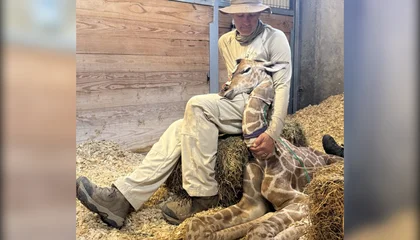
A baby giraffe is fighting for her life at a zoo in Kansas.
The female reticulated giraffe calf, named Milani, was recently born via cesarean section—a procedure no known giraffe calf has ever survived, according to a statement from the Tanganyika Wildlife Park in Goddard, a small town about 15 miles west of Wichita. Veterinarians and keepers are now providing the calf around-the-clock care to give her the best chances of success.
The saga began in June, when staff noticed that a pregnant adult female named Virtue—Milani’s mother—slowly stopped eating. When they took blood samples, they saw that her lactate levels were high, an early indication that her body was “failing at the cellular level,” per the statement. Within 72 hours, her lactate levels had increased sharply, and testing showed signs of a blood clotting disorder.
“Her organs were shutting down, and the condition was irreversible,” according to the statement. “The only question left was whether the unborn calf could be saved.”
Tanganyika Wildlife Park experts got in touch with six veterinarians and specialists from nine institutions, including the Sedgwick County Zoo, Kansas State University, the Columbus Zoo and the International Center for Giraffe Conservation at the Cheyenne Mountain Zoo.
After consultation, the team decided the best path forward was a terminal C-section. On July 11, they delivered the calf surgically and then humanely euthanized Virtue while she was under full sedation. A necropsy later revealed that Virtue had a uterine cyst and was suffering from advanced heart and kidney disease, according to the park.
Losing Virtue was incredibly difficult for Tanganyika staffers, as they’d been caring for her for 16 years.
“Some people are crying as they work and keep going, and some people probably haven’t dealt with it yet,” LynnLee Schmidt, the wildlife park’s chief operating officer, tells KAKE News’ Sydney Ferguson, adding that, despite their grief, team members “shifted [their] focus to the baby immediately.”
Veterinarians suspect the calf was born between three and seven weeks early, with underdeveloped lungs. Typically, giraffe calves are born while their mothers are standing. Passing through the birth canal and falling nearly six feet to the ground usually helps the calf transition to life outside the womb, severing the umbilical cord and prompting them to take their first breath.
But since Milani was born surgically, veterinarians had to recreate as much of that experience as possible. They dried her off, suctioned her nose and mouth, stimulated her breathing and gave her oxygen.
Veterinarians also tried to replace the infection-fighting antibodies she would normally have received from colostrum, her mother’s nutrient-dense first milk. They administered blood plasma from a giraffe and colostrum from cows, as well as antibiotics and steroids.
The baby’s name means “new birth” or “new era,” the wildlife park shared on social media when it was announced on July 25. It’s also a nod to Mili, a giraffe at Dickerson Park Zoo in Missouri who donated the plasma.
The calf is now being monitored 24 hours a day, with at least two people keeping an eye on her at all times. Veterinarians are also regularly performing bloodwork to check her hydration, temperature and glucose levels.
Milani still has a long road ahead. But she’s slowly making progress. Per KWCH 12 News’ Matt Heilman, she’s now standing up and lying down on her own. The wildlife park also shared a video of her with the “zoomies,” or frolicking around her enclosure with gusto.
“Nobody expected her to live through this, and so it’s been amazing to see,” Schmidt tells KAKE News. “She’s just checking off the milestones like they’re nothing.”
Reticulated giraffes are endangered. According to the nonprofit Giraffe Conservation Foundation, the subspecies has lost more than 40 percent of its population over the last 35 years. That’s largely because of habitat loss, poaching, human-wildlife conflict and drought. An estimated 11,048 adults remain in the wild, according to the International Union for Conservation of Nature.
Females have long gestation periods—15 months, on average—and they give birth to just one calf at a time, so every new giraffe baby that survives is an important contribution to the entire species.
“Every calf raised in managed care carries genetics forward into a population under real pressure, and this one carries Virtue’s,” according to the statement.