Is there any organisation in the country as addicted to its own destruction as the BBC? It feels like every day there is another news story about the Beeb – one of the world’s most venerable legacy media corporations – demonstrating a total lack of institutional confidence. Channels shuttered, programmes ditched, staff culled: the BBC is being drawn into a permanent cycle of self-flagellation.
New Director-General Matt Brittin has been tasked with creating a modern, streamlined BBC, one capable of withstanding political scrutiny as it heads into next year’s charter renewal. As part of this restructure, the organisation is looking to shed £100m of budget assigned to “content”. In recent weeks, we’ve seen Radio 4’s flagship Today programme slimmed down, and the demise, after 57 years, of The World Tonight. And while the schedule is being brutally cleared, the BBC is also attempting to bridge the perceived shortfall between the estimated 94 per cent of adults who use the BBC, and the 80 per cent who actually pay for the license fee. Every World Cup game was incongruously watermarked with a QR code for license renewal, while an updated version of John Cleese’s famous “what has the BBC ever done for me?” advert, featuring Romesh Ranganathan slow-rapping his way toward a giant lever to turn the BBC “off” (operated, naturally, by Louis Theroux), felt misjudged. Today, the axe has thus fallen on three TV institutions: the Bradley Walsh-hosted reboot of Blankety Blank, Celebrity Mastermind, and Live at the Apollo.
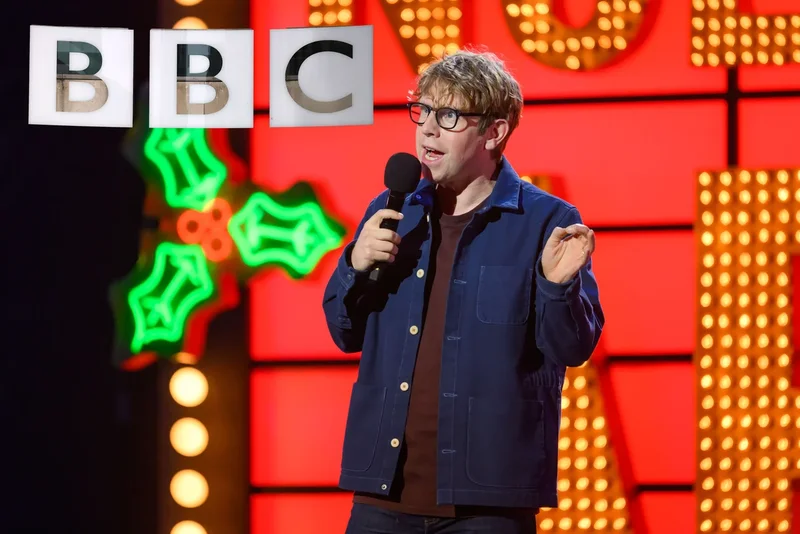
There will not be much consternation about the first two. Since it relaunched in 2021, Blankety Blank has run for 44 episodes, bringing the total archive for the series to 258 shows. That’s enough to provide daytime telly reruns for longer than its viewers’ memories. Similarly, Celebrity Mastermind, which still has a pre-filmed season to air, has broadcast 209 episodes since its birth in 2002. There will be plenty of people within the BBC who think that constitutes a good run for such a simple format. But Live at the Apollo is a different beast – and its cancellation is a bleak portent of the BBC’s future.
When it began life in 2004, hosted by Jack Dee, the show was designed as a showcase for some of the world’s funniest live comics, like Joan Rivers, Jo Brand and Ross Noble. But by the fourth series, in 2008, the show had evolved into something else. It paired big names from British comedy with rising stars. for the next 18 years, Live at the Apollo would be seen as a rite of passage for comics looking to break through from Edinburgh Fringe success to the lucrative mainstream. Sarah Millican, Jack Whitehall, Josh Widdecombe, Nish Kumar, Katherine Ryan, Aisling Bea: many of the current crop of household names got some of their first primetime experience on the show.
The UK used to be the world’s leading shipbuilder, then we gave up on that. We used to sell cars – Rovers and Triumphs and Morrises – all over the world, then they went bust. We used to be a top global financial hub and then, well, you know what happened. But one export we’ve held onto is comedy. And the BBC has been the great incubator of British comedy, from Fawlty Towers to The Office. The ethos of the BBC’s comedy programming was historically driven by a desire to set the tone of British humour. Talented young comics were given opportunities in sketches and sitcoms, with taste-making producers commissioning on instinct, rather than by algorithm. Spike Milligan, Monty Python, Fry & Laurie and French & Saunders, Ben Elton and Steve Coogan and Armando Ianucci and Jesse Armstrong, Ricky Gervais and Phoebe Waller-Bridge and Michaela Coel: these were all big swings taken by our national broadcaster.
Increasingly, however, it feels like the opportunities for young and new comedians to make that step up to television work are being stifled. The risk appetite of the organisation has never been lower. This has been compounded by the rise of comedy podcasting, which represents a decentralised platform for comedians to publish their work. Some of these shows – Off Menu, Parenting Hell, Shged Married Annoyed – are far more lucrative for their hosts than anything the BBC can offer them. There is a sense that where, previously, an appearance on Live at the Apollo represented a real professional breakthrough, it would now be massively superseded by a guest slot on one of these private sector podcasts.
But there is a real danger in the BBC recusing itself from comedy innovation. These podcast formats are enjoyable but derivative. Whether it is the manic satire of The Day Today, the charming grotesquery of The League of Gentlemen, or the warm embrace of This Country, the BBC has always invested in the next big thing. Its current big hit – Ann Droid – was written by, and stars, Diane Morgan, a deadpan comedian who made her breakthrough on Live at the Electric, a BBC Three spin-off of Live at the Apollo. That show was cancelled in 2014 and two years later BBC Three was closed as a linear channel (it returned in 2001 but with vanishingly little original programming). Viewers are lucky that Diane Morgan made it out of Live at the Electric, onto Charlie Brooker’s Weekly Wipe, and then, eventually, to Ann Droid. But we may not be so lucky with the next wave of comedians.
Comedy is one of Britain’s last great soft power resources. Losing that in pursuit of cost efficiencies would be a crying shame. The BBC must make a positive argument for its existence, rather than shrinking like a dying houseplant. Sure, clear out long-running formats that don’t provide value for viewers, but don’t hobble our chances of being the world’s funniest nation for generations to come.