Brazil’s Foreign Direct Investment Surges 33% in First Half of 2026
Capital Flows
Foreign direct investment into Brazil jumped 33% in the first half of 2026 to roughly US$47 billion, signalling robust international confidence even as global capital remains selective.
The Numbers Behind the Foreign Direct Investment Surge
Brazil recorded US$46.9 billion in foreign direct investment inflows between January and June 2026, according to the Banco Central do Brasil’s external sector statistics. That compares with US$35.3 billion in the first half of 2025, a 33% year-on-year increase.
The twelve-month accumulated figure reached US$89.3 billion through June, equivalent to 3.6% of gross domestic product. The central bank’s June 2026 Monetary Policy Report had already flagged improving investment trends and revised GDP growth upward.
Monthly inflows remained consistently strong throughout the semester. April alone brought US$8.9 billion, 65% higher than the same month in 2025, while June added another US$9.1 billion.
A Shrinking Current-Account Gap
The current-account deficit for June 2026 came in at US$2.3 billion, sharply lower than the US$5.2 billion deficit posted in June 2025. The central bank’s official release confirmed the figure, which market reports rounded to US$2.33 billion.
A robust trade surplus drove the improvement. Brazil recorded a goods trade surplus of roughly US$8.8 billion in June alone, outweighing persistent deficits in services and primary income outflows.
Over twelve months, the current-account deficit stood at 2.46% of GDP. That is comfortably below the 3.6% of GDP represented by FDI inflows, meaning long-term investment more than financed the external gap without reliance on volatile portfolio flows.
Live Market IntelligenceBrazil — Live Market Board
Rio Times · Live Market Intelligence
Brazil — Live Market Board
-0.89%
174,992.43
-0.89%
67,304.62
+0.18%
10,879.65
-0.77%
3,247,270
-0.28%
2,299.02
-0.10%
57,237.60
—
| Instrument | Last | Change | YoY | Prev. | High | Low | Volume |
|---|---|---|---|---|---|---|---|
| IBOV | 174,992.43 | -0.89% | +31.86% | 176,564.75 | 176,564 | 174,854 | — |
| USD/BRL | 5.13 | +0.24% | -8.11% | 5.12 | 5.14 | 5.11 | — |
| SELIC | 14.25% | — | — | — | — | — | |
| PETR4 | 42.32 | +2.69% | +30.49% | 41.21 | 42.40 | 41.88 | 16,014,800 |
| VALE3 | 74.81 | -1.16% | +36.59% | 75.69 | 76.20 | 74.81 | 4,355,100 |
| ITUB4 | 42.08 | -1.82% | +25.01% | 42.86 | 42.73 | 42.00 | 6,734,600 |
| BBDC4 | 18.40 | -1.97% | +19.47% | 18.77 | 18.66 | 18.39 | 8,635,200 |
| BBAS3 | 20.78 | -0.24% | +4.11% | 20.83 | 20.89 | 20.46 | 5,128,200 |
| B3SA3 | 15.52 | -3.00% | +22.19% | 16.00 | 15.97 | 15.49 | 16,915,100 |
| ABEV3 | 16.15 | +0.31% | +22.59% | 16.10 | 16.23 | 16.05 | 10,387,500 |
| WEGE3 | 46.04 | -1.41% | +25.86% | 46.70 | 46.68 | 46.01 | 1,548,600 |
| PRIO3 | 58.27 | +2.64% | +38.86% | 56.77 | 59.08 | 57.90 | 3,332,900 |
| SUZB3 | 42.79 | -0.72% | -17.47% | 43.10 | 43.31 | 42.70 | 826,800 |
| RENT3 | 37.33 | -2.71% | +5.24% | 38.37 | 38.20 | 37.11 | 2,339,500 |
| AZZA3 | 16.75 | -2.33% | -53.24% | 17.15 | 17.23 | 16.61 | 822,400 |
| CSNA3 | 5.24 | -7.09% | -34.58% | 5.64 | 5.62 | 5.22 | 9,137,500 |
| GGBR4 | 24.76 | -1.51% | +48.35% | 25.14 | 25.29 | 24.76 | 1,528,200 |
| ENEV3 | 25.97 | +0.46% | +92.80% | 25.85 | 26.37 | 25.61 | 4,302,900 |
4 of 15names higher.
Energyled, while
Mininglagged.
What Is Drawing Foreign Direct Investment to Brazil
Higher commodity prices have strengthened Brazil’s export earnings, making resource-linked projects more attractive to multinational capital. The central bank’s June 2026 Monetary Policy Report projected a full-year current-account deficit of about US$56 billion, or 2.1% of GDP, helped by sustained trade surpluses.
Beyond commodities, investors are responding to a domestic demand recovery and infrastructure concessions that continue to draw long-term players. Sectors including renewable energy, agribusiness, and technology services have featured prominently in recent inbound deals.
The FDI figures suggest that international boards are looking through political noise and focusing on Brazil’s scale, resource base, and real-economy returns. The country’s ability to attract direct investment rather than hot money marks a structural advantage in a world of tighter global liquidity.
The Latin America Read-Through
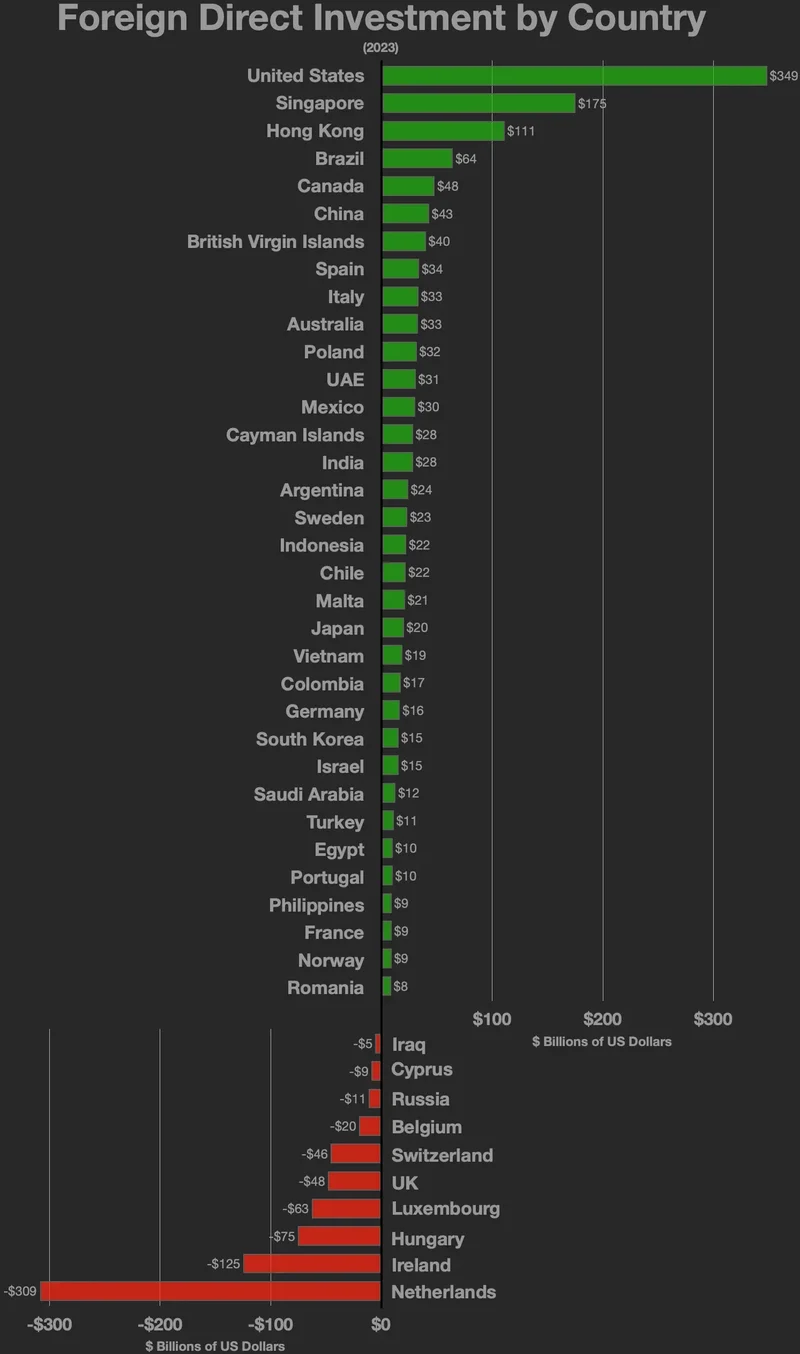
Brazil’s FDI performance stands out in a region where capital flows remain uneven. Mexico has benefited from nearshoring trends, while Argentina is still stabilising, and Chile and Colombia face their own political and fiscal debates.
For multinationals allocating Latin American exposure, Brazil’s combination of market size and improving external accounts strengthens its case as a core holding. The FDI coverage ratio, with inflows exceeding the current-account deficit, reduces vulnerability to sudden capital-flow reversals.
Regional funds and family offices are also taking note. The data supports a narrative of Brazil as a destination for patient capital, even as shorter-term traders react to domestic political headlines.
What Investors and Expats Should Watch Next
The central bank’s next external sector release will show whether the second half maintains the first-half momentum. Monthly FDI figures above US$8 billion would keep the annual total on track to exceed US$90 billion.
Exchange-rate movements and the interest-rate trajectory matter for the currency translation of foreign earnings. A stronger real can erode the local-currency value of dollar-denominated investments, while a weaker real boosts export competitiveness.
For expatriates and foreign professionals, sustained FDI signals job creation in sectors like engineering, project management, and financial services. The data reinforces Brazil’s position as a long-term play rather than a short-term trade.
Frequently Asked Questions
How much foreign direct investment did Brazil receive in the first half of 2026?
Brazil received US$46.9 billion in foreign direct investment from January to June 2026, according to Banco Central do Brasil data. That represents a 33% increase over the US$35.3 billion recorded in the same period of 2025.
What drove the improvement in Brazil’s current-account deficit in June 2026?
A strong goods trade surplus of roughly US$8.8 billion in June 2026 helped narrow the current-account deficit to US$2.3 billion, down from US$5.2 billion in June 2025. Higher commodity prices and robust export performance were the main factors behind the improvement.
Does Brazil’s FDI cover its current-account deficit?
Yes. Twelve-month FDI of US$89.3 billion, or 3.6% of GDP, comfortably exceeds the twelve-month current-account deficit of 2.46% of GDP. This means long-term direct investment more than finances Brazil’s external funding needs without depending on short-term portfolio flows.
LatAm Markets: Live Signals → — real-time movers, turnover leaders and FX across Latin America.