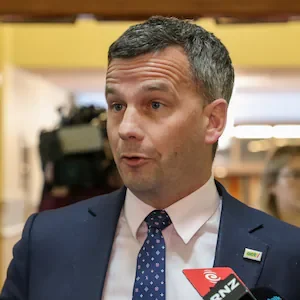
Act Leader David Seymour has proposed increasing the proportion of the health budget spent on Pharmac by 1% a year, to bring New Zealand in line with Australia and closer to the OECD average. Photo / Mark Mitchell
Pharmac funding call makes sense
It’s doubtful there will be a time when I can politically align with the Act Party, as ideologically we’re worlds apart.
However, I fully support its policy to increase the number of Pharmac-approved drugs available to the New Zealand public. Budget 2026 allocated asubstantial amount of badly needed spending to health, but proportionally Pharmac received a comparatively small amount.
David Seymour is spot on in stating that no New Zealander should have to mortgage their home or go offshore to receive lifesaving drugs. It’s shortsighted to deny medicines that could enhance the quality of life, thereby making a person more productive and less of a drain on an already beleaguered health system.
I hope the other political parties will set aside politicking and support Act’s proposal wholeheartedly.
While Act’s new policy regarding increasing the percentage of the total Health budget is likely to be a vote-getter, one has to wonder about two repercussions. First, if more of the total budget is going to Pharmac, which other areas are going to see a reduction in their percentage of the health budget? Second, if New Zealand spends more on drugs, will that reduce the demand in other areas?
In its announcement, at least as reported, Act has not mentioned what the impact would be other than bringing New Zealand in line with Australia and improving our standing in the OECD. If being able to afford more and different drugs means less need for treatment by other means or possibly no other demands on the health system, then the policy makes sense. If, however, there is no corresponding decrease elsewhere in the health system, then Health New Zealand will be no better off. It could even be worse off.
I, for one, would like to see an independent review of the overall benefits of increasing Pharmac’s budget as a percentage of the overall Health budget with an objective discussion of the trade-offs.
Dunstan Sheldon, Hamilton.
Defending free speech
I admire councillor Julie Fairey as an articulate, highly informed and very helpful elected member. However, I am staggered that she has raised concerns about a public meeting being held in a council venue. Surely there is a huge irony in even suggesting that a meeting to discuss the limits of free speech with Rob Campbell is somehow not okay?
I feel lost. My leftie forbears fought for the right to free speech when unionism and communism were the bogeys of the day. Now many on the left want to cancel free debate. We reach for the truth by listening to and debating, even those beliefs we hold most dear.
Isn’t it interesting that with all the debate and scaremongering about the wealthy paying more tax, we also have people such as Paul Henry lamenting our times not being the same as in his youth (ironically, we are the same age).
Well, people forget the top tax rate then was 69.75% and I don’t think the wealthy fled the country. They certainly invested in deer farms, etc.
But if you appreciate living in a great place and want it to be greater, why would you flee? Bear in mind that arguably the most successful and contented countries in the world have high taxes and “share the love”.
Hanish Walsh, Devonport.
Home truths
Excuse the sarcasm but if I was a homeless person, could I knock on the door of any Green Party supporter and say that because they have a roof over their heads but I don’t, and the Green Party believes that the haves should be made to share with the have-nots, would they mind if I moved in straight away?
David Pickford, Whitianga.
Faith and belief
Along with letter writer Andrew Tichbon (July 28), I also deplore the antics of aeroplane evangelists – giving no realistic option to exercise the right to leave the room. However, I disagree with the “unproven dogma” label.
Being a sceptic at heart, given that some aspects of the overall Christian story have a once-upon-a-time flavour, I have spent some 65 years testing what and why I believe. God says His Creation is the starting point, that the evidence proving His existence is “plain to see”. Modern research in several disciplines is, at the very least, pointing to design rather than random evolution, archaeological discoveries confirming Bible “fairy tales”. Thus my “faith” is very much underpinned by tested evidence.
However, the question of God is like the question of climate change – both are an inconvenience – recognition of them requires us to shift out of our comfort zone.
Al Smith, Glen Innes.
Go beyond the headlines with our daily news podcast The Front Page: