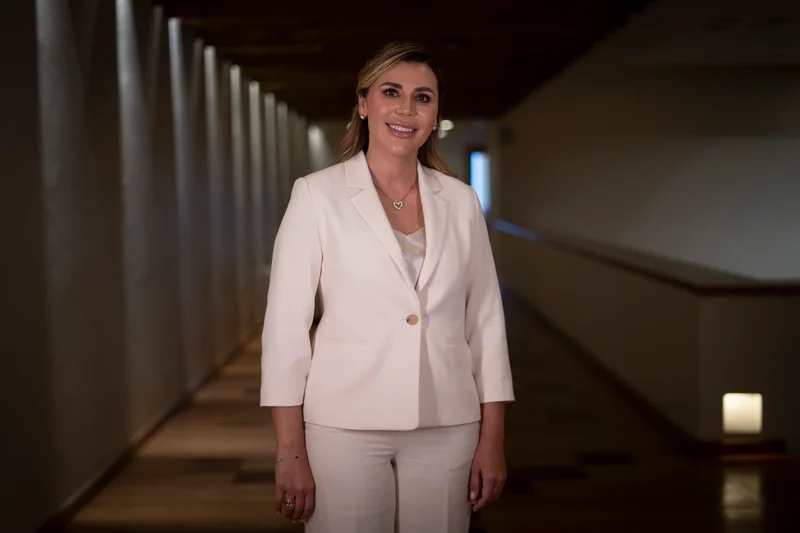
The efforts made by Baja California Governor Marina del Pilar Ávila to recover her U.S. visa have become a problem for the government of Claudia Sheinbaum and Mexico’s ruling party, Morena. Audio recordings were released in which Ávila, 40, is heard speaking with an intermediary in the United States, allegedly from the FBI, offering information to Washington; the leak has dealt a blow to Sheinbaum’s narrative of defending national sovereignty against U.S. interference.
The governor, however, claims that her conversations were merely efforts to recover the visa that the U.S. government had canceled without an explanation for her and her husband, Carlos Torres, in May 2025. Ávila, who denies having cooperated with U.S. authorities beyond the institutional channels as the head of a border state, has not yet regained permission to cross into the United States.
Ávila says that Jaime Bonilla — her predecessor in the governorship and a former party colleague with whom she has a deep enmity — set a trap to record her in December 2025 by making her believe he would help her recover the travel document. The governor says Bonilla sent her an intermediary who claimed to work with “the FBI or HSI,” though she did not specify which agency (the first one reports to the Justice Department; the second one to the Department of Homeland Security). She called it “a psychological ambush” meant to make her believe the United States had her in its sights and might even extradite her. “I am the governor, but I am also a mother. When they started talking about investigations and a possible extradition, I thought about my children, because nothing like that had ever been suggested to me before,” the governor says in an interview with EL PAÍS in Mexico City.
Question. What should the relationship between a border state and U.S. security agencies be like?
Answer. There must be a lot of communication and coordination, without subordination. The president, Claudia Sheinbaum, has said this. I govern one of the world’s most important borders. That implies shared challenges with the United States, not only on security but on migration, the economy, social issues and the environment. There are many topics we address; we have binational security groups to work together.
Q. Regarding the leaked audios, which authorities did you speak with about your visa cancellation?
A. A person came to me who had been recommended by former governor Jaime Bonilla at a time when there was communication between us. He told me: ‘This is someone who can help you, who can give you information about your visa issue.’ I received him thinking we would discuss the matter, but he began raising scenarios I had never heard before: charges, sanctions; he even mentioned extradition and letters. I felt it was a psychological ambush. It was an ambush. I asked, ‘What are you talking about? I hadn’t heard any of this.’ The first thing that came to mind was my children. I have a 13-year-old daughter and a little one who is four. I heard arguments from someone skilled at intimidation, at frightening people, at generating fear and even prompting certain responses. I told him: ‘Take all of that to my lawyers; I thought we were meeting about the visa.’
Q. When did this happen?
A. In mid-December 2025. I told them to handle everything through formal channels, with an advisor. Of course I sought legal advice to ask what was happening. In one of the calls he made to me, they mentioned Panama. I have never been to Panama, not even on vacation. The scenarios mentioned in the audios were never carried out. They never contacted the people who advised me. Today I know it was a trap. It’s clear: they even recorded me, they steered the conversation, they tried to corner me.
Q. How did that individual present himself?
A. As an advisor, an intermediary who was coming to help because of his closeness to the former governor. Bonilla is a U.S. citizen, he lives in San Diego, participates in politics and is affiliated with a party in the United States [the Republican Party], and it seemed to me that he was genuinely someone who would explain the visa situation to me.
Q. What is the status of your visa? Have they explained why it was canceled?
A. The status is ‘administrative process,’ and no, I do not know the reason.
Q. In the audios you say you were willing to provide information from the security groups. What did you mean?
A. At those meetings we discuss crime trends, how common-law crime develops, thefts, homicides... We have binational security groups constantly, operating within the legal framework. The information shared is within the law, and it benefits both sides of the border in combating criminality.
Q. In the context of the visa, what did that offer have to do with anything?
A. No, it was not in the context of the visa; it was in the context of that particular meeting, which was recorded to later publish decontextualized audio fragments as a form of pressure.
Q. Who was the advisor Bonilla sent you?
A. I cannot say more because yesterday I filed a complaint against those responsible for this situation. I have the name and phone number, but his identity will be made known in due course.
Q. What are you accusing them of?
A. Of the crimes that the authorities determine. There was a recording; he presented himself as an advisor to an agency; among other things, there was the psychological ambush intended to intimidate me, the violence I felt at the time. I was alone, without a lawyer, with no one who could explain what they were talking to me about in that moment.
Q. Which agency did he claim to represent?
A. He told me he was an external consultant to the agencies, it could be the FBI or HSI.
Q. Did you inform President Claudia Sheinbaum or anyone in your cabinet, such as Secretary Omar García Harfuch, that you were meeting these contacts about your visa?
A. They knew I was pursuing the visa process.
Q. Did they know about the external advisor?
A. No; I looked for advisors because they made all these proposals and speculations. Of course I seek legal counsel.
Q. Can you swear and maintain that you only discussed the visa with U.S. authorities or advisors?
A. Of course; it is a strictly personal matter and also about coordination within the legal framework for cross-border, binational issues — all within the law.
Q. Will we hear another audio of you about negotiations, judicial benefits or accusations against other Mexican politicians?
A. I don’t know if there will be more audios. However, I know the context in which they were made: an ambush in which they tried to elicit responses, where they put forward complex scenarios.
Q. Did you feel fear?
A. I thought about my children. I didn’t fully understand what they were referring to. They even mentioned that I could be extradited.
Q. Can you confirm that no U.S. authority has told you there is an investigation against you?
A. What I can confirm is that we continue working. At this moment I have not received further information. I continue coordinating with U.S. authorities.
Q. What repercussions do you think these leaks will have for Morena ahead of the 2027 elections?
A. Our movement is strong and united. In Baja California there are many results. We have achieved a reduction in virtually all crimes; we are carrying out projects like never before. For me, one of the main achievements is the reduction of poverty.
Q. Faced with attacks from the opposition, would you be willing to step aside to reduce political pressure and even to be investigated?
A. My conscience is clear and I hold my head high. I do not hide; there has not been a single day when I have stopped working for the people. I am on the ground, in neighborhoods, supporting those who need it most. I do not engage in politics for power. I do it to help others.
Q. Why did you ask Jaime Bonilla for help?
A. I did not ask him for help; he offered it. We had a meeting in the summer of 2025 that I accepted to attend because of the movement we come from and with the aim of generating political peace in the state. I accepted his help in good faith. This [the clash with Bonilla] goes back to 2022 with the cancellation of a 40 billion-peso contract with the company Next Energy to build a photovoltaic plant that did not have federal permits. My responsibility as governor was to cancel that contract. That’s where the revenge and persecution started. It is not a personal or political matter; it is a matter of justice and responsibility. I was not going to be complicit in that fraud.
Q. Given your fraught history with Bonilla, why did you accept his help?
A. It was a moment when we were communicating. It was strictly a personal matter: the visa. I listened to the proposals and then this person [Bonilla’s envoy] sought a meeting with me. Since it was something I would never do to someone else, I accepted in good faith. And yes, it was a mistake to receive [the envoy], I acknowledge that; it was a mistake to trust this person. It was a trap.
Q. It a mistake to trust whom?
A. Both of them.
Q. Are you still trying to recover your visa?
A. Of course. For a border resident, it is an important document.
Q. If you got it back, would you go to the United States? Aren’t you afraid?
A. If I ever recover my visa, of course I would go to the United States.