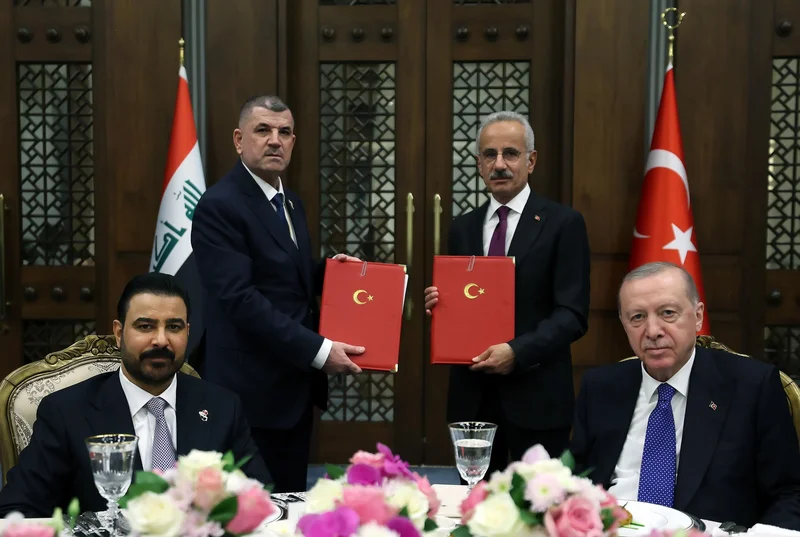
The 1973 framework that governed Iraqi crude through Turkey is over. President Recep Tayyip Erdoğan said so in Ankara on July 28, standing with Iraqi Prime Minister Ali al-Zaidi: the crude oil pipeline agreement had expired the day before. What followed was not a quiet technical patch. It was a political offer of large oil volumes, a wider energy package, and a Turkish equity seat in Kirkuk through state oil company TPAO’s stake in a BP vehicle.
Treat the “one million barrels a day” line as politics until the flows show up. Treat the equity as real.
A treaty ends; a package opens
The Iraq-Turkey Crude Oil Pipeline Agreement, signed in 1973 and implemented in the mid-1970s, was the intergovernmental constitution for the Kirkuk-Ceyhan system. A Turkish presidential decision published in July 2025 set its termination for July 27, 2026, along with related protocols.
That date arrived. Erdoğan’s public message was forward-looking: sign a comprehensive energy cooperation agreement as soon as possible. Mid-July, Turkish Energy Minister Alparslan Bayraktar had said a twelve-month cover text was near final so oil could keep moving to Ceyhan while a broader deal was negotiated. The July 28 frame mattered more for strategy than for plumbing. Ankara refused to treat a fifty-year instrument as automatic inheritance. It wanted a reset written for oil, and for the gas and power conversations that now travel with it.
The signature that cleared compliance
The same day, TPAO agreed terms to take 15 percent of BP Energy Company of Kirkuk Limited, the contractor vehicle for redevelopment of major northern fields. After completion, subject to regulatory approvals, the split is bp 43 percent, ConocoPhillips 42 percent, TPAO 15 percent. ConocoPhillips had already agreed its farm-in earlier in July during the Washington cycle of Zaidi’s travels.
bp’s release is precise where political speeches are not. The Development and Production Contract covers the Baba and Avanah domes of Kirkuk plus Bai Hassan, Jambur and Khabbaz. The initial phase is described as more than three billion barrels of oil equivalent. The fields remain Iraqi state property. North Oil Company and North Gas Company keep their operating roles under the disclosed framework. Contractor remuneration is linked to incremental production, price and costs.
Fifteen percent is not control. It is incorporation. Turkey converts geography (the pipe, the Mediterranean outlet, the neighbor relationship) into a bookable seat beside Anglo-American capital, under Iraqi title. That is industrial policy with a political face. It is also why the equity should be scored more heavily than the summit arithmetic on volumes.
One million barrels, three different stories
Turkish coverage quotes Erdoğan relaying Zaidi’s line: Iraq can supply Turkey a million barrels a day, so there is no need to depend on others. Bayraktar, for his part, ties the Kirkuk stake to TPAO’s longer corporate ambition of building toward a million barrels a day of production capacity. Historic descriptions of the pipeline system’s design capacity sit in a higher band still, often around 1.5 to 1.6 million barrels a day.
Those are three different claims. A political supply offer is not a corporate production target. Neither is a nameplate design figure. None of them is a verified loading rate for late July 2026.
After the 2023 international arbitration shock, northern exports were offline for a long stretch. Restart reporting this year put early flows far below the political headline. Design capacity is not deliverable capacity. Deliverable capacity is not contracted offtake. Offtake is not nominated cargoes. Cargoes are not barrels over the rail at Ceyhan. Until the meters speak, the million-barrel sentence belongs in quotation marks.
The legal memory under the new talks
The old framework did not simply age out. It became the legal battlefield of the Kurdistan Regional Government’s independent marketing fight with Baghdad. An ICC tribunal in 2023 found that Turkey had breached the pipeline agreements by facilitating those exports without the federal consent the treaties required. Public figures for the net award to Iraq for the 2014-18 period cluster around $1.5 billion before interest. Loadings stopped. Years of lost northern revenue followed. A Paris court later rejected Turkey’s bid to annul the award; payment politics remain unfinished business in open reporting.
Any comprehensive energy text will be written under that shadow: who authorizes liftings, how SOMO’s federal marketing claim is enforced, and what happens to money still argued over. Equity in Kirkuk does not erase the award. It sits beside it.
Hormuz is a permission fight. The north is insurance.
I argued this week that the Strait of Hormuz is sliding toward a fee-and-permission regime. That diagnosis raises the strategic price of every credible non-Strait outlet, even when absolute northern volumes remain modest.
Insurance does not have to replace the insured asset barrel for barrel on day one. It has to be credible enough to change bargaining power, shipping behavior and capital allocation. A working Kirkuk-Ceyhan system is one node. Plans and studies for a Basra-Haditha spine that could point southern crude toward Ceyhan, Syria’s Baniyas or Jordan’s Aqaba are another. Large U.S. commercial packages around alternative routes, announced around Zaidi’s Washington stop, fit the same architecture.
In that map, Hormuz is southern permission politics. Ceyhan is the northern sovereign interface that runs through Ankara. Upstream equity is the long-cycle industrial stake in the molecules that make the corridor valuable. Gas and power talks are the package glue that pure transit fees never supplied.
Corridor sovereignty
Boards and ministries keep asking whether the pipe will “stay open.” That is the wrong unit of analysis.
The better questions are who writes the next rules for liftings and fees, who sits upstream when redevelopment barrels are booked, how federal and Kurdish production feed the line without reopening the arbitration wound, and how much option value the northern corridor holds while Hormuz remains a governance problem.
The photograph in Ankara will age in a week. The fight over the next corridor constitution will not. The 1973 framework is finished. What replaces it is a bargain over sovereignty in motion: the pipe, the power deals and the equity seat. Volumes will arrive when contracts, security and field work put them on the water. Until then, believe the share register more than the slogan.