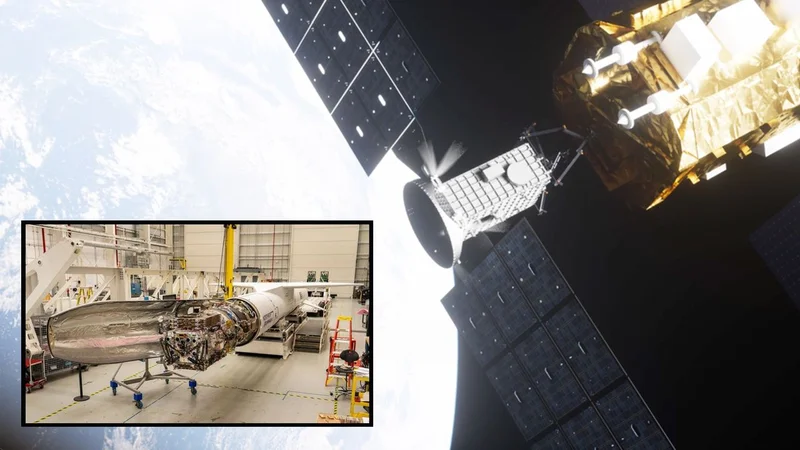
Things aren't going so well for NASA's latest satellite rescue mission.
NASA launched the Swift Boost mission on July 3, sending a specialized spacecraft to low Earth orbit on the final flight of Northrop Grumman's air-launched Pegasus XL rocket. The spacecraft is called LINK and was built by Arizona-based Katalyst Space Technologies. LINK was sent to orbit to try and link up with NASA's Swift observatory, a highly successful scientific satellite designed to search for gamma-ray bursts, some of the most energetic events in the universe.
But it looks like just a few weeks after launch, LINK is experiencing some issues. "Katalyst's LINK servicing spacecraft experienced issues with attitude control, causing the spacecraft to spin and resulting in sporadic communications," NASA wrote in an update on Tuesday (July 28). Despite the malfunction, however, the space agency says the rest of the spacecraft is functioning normally and remains in otherwise good health.
According to preliminary analysis of the issue, two of the LINK spacecraft's three reaction wheels are not operating. In addition, there is "some loss of functionality" in LINK's cold gas thruster system.
The failure with the LINK spacecraft's reaction wheel is slightly ironic, given that the Swift observatory itself once had issues with its own reaction wheels. In 2022, NASA placed the observatory in safe mode when one of its reaction wheels caused minor issues with the spacecraft's movements.
Mission teams will now try to use the spacecraft's electric propulsion system to stop the spinning and regain control. If that can be done, NASA and Katalyst will then have to evaluate if the mission can proceed as planned.
Swift's orbit has been decaying for years, and the observatory is unable to boost its orbit on its own. Thus, LINK was designed to meet up with Swift in low Earth orbit and spend some time studying the observatory to determine how best to grab onto it with three robotic arms. Once it has linked up with Swift, LINK should be able to use its own thrusters to boost the observatory to a higher orbit and extend Swift's life.
The Swift observatory, officially known as the Neil Gehrels Swift Observatory, was launched in 2004 at a cost of $250 million. The Swift Boost mission only cost NASA $30 million.
Over the last 22 years, Swift has been searching the sky for gamma-ray bursts and other high-energy astrophysics phenomena in the cosmos. In 2022, the observatory spotted a gamma-ray burst nicknamed the "BOAT," short for Brightest of All Time. At the time of discovery, it was the most powerful space explosion ever seen.
Brett is curious about emerging aerospace technologies, alternative launch concepts, military space developments and uncrewed aircraft systems. Brett's work has appeared on Scientific American, The War Zone, Popular Science, the History Channel, Science Discovery and more. Brett has degrees from Clemson University and the University of North Carolina at Charlotte. In his free time, Brett enjoys skywatching throughout the dark skies of the Appalachian mountains.