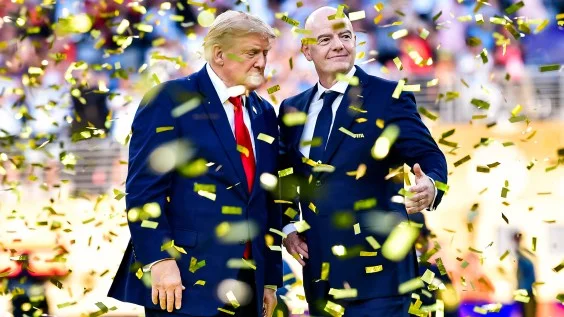
The recently concluded World Cup was the shining example of FIFA president Gianni Infantino's particular brand of evil. It was nakedly greedy, nakedly corrupt, nakedly ugly, and also totally awesome. Infantino's bet was that he could openly screw everyone—fans, teams, referees, ear-havers, even the sport itself—and could still get away with it simply because soccer is too good. As expected, he was proven right. And unsurprisingly, he's already trying to push things even further.
On Tuesday, The Times reported that Infantino's latest plan is to sell the World Cup to private equity investors, all under the guise of "growing the game," which not so coincidentally involves growing his own bank account. Specifically, Infantino's plan would include FIFA setting up a company, tentatively named FIFA Forward Enterprise, that would handle the commercial rights to the World Cup. FIFA would retain majority control of the FFE company, and each of the 211 member associations would get a stake reportedly worth around $20 million each. The rest would be sold off to investors, around 21 percent of the company, who would almost certainly see an immense return even on the planned $10 billion infusion from their investments. The search for investors is, of course, tainted to fuck already with Trumpworld, as FIFA is reportedly marking Jared Kushner's brother Joshua and his private equity company Thrive Capital as primary investors for the FFE project. But hey, remember that $20 million? Eh? Everybody wins! Right?
Well, sort of. The dirty secret of FIFA's current set-up is that it is very easy to bribe quite a few of the 211 organizations. Not in the Sepp Blatter fashion of literally giving them money under the table. That's gauche in Infantino's FIFA. Instead, the money is promised over the table and with all of the good "growing the game" intentions he can fit into his media appearances and statements. For many of FIFA's member associations, $20 million is a lot of money. (For others, such as the UEFA associations, it is a drop in the bucket.) Infantino is able to buy the votes he needs—plans such as this FFE gambit are subject simply to a simple majority from FIFA members—to incorporate his plans, but simple mathematics show how weak his actual support is. Tallying up that $20 million for each of the 211 countries comes out to around $4.2 billion, leaving almost $16 billion of FIFA's valuation of the prospective FFE company ($20 billion) up for grabs between the world soccer governing body and those pesky investors.
The positives for a wide swath of the member organizations are clear: more money is good. But the negatives are easily foreseeable as well. Infantino has often wanted to "grow the game" in the most literal manner: more games, more teams, more tournaments, more revenue. That's what led to the 48-team World Cup, and what will surely lead to another expansion to 64 teams in the near future. (South America's CONMEBOL members have proposed just that for 2030, and Infantino is reportedly a supporter.) What happens when that's not enough? What happens when investors decide they want more money more frequently? Private equity is a gluttonous beast, and those questions will pop up almost immediately upon the establishment of the FFE, if this plan does go through. How long before the World Cup moves to biennial cadence? Where does it stop?
The answer is obvious: Left to its own devices, FIFA is willing to squeeze and squeeze the sport for every possible cent, even at risk of killing the appeal of the best tournament in sports. An enormous portion of the World Cup's sanctity comes from its scarcity. Players only get a few cracks at winning it, giving each tournament almost unbearable stakes and nearly infinite rewards. To increase the World Cup's frequency would be to misunderstand what makes it such a powerful asset, to use language Infantino can understand. This is a familiar blueprint for private equity in every industry: Buy into something great, pump it for as much money as you can, and then get the hell out, leaving a smoldering corpse before anyone knows what happened.
The World Cup is not immune to the realities of private equity, because FIFA is not immune. Infantino sees the big picture, but only for himself. The Times report lays this out quite clearly, even as FIFA denies that this is already the plan: Once Infantino exhausts his presidential eligibility—the next FIFA elections will likely see him win his third and final term, culminating in 2031—he will slide over to lead the FFE, with a yearly salary reportedly in the $64 million range. Infantino's soft landing after maxing out his presidency is to hold the World Cup hostage for his own gain. At least the man is consistent.
There is some hope that Infantino's plan will fail. The news was met quickly and furiously with opposition from some of the most important corners of soccer. Most crucially, UEFA, soccer's European confederation, is pissed. In a statement responding to the article in The Times, UEFA was clear about its opposition:
This crosses a line that football's governing institutions should never cross. UEFA takes it extremely seriously. So should every national football association. So should every stakeholder: leagues, clubs, players, supporters, governments and everyone who cares about the future of the game.
The soul and governance of football are not assets to trade – especially with zero transparency as to who gains financially.
None of us are the owners of football. It is not FIFA's to sell.
Reports on Tuesday state that UEFA is considering hitting the doomsday button should this plan move forward, with a potential threat to boycott the World Cup. That would be a catastrophe for FIFA and for the World Cup. UEFA has the most money, the most talent, the most history. A World Cup without UEFA is a non-starter.
Would that be enough? Or, perhaps the more crucial question is, would UEFA truly go through with a boycott? Relations between FIFA and its most powerful confederation have never been lower, hitting a nadir with the controversy around Folarin Balogun's red card at this past tournament. There's not just a breakdown of trust between the two mega-powers of soccer, but open animosity, and Infantino's newest plan is only going to make this all worse.
And yet, for all of his many faults, Infantino is a master at this game, so you can never count him out. He's already putting the pressure on FIFA's members through false concern, boiling down to "support me or get less money." Infantino said in a letter to the member associations that the plan would allow up to $40 million for each association, thanks to the aforementioned $10 billion investor package, an even higher financial incentive than the originally reported $20 million. If the plan does not go through, Infantino says, the status quo will remain a measly $2.7 billion to be shared around the world.
That's a pitch that will play well around much of the world, which does not enjoy UEFA's many advantages. (For its part, UEFA released a second statement on Wednesday about this new development, saying that this move "says everything you need to know about this plan.") If the plan does go to a vote—Infantino has reportedly set a deadline of Sept. 19 for associations to sign up for the proposal, a precursor to an official vote—the matter will revert to the typical FIFA numbers game. Controlling FIFA has always been a simple matter of courting votes, and Infantino has knows well how it only takes "persuading" the large number of small countries with a heavy envelop to push otherwise unpopular decisions through.
Where FIFA and the World Cup go from here will depend on how much pressure UEFA and other bodies (the North America and Asian confederations have also expressed misgivings about the plan) can exert, and how committed its members will be to upholding that pressure. If there's some hope, it's that Infantino has been buffeted on another ambitious and craven plan, thanks to public pressure and internal confrontation. In 2018, he attempted a similar investor ploy, a $25 billion plan that would have seen an expanded Club World Cup and a Nations League tournament encompassing the entire world. The money would have come from Japanese bank SoftBank and Saudi Arabia's investment fund. In a perfect mirror to this new plan, Infantino is reported to have wanted to helm the organization that would have been in charge of that money.
This new plan is miles beyond that, though, because the World Cup is the World Cup. FIFA could always point to it as its beacon, even as it rummaged through the drawers for every penny it could find. The growth to 48 teams went over smoothly enough because it created an even more vibrant tournament, and the almost assured increase to 64 will do the same. But there's no masking what this investor plan is for, and it's only for Infantino himself.