The Federal Reserve opted to hold its key interest rate steady on Wednesday, a decision reached despite persistent inflationary pressures and a surge in energy prices exacerbated by the ongoing conflict in Iran.
The central bank's rate-setting committee concluded its two-day deliberations with a 9-3 vote, marking the fifth consecutive meeting where the benchmark rate remained at approximately 3.6 percent.
Three members dissented, advocating for a quarter-point interest rate hike: Beth Hammack, president of the Federal Reserve Bank of Cleveland; Neel Kashkari, president of the Minneapolis Fed; and Lorie Logan, president of the Dallas Fed.
These policymakers had previously signaled their openness to raising rates as a measure to combat high prices.
Inflation has stubbornly remained above the central bank’s 2 percent target for over five years, creating a significant challenge for policymakers.
The escalating Iran war has cast a shadow of uncertainty over the global economic outlook, driving energy prices higher and intensifying the very inflationary pressures the Fed aims to control.
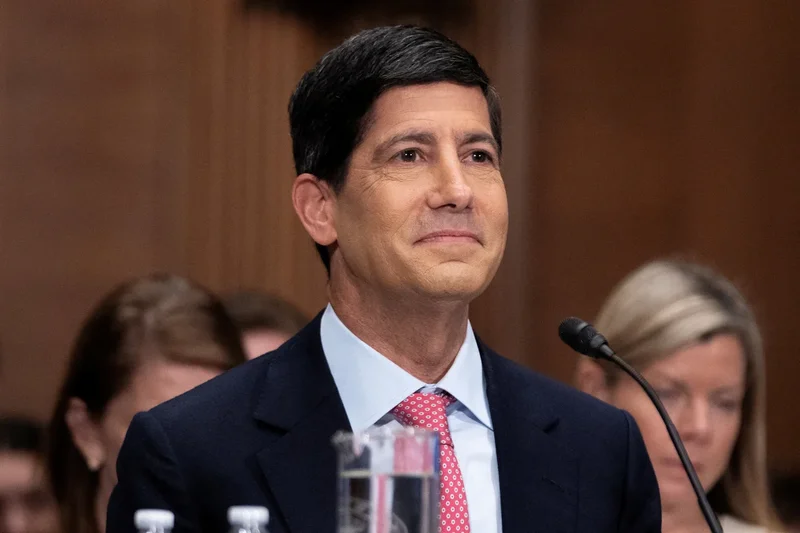
New Fed Chair Kevin Warsh, presiding over only his second meeting of the rate-setting committee, has publicly declared he has "no tolerance" for elevated inflation.
His appointment by President Donald Trump came amidst intense pressure from the then-president for the Fed to cut rates rather than increase them, adding a layer of political complexity to the central bank's independent decision-making.
Despite the current hold, Wall Street traders largely anticipate a rate hike at the Fed’s next meeting in mid-September.
This sentiment is a significant shift, with 76 percent now forecasting an increase, up from just 59 percent a month ago, according to the CME FedWatch tool.
Analysts Joseph Egelhof and Guneet Dhingra at BNP Paribas Securities noted that while a "shock rate hike" this week was possible, policymakers were more likely to delay to avoid disrupting financial markets.
"Policymakers’ patience with high and persistent inflation is broadly exhausted, meaning there is a significant risk of a rate hike in September," Egelhof and Dhingra wrote.
The central bank is also awaiting further economic data, with the Commerce Department set to release its first look at April-June economic growth and the Fed’s preferred inflation measure – the personal consumption expenditures (PCE) price index – for June on Thursday.
The ongoing violence in Iran continues to inject considerable uncertainty into the Fed’s decision-making process.
Last week, the price of oil briefly surged past $100 a barrel amid intensifying fighting. Early Wednesday, Jordan intercepted missiles launched from Iran, hours after the U.S. military reported downing another Iranian barrage targeting American forces in the Middle East, signaling an end to a brief lull in hostilities.
The conflict’s impact on global energy supplies has been profound. Following U.S. and Israeli attacks on February 28, Iran temporarily shut down the Strait of Hormuz, a vital waterway through which a fifth of the world’s oil and natural gas passes.
This action triggered the greatest disruption in oil supplies in history, sending energy prices soaring. While prices have since fluctuated with the ebb and flow of conflict and de-escalation talks, the average cost for a barrel remains $10 to $15 higher than this time last year.
Adding to the instability, Iranian-backed Houthi rebels from Yemen are now targeting shipping in the Red Sea, attempting to impede tankers carrying Saudi Arabian oil through the Bab el-Mandeb Strait.
This complex geopolitical landscape places the Fed’s inflation fighters in a difficult position.
Carl Weinberg, chief economist at High Frequency Economics, articulated the central bank’s dilemma: "Sure, it is possible that the latest rise in prices is a transient blip that will reverse in a heartbeat.
Then again, it seems equally that the war with Iran will get worse, that the Strait of Hormuz and Bab al-Mandab will remain blockaded for months or longer, and that energy prices will continue to trend up."
He questioned whether the Fed should "set monetary conditions on a hope that oil prices will reverse course and stay low ... or should a central bank eschew wishful thinking and do its job of minimizing the probabilities that inflation will exceed target?"
Inflation has consistently exceeded the Fed’s 2 percent target since early 2021, a period when the U.S. economy experienced rapid overheating as it rebounded from COVID-19 lockdowns.
After peaking at just over 9 percent in mid-2022, inflation began to recede following 11 rate hikes by the Fed in 2022 and 2023, but progress has largely stalled.
Beyond the Iran war, other factors contributing to inflationary pressure include Donald Trump’s tariffs on foreign goods and a significant surge in investment in data centers to power artificial intelligence, which is driving up the cost of computer chips, equipment, and electricity.
While so-called core inflation, which excludes volatile food and energy prices, showed signs of cooling in June – partly due to a slower rise in apartment rents – and a temporary drop in gasoline prices offered some overall relief, several Fed policymakers maintain that rate hikes are essential to bring inflation back to its 2 percent target.
Christopher Waller, an influential member of the Fed’s governing board, underscored this urgency in a recent speech, stating: "Sternly staring at inflation until it melts before our withering gaze is not an option."