It only took 50 seconds. In the final moments of a public committee hearing, Queensland’s shadow attorney-general asked a question that, ironically, moved the remainder of the session behind closed doors.
The symbolic act was the latest twist in a Queensland extortion case that has been shrouded in secrecy since it first emerged in a local courtroom in Far North Queensland, and briefly came to light in the Wild West of social media.
The identity of a high-profile man embroiled in the Cairns case, and the fight to unmask him, has sparked concern and curiosity in Queensland’s most influential circles.
Changes to Queensland law could even follow. Leading criminal lawyer Terry O’Gorman, known for his work in the Fitzgerald Inquiry, believes the saga should prompt the state to seriously consider reforming suppression laws.
While the press have been ordered not to report details of the allegations, this has only fuelled interest in the case. The media will on Friday seek to have a non-publication order on the man’s identity overturned.
Last Friday, Labor’s Meaghan Scanlon was the latest to ask questions publicly. With LNP Deputy Speaker Jon Krause about to bring a budget estimates session probing police spending to a close, Scanlon made a final intervention.
The Gold Coast-based Labor MP raised a point of order, declaring people “have a right to know the cost of the King’s Counsel to protect the identity of the reported high-profile man”.
Scanlon requested the committee shift into a private hearing to ask acting Police Commissioner Brett Pointing and Police Minister Dan Purdie about the bill to taxpayers.
Krause accepted. With two minutes left in the session, held in the state’s abolished upper house, he closed the hearing to the public. And that was that.
Speaking to media outside the chamber shortly after, Scanlon was asked about the confidential meeting. She noted there were parliamentary restrictions on revealing details of such sessions, and highlighted the government of the day’s absolute control over parliamentary process.
“Ultimately, it’s a matter for them,” Scanlon said of the justice committee’s LNP members and chair.
It was the second time in as many months the opposition had asked questions in parliament about the bill police have racked up in their fight to uphold the suppression order, and the second time those questions were blocked.
Scanlon and Labor have flagged plans to formally dissent one such ruling by Speaker and Condamine LNP MP Pat Weir, which would likely happen when MPs return to George Street in late August.
But the opposition isn’t the first to air concerns over the case; for weeks, it has raised questions about transparency in Queensland’s justice system.
Local reporters in Cairns first became aware of the case when prominent defence barrister Brydie Bilic appeared in the court to represent her client, who cannot be named under the current orders.
In that proceeding, the name of the high-profile man was also aired, before a suppression order was eventually put over the case. A member of the public in the court who allegedly published the name of the prominent man was also charged.
There are limited details the press can report.
The man, known only as “MM”, is not facing any charges himself.
O’Gorman, the vice-president of the Queensland Council for Civil Liberties, says there is clearly tension between open courts, open justice, the right of the media to know, and the public interest.
He says Queensland’s current suppression laws should be examined. An alternative would be an Open Courts Act, similar to Victoria’s, which was brought in amid concerns suppression orders were being granted too often across courts in the state.
“The law of suppression in Queensland is such that once [this case] is concluded, serious consideration needs to be given to making a referral to the Queensland Law Reform Commission as to whether we should follow Victoria and put all of the Queensland law, in relation to suppression of names in civil and criminal cases, under an act of parliament,” O’Gorman says.
He says the suppression order in the Cairns case was an unusual step.
“It would be overstating it for me to say it is unprecedented, but it is a pretty unusual step.
“Lawyers and journalists interested in the principles of open justice and how courts balance the competing issues of open justice, freedom of the media to report, versus unnecessary destruction of personal reputation, is a centrally important issue in this whole area of suppression of names.”
The media has sought to fight the case on the grounds of open justice. Andrew O’Brien KC, representing several media outlets, including this masthead, told the court last month there was no evidence that lifting the suppression order and identifying the man would in turn identify the complainant.
Acting Magistrate Gelma Meoli ultimately ruled to uphold the police order for suppression. She told the court non-publication orders were made in blackmail and extortion cases, and if threats were not suppressed, victims of this type of offending would not come forward with their complaints.
The decision has since been taken to the Supreme Court of Cairns for a judicial review, expected to be heard on Friday.
Andrew Hemming, an associate law professor at University of Southern Queensland, says there is a high bar for a suppression order.
In terms of the media’s judicial review, the question would be whether the magistrate was correct in assuming all three people involved in the case must have their identities suppressed.
Hemming says the magistrate has three options: the suppression order stands; it gets lifted, but only for the man; or it gets lifted for the man and the defendant.
Kristy Bell, director of Bell Criminal Lawyers, says suppression orders in Queensland are generally rare, given the onus is usually on the applicant to establish why an order should be made.
But, she says, the principle of open justice is not absolute, and “may be limited through the use of the court’s implied powers, where it is necessary to secure the proper administration of justice”.
She points to the case of Hogan v Hinch, where broadcaster Derryn Hinch was charged for naming two sex offenders, and a suppression order was considered necessary for the proper administration of justice.
“That example is applicable to the present case,” Bell says, adding that extortion is a serious offence with a maximum of 14 years’ imprisonment, and there is a clear public interest in securing prosecutions.
“Where the threat subject of the charge involves the release of information, allowing the media to publish that information is to carry out the threat itself. This would achieve the very outcome the demander, or the defendant, had threatened.
“If that were allowed to occur, there would be no incentive for a victim of extortion to come forward and report the offence.
“They would be more inclined to comply with the demand in order to avoid that outcome. Such a scenario is clearly not in the public interest.”
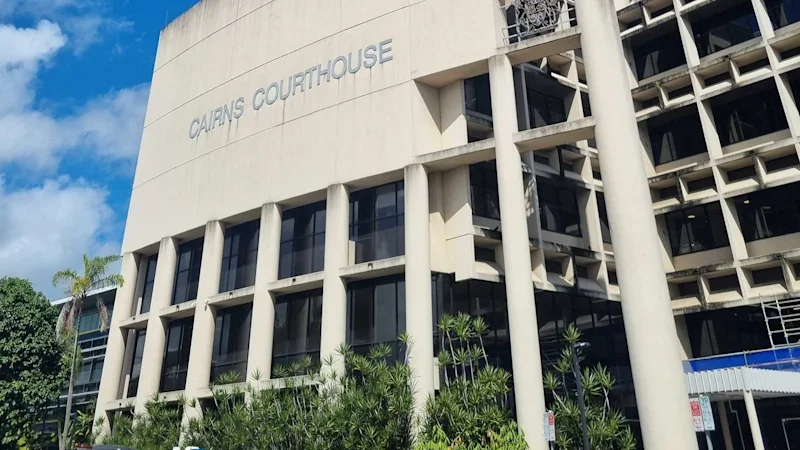
On Friday, several Brisbane journalists will fly to Cairns to join local media at the brutalist CBD building where the Supreme Court will hear the judicial review.
But even if that hearing ends up with the suppression order overturned, the prosecution would ultimately have the avenue to appeal.