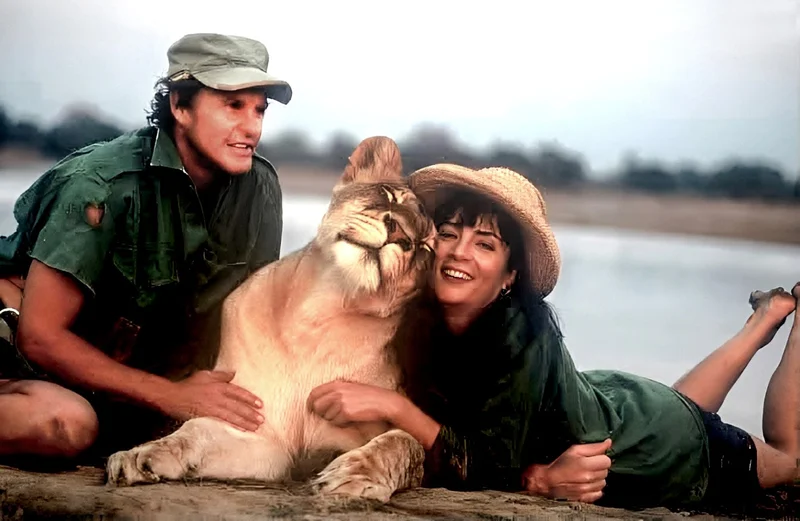
For two decades, the calm of Gillian van Houtenâs voice reached into living rooms across South Africa, carrying news of unrest, referendums and a country remaking itself. Then, in her forties, she walked out of the newsroom and into a tented camp on the banks of the Sand River, choosing leopards over deadlines and campfires over studio lights. She died on 25 July 2026, at the age of 72, after an illness that slowly took from her the very things she had once traded in for a living: memory and speech.
She grew up in Pinelands, a quiet garden suburb in Cape Town, the youngest of four children. Her sister Penny came first, then her brothers Mark and Peter. She was schooled in the Pinelands area before going on to study journalism and English at university, and her first newsroom job took her north to Pretoria, where she learnt her trade as a reporter before television called her on to Johannesburg.
Through the 1980s and into the 1990s she became one of the countryâs most familiar faces on the SABC, anchoring bulletins through a period when the evening news carried real weight. Archival footage from the late 1980s, dug up again in the days after her death, shows her reporting on the conflict along the South West Africa-Namibian border with the same steadiness that would define her decades on air.
Presenters who worked alongside her in Johannesburg in the early 1990s recall a newsroom under real pressure, covering a country moving toward its first democratic election, and remember van Houten as someone who never let that pressure show on air. That steadiness, glimpsed through a television screen hundreds of kilometres away, was what first caught the attention of a young filmmaker working among leopards in the Sabi Sand.
âI saw her on television. Most beautiful woman Iâd ever seen in my life,â says John Varty, who was then based at Londolozi, on the Sabi Sand Game Reserve bordering the Kruger National Park. He wrote to her, in the years before email was a possibility. âDear Gillian, would you like to make the news instead of reading the news? Signed, John Varty,â he recalls writing. Two weeks passed before a fax arrived in reply, carrying a single word: yes.
Varty was Van Houtenâs opposite in temperament and her equal in stubbornness. He had already made more than 30 wildlife films by the time they met, and, with his brother Dave, had helped build Londolozi into one of the countryâs first private wilderness reserves, a place that would go on to train a generation of rangers and shape how South Africans thought about conservation tourism.
Where she had built a career on restraint, delivering difficult news in an even tone night after night, he had built one on risk, living as close to dangerous animals as the work allowed. Conservationist Michael Brosnan, who founded the organisations Khuselaearth and Wild Connection, later described the pair as opposites who completed each other, crediting her with âa broadcasterâs ability to communicate, a writerâs sensitivity and a deep understanding of the natural worldâ, set against Vartyâs appetite for extremity.
She joined him at Londolozi, where Varty was filming Silent Hunter, a documentary about a leopard he called the Mother, matriarch of a dynasty that would go on to draw wildlife crews from around the world.
Van Houten met the Mother Leopard not long before the animalâs death, and it was in the aftermath of that loss that she and Varty, working with tracker Elmon Mhlongo, took in an orphaned lion cub they named Shingalana.
For eighteen months Van Houten helped raise the cub, teaching her to hunt with a patience she reserved for an autocue, while continuing to fly to Johannesburg most Thursdays to record magazine programmes such as Premier and Top Billing, returning to the bush by Sunday.
Shingalanaâs pull in two directions, toward the humans who had fed her and toward the wild she was born for, became the subject of a documentary, Shingalana: The Little Hunter, and remains a striking account of what it costs to send a hand-raised predator home.
When Shingalana turned eighteen months old, the family moved on to Zambia, where van Houten and Varty took on the rehabilitation of two further orphaned leopards, one named Jamu, whose mother had been killed in a wire snare.
It was gruelling work, run from tented camps in the Luangwa Valley, and it nearly cost Van Houten her life when she was struck down with a severe case of malaria. She was still in hospital, sharing a room with Varty, who had also fallen ill, when Nelson Mandela was sworn in as president of South Africa on the television above their beds in 1994.
Their daughter Savanna arrived first, and was schooled by tutors who travelled with the family through tented camps in the Luangwa Valley and later in Kenyaâs Maasai Mara. Twin sons, Sean and Tao, followed four years later and were raised the same way, shifting between reserves rather than suburbs.
All three eventually settled into more conventional schooling, at St Andrewâs and the Diocesan School for Girls in Grahamstown, before studying at the University of Cape Town and then travelling abroad. Sean had set his sights on professional rugby until an injury ended that path, and turned instead to the familyâs film business, which he now runs.
Tao writes scripts and is at work on a novel. Savanna designs high-end eco-tourism safaris across Zambia, Zimbabwe, Botswana, Tanzania and South Africa. âTheyâre all involved in the conservation and eco-tourist industry, just like their mother,â Varty says.
Van Houtenâs years in the bush produced a second career, this time on the page. In 2003 she published The Way of the Leopard, drawn from a year spent filming and studying two leopard cubs she called Little Boy and Little Girl, a book that tried to put into words what she described as the mystical yet profound means by which the animals seemed to communicate with each other and with her.
The shift from newsreader to author was not, in her own telling, as sharp a break as it might have appeared from the outside. Both jobs asked her to take something complicated, a war on a border, the behaviour of a leopard raising cubs, and render it in language an ordinary reader could follow without feeling talked down to. Reviewers of the book praised it for letting readers connect with wild animals through patient observation rather than through drama manufactured for a camera.
She also wrote for Fairlady magazine on subjects ranging from elephant culling to the wider politics of conservation, work she credited in part to the influence of Femina editor Jane Raphaely, and those pieces carried the same instinct, treating conservation as a set of hard, unglamorous choices rather than a simple story of good guarding bad.
Her account of raising Shingalana was later included in Intimate Nature: The Bond Between Women and Animals, an anthology built around the argument that an intuitive relationship with an animal can teach as much as any field study.
Colleagues who knew her away from both the studio and the bush describe someone whose composure on screen was not a performance. She practised yoga and meditated daily, kept to a vegetarian diet and gave whatever she was doing her full attention.
âJust, whatever she was doing, whether it was broadcasting or making a movie or writing a book, she went 100 percent. She gave 100 percent to everything,â Varty says.
Away from the cameras, he remembers her as unpretentious and searching. âBehind the public persona, she was down to earth, concerned with her health, vegetarian, meditated every day, very spiritual. Yes, the word spiritual comes to mind when describing her,â he says.
That constancy was tested more than once. Varty survived a helicopter crash, a heart attack and, in 2012, a serious tiger attack at Tiger Canyons, his ambitious and often disputed project in the Karoo to establish a free-ranging population of tigers outside Asia.
The project divided opinion among conservationists, some of whom questioned whether tigers, a species with no natural range in Africa, belonged in the Karoo at all, but van Houten stayed involved in its daily life regardless of the argument.
Each time Varty was hurt, she was there. âWhen I crashed in the helicopter, she was there for me. When I had the heart attack, she was there for me. When I had the tiger attack, she was there for me,â he says. âSheâs just a very, very solid, dependable, reliable person to have as a partner. No man could have asked for a better companion.â
In 2019, after his heart attack, she spoke publicly about his recovery, urging well-wishers to plant indigenous trees in his honour rather than send flowers. Brosnanâs later tribute to the couple made a point of separating the manâs methods from his motives:
âWhether people agreed with all his methods or not, there could be no doubt about his courage, his determination and his willingness to devote his life to the animals he loved,â he wrote, a description colleagues say applied almost as well to the woman who chose to stand beside him through all of it.
In 2022, van Houten was diagnosed with frontotemporal dementia, though the family suspected the illness had already been at work for a year or more before the diagnosis came. The condition targets the front and right side of the brain, and in her case it dismantled her short-term memory and her speech while leaving other faculties strangely untouched.
She went on painting fine pictures, and for most of her illness she could still recall the personal identification number, or PIN, for her mobile phone. âThe left brain was still working, but the right brain had atrophied,â Varty says.
Once the family understood what was coming, they took her travelling as much as they could, through Namibia and around South Africa, and back to Londolozi, where she was driven out on game drives even after she had stopped being able to name the animals she saw.
The disease gave the family, in Vartyâs estimate, around four reasonably good years before her mobility began to fail and she moved into high care at Noordhoek Manor. âItâs expensive, but worth every cent,â he says of the facility, singling out one carer in particular, Annatjie Lourens, who looked after van Houten through her final two years.
âShe gave her heart and soul to caring for Gill,â he says. Van Houten died without pain, managed carefully by her carers, with Varty and their son Tao at her side. âShe passed peacefully,â he says. âI was with her; Tao was also with her.â
âOverwhelming responseâ
News of her death brought what Varty describes as an overwhelming response, with messages reaching him from the United States, Canada, Holland, England, Scotland, Wales, Kenya, Botswana, Namibia and Zambia, as well as from across South Africa. âJa, she was loved globally,â he says. Former newsroom colleagues remembered a woman who took her work seriously without losing her warmth.
Gary Alfonso, who met her in the Johannesburg newsroom in 1991, recalled her as âalways so professional,â adding that a game ranger eventually stole her heart and she left the news business altogether.
Colin Fluxman, who worked alongside her on the current affairs programme Good Morning South Africa some thirty-six years earlier, remembered her dedication to wildlife preservation and what he called her wonderful demeanour, saying she was admired by all her colleagues and friends.
It is that composure, more than any single bulletin, which explains why clips of her reading the news more than three decades ago circulated so widely in the days after she died, watched by people who had long since forgotten the stories she reported, but had never forgotten her face.
Conservation advocate Jill Watson described her as a woman who answered a quieter, more profound calling than fame, praising the writing and documentary work through which she helped tell the stories of animals she plainly cherished, with care, insight and genuine affection.
Varty, who called her Gilly, says her greatest achievement had nothing to do with the newsroom or the books. âWhen she was broadcasting she had makeup artists and hairdressers faffing over her,â he says.
âWhen she came to the bush she lived most of the year in tents. She had to cook her own food and clean the tent. It was quite rough. She adapted remarkably well to that. I think that was her greatest achievement.â
Their children were born late, after four decades in which broadcasting, and later the bush, had already shaped who Van Houten was, and Varty describes Savanna, Sean and Tao as the greatest gift of the life he and van Houten built together.
âShe had the children late,â he says. âFor 40 years of her life, they werenât born. So all those years of broadcasting and many of the years with me in the bush, they werenât around. They couldnât appreciate the early years of Gill. But all of them came. They were all overseas. They all came to be with her, supported her. And they just have the utmost admiration for her.â
Gillian van Houten spent one half of her working life telling South Africans what was happening in their country, and the other half showing them what was happening in the wild beyond it. Few newsreaders learn to read the silence of a leopard as fluently as they once read an autocue, but by every account she managed both, and did so without pretence. DM