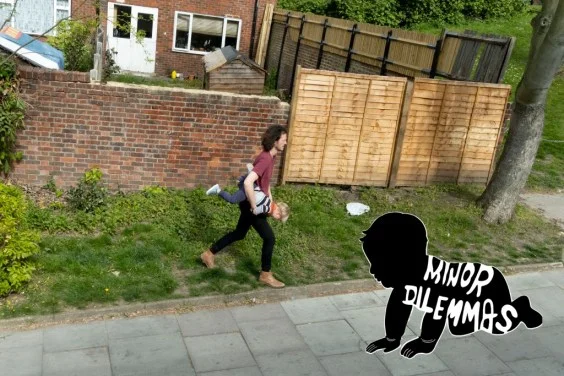
Welcome back to Minor Dilemmas, where a member of Defector's Parents Council will answer your questions on surviving family life. Have a question? Email us at minordilemmas@defector.com.
This week, Justin answers a question about discipline.
How the heck do you discipline a 2-year-old? I ask because whenever I try to put him in timeout for, say, hitting his little brother, he doesn't seem to get it. In fact, he laughs and
wantsto be in timeout. It's very frustrating. I worry that I've already lost control of my kid and that he's going to grow up to be an asshole. I worry that other people think my wife and I don't handle him well and that he misbehaves. I worry that we don't entertain him enough as parents. I worry… well, I worry about a lot of things. Have we already failed him? Is there something different I should be doing? He's a great, funny, and sweet kid, but sometimes he's hard to manage.
I was recently hanging out with a friend who has known me since high school, our kids whipping around her house and ping-ponging off each other at a level that qualified as supervision and group play while still allowing the adults to talk. Or, in this case, to catch up while a surprisingly competitive World Cup match unfolded in the background. I was caught off guard when, out of nowhere, she told me that she liked my "dad voice," which felt less like a measure of the time lapsed in our friendship than recognition of some new ability I had unlocked.
If I had to describe the tone in my voice most days it would be steady, a practiced harmonizing with the competing threats and indulgences of a 3-year-old and a 15-month old. I wish I could say this was an accomplishment realized through more meditative practice, the very pinnacle of the gentle parenting movement lilting through the house like a song on the wind. That would be a lie.
I first noticed my voice change when our oldest reached the age where she wanted to test boundaries by tossing her dinner across the floor or ripping off her diaper at the most inopportune times, almost always followed by a wild and knowing giggle. These were some of the earliest times I remember responding by using her full government name and then immediately afterwards looking around in shock, terrified that I had somehow been inhabited by the spirit of my mom.
By the time she was 2 we had entered the undiscovered country of tantrums. Every household decision was now cause for a meltdown. Wanted strawberries instead of blueberries? Saying no to another episode of "Spidey?" Welcome to your personal Chernobyl. This became more dire during potty training, when we were literally locked in—we put the whole family in protective custody for the weekend—and had to ride out the power struggle between us, our daughter, and nature. Hearing you child scream "I don't want to POTTY" and then pee all over the floor stops being funny sometime after the fifth or sixth accident. Here, again, tone was everything. Unless I wanted to introduce a lifetime of shame or other lifetime complications related to potty time, it was important to play it cool. Or, at least, wait to have a stress-induced crash out until after her bedtime.
Our voices become important at this age because the options for discipline and encouragement are narrow and the stakes feel impossibly high. There is not one way to solve this, but we do know the absolute red lines that you do not cross. We want to leave the roads open to our children's discovery on their own terms, to find their own voices in the drowning volume of the world, or through mining unexpected pleasures out of ordinary life. In exchange we take on the burden and worry that would otherwise get in the way of that.
In our house my partner and I realized that we had created a good cop/bad cop dynamic, where she was more permissive at times and I was the one trying to keep things on rails. So when our oldest is getting out of pocket, throwing fists when she's unhappy, testing the edges of "bad" words or doing something she's been told not to, I'm often the one who intervenes. And when that happens I'm on the receiving end of our daughter's wrath: "Don't SAY THAT TO ME," is one of her favorites, along with "it's OVER," and the classic, "I don't like you, Baba."
And every single time it's like trying to recover from the most devastating rabbit punch delivered right to back of my skull. No one really tells you just how bad you're going to feel when something like this happens. Or just how much you're going to beat yourself up over the choices you make when it comes to discipline. When the time comes that you actually do lose your patience and yell at your child you'll want to haul your own ass off to jail.
Now that she's 3, I'm taking an approach that I believe is clinically referred to as "fuck around and find out." Which is to say, now that she is more knowledgeable and more durable, when she wants to play around on stairs or jump on the couch—even after repeated warnings—and she dings herself, it presents the opportunity to talk about why her parents keep pestering her to listen when they ask her not to do all that. And yet, every time she gets too close to a hot stove or runs off in a busy area I'll have to move the dials around to find how much risk I'm comfortable with. If it does end in tears I will chew that game tape for hours and flog myself for every perceived misstep.
It took me time to realize that all parenting comes down to trial and error, and our capacity for patience and reinvention. In all likelihood your child will not become an asshole if you are trying your best and you talk to them about that daily struggle. The truth, of course, is that none of us really know what shape their future will take or if we'll be around to see who they become.
All we have is the next morning. And when it comes, my daughter gets out of bed as if she's been remade, she bursts open for the day, offering up hugs and unbridled excitement. She will say she loves me, and I will ask about her dreams, and she will tell me them in detail. They mostly involve lions.