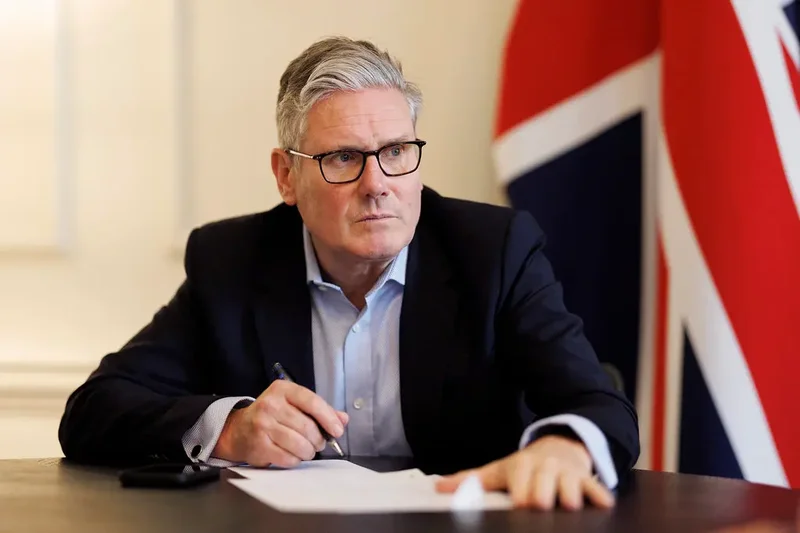
Former British prime minister Keir Starmer, who came to power in a landslide victory in July 2024, resigned less than two years after he failed to deliver the promised higher economic growth, cut the cost of living and turn around ailing public services.
This should serve as an example to African leaders who cling to power, even if they fail in government or are embroiled in corruption and personal scandals.
Even after failing for long periods in power, sometimes decades, many African leaders astonishingly believe they are indispensable. Their supporters and voters also misguidedly think those leaders can somehow hold their countries together, even after failures in government, authoritarianism and nonsensical economic policies plunged their countries into crises.
Starmer, the former Labour Party leader, was not embroiled in a corruption scandal, cataclysmic economic failure or personal scandal.
However, he failed to provide a believable plan to turn around the British economy, slash the cost of living and shake-off public perceptions that there was a moral breakdown among the governing Labour elite surrounding him.
Starmer’s popularity in public polls continued to decline, reaching a low-point when he polled lower than the Labour Party.
The rising Nigel Farage-led Reform UK, a right-wing party, started to eclipse Labour in opinion polls. Starmer was unable to respond convincingly to the Reform UK’s strident calls for hardline anti-immigration policies. The UK has seen violent street protests by those wanting tougher anti-immigration policies.
The Labour Party also began to lose voters to the Green Party.
By late last year, there were mounting calls from the Labour Party for Starmer to step down, with rivals, including Andy Burnham, the then-mayor of Greater Manchester, now having succeeded Starmer as the new Labour Party leader and UK prime minister, declaring he would challenge Starmer in a leadership election.
In February this year, Starmer was shaken when Anas Sarwar, the Labour Party leader in Scotland, called on him to resign. However, many members of Starmer’s cabinet came out in support of him.
A poor showing by the Labour Party in the country’s May 2026 local government elections turned the tide in the party’s top leadership against him. The fatal blow came when his fiercest rival for the party leadership, Andy Burnham, 56, the then-mayor of Greater Manchester, won a special election for a seat in Parliament.He convincingly won the seat of Makefield in England’s north west against Rob Kenyon of Reform UK, bucking a rising losing streak by Labour against Reform UK and showing he could counter the Reform resurgence. Burnham, nicknamed the “King of the North”, won with close to 55% of the 45 510 votes.
In his resignation letter, Starmer highlighted that he had modernised the Labour Party, decreased the National Health Service waiting lists, lifted half a million children out of poverty and strengthened workers’ and renters’ rights. He had also improved the UK’s image on the world stage, kept the UK out of US President Donald Trump’s war with Iran and fought to keep the Trump administration engaged with Ukraine, rather than siding with Russia.
However, the public demanded more decisive action to alleviate the cost of living crisis , slash rising unemployment and still pedestrian public service delivery and perceived high immigration from poorer countries.
Starmer also made critical misjudgements, including appointing Peter Mandelson, who has been embroiled in scandal and was revealed to be close friend of Jeffrey Epstein, as the UK ambassador to the US. This gave the perception that Starmer and his inner circle were as tarnished as the previous Conservative governing elite.
Starmer, also resisted introducing policies publicly perceived to ease the costs of living but under public pressure, he recanted. For example, he initially restricted winter fuel subsidies for pensioners,then under public pressure, changed his stance. Such vacillating eroded his authority.
Over time, it increasingly appeared that the government was losing control over pressing societal problems, was drifting and did know how to resolve the problems.
Starmer appeared to become more adept at foreign policy issues yet more out of touch with domestic challenges.
When Starmer arrived in the prime minister’s office in July 2024 he inherited an embattled public service struggling because of budget cuts, slowing economic growth and millions of citizens struggling financially.
Youth unemployment in Britain had been rising. An independent report on youth unemployment done for the UK government and led by the former health secretary Alan Milburn found that nearly one in eight 16- to 24-year-olds in Britain are not in education, employment or training.
Britain’s international standing had declined over the past few years. The country shifted from the European Union. The British Commonwealth, of which Britain had been at the centre of, was fracturing.
The death of Queen Elizabeth, who was a non-political partisan, symbolic institutional anchor during times of political and societal turbulence, shook the British nation, adding to the sense of unmooring of the nation. Britain’s alliance with its ally, the US, frayed with the arrival of Trump and his US-first foreign security and policies, high tariffs and move on Greenland.
China’s global trade surplus, flooded economies, including the UK’s, contributed to de-industralisation and added to Britain’s economic crisis. New emerging powers, such as India, Brazil and Saudi Arabia have become influential on the back of their growing economies. The rise of artificial intelligence has disrupted the structure of all countries’ economies, undermining established industries and employment and threatening to leave many economies behind. All the new challenges demand extraordinary imaginative, pragmatic, steady and continuously reassuring leadership.
Starmer was elected by a landslide in 2024, because he promised calm, pragmatism and competence after years of Conservative Party instability, personal scandals and chaotic governance. Former Conservative prime minister Boris Johnson was embroiled in multiple scandals, including "Partygate" whereby alcohol-fuelled parties and events were held in government buildings while the UK was under strict Covid-19 lockdown rules. He faced scrutiny over allegations that renovations at his private residence were funded by a donation and in 2022 his government increased taxes when the country was facing a cost of living crisis.
Liz Truss lasted only 45 days as Conservative prime minister after she tabled a "mini-budget", which proposed £45 billion in unfunded tax cuts in September 2022. The mini-budget triggered a financial market meltdown, plunging the British pound to record lows and increasing government borrowing costs.
Prime minister Rishi Sunak also found himself mired in several political controversies. Sunak faced multiple ethics investigations into his financial interests and transparency. He was caught up in the Johnson’s Partygate which contributed to the collapse of his prime ministership and was given a penalty and faced questions about whether he had properly declared his wife's shares in a childcare agency that stood to benefit from government budget subsidies.
Starmer has been unable to communicate a vision of hope for Britains, given the cost of living, rising migration and country identity crises he inherited. He also had no clear reform plan.
Reform UK, one of the opposition parties, has increasingly captured the public imagination through its vision for Britain.
Reform UK, originally the Brexit Party, was started by Nigel Farage, who was known as a right-wing politician, in 2018. In the UK May 2026 local elections, Reform UK won 1 453 council seats in England, became the opposition in the Welsh Parliament (known as the Senedd) and performed well in Scotland. Reform UK has positioned itself as outside the established political elites of Labour and Conservatives and a party that could fix a “broken\|’ Britain. It is a strongly anti-migrant party.
In the past, UK voters were generally aligned along the ideological blocs of Labour and Conservatives. In more recent times, politics has become more fractured. More importantly, voters, fearful of the rise in living costs, high unemployment, poor public services and that established Labour and Conservatives party leaders were not fully engaged in dealing with the existential problems decisively are increasingly seeking answers in populist right-wing politics.
Burnham, as the new Labour leader and new prime minister, will face the same issues that kneecapped Starmer. Burnham has pledged to see off the challenge of a rising populist Reform UK. Burnham also promised to defend the UK’s interests in the same way he defended theGreater Manchester region’s interest when he was mayor. He said he would work to offer hope to people in “forgotten places everywhere”.
Burnham acknowledged that it was Labour’s “last chance” to turn its fortunes around, saying he would reduce the domination by the Westminster (Parliament) political class of the country’s politics, economics and society, give more power to the regions and non-political elite outsiders and deliver the change the country was “crying out for”.
Starmer’s resignation also has specific lessons for South Africa’s ANC and President Cyril Ramaphosa. Like Starmer, Ramaphosa might be strong in foreign policies but at home he clearly appears not to grasp the gravity of the hardships of ordinary people. He lacks new ideas, recycles the old failed policies and failed ANC leaders and advisers to tackle state corruption, ANC cadre appointee incompetence and complacency, state and infrastructure failure, high unemployment, awlessness and societal violence.
Sadly, many ANC leaders blame the usual scapegoats – apartheid, whites, foreign Africans, white monopoly capital, Israel and Trump — rather than taking accountability for 32 years of self-inflicted failure, caused by corruption, ANC cadre appointee incompetence, nonsensical, fundamentalist ideological and emotional anti-growth economic policies, anti-South Africa interests foreign policies and BEE policies that have largely enriched the ANC elite.
If the ANC and its leadership continue with the ostrich-in-the sand approach, in the face of the consequences of its own government’s harmful policies, corruption and cadre-appointee incompetence, then populist parties and extra-parliamentary groups, who sell snake-oil and one-solution policies for all the country’s complex problems and who are even more into blame-shifting, will push the ANC and its government of national unity partners out of power in coming elections.
The anti-migrant groups is an example of the rise of such new populist and extra-parliamentary groups and individuals, who also blame the Constitution, democracy, apartheid, whites, white monopoly capital and people who do not look like them for the problems caused by the ANC’s corrupt, incompetent and anti-growth economic policies.
William Gumede is an associate professor at the School of Governance, University of the Witwatersrand, and author of the best-selling South Africa in BRICS (Tafelberg).
The article is based on his recent interview with the SABC’s Channel Africa.