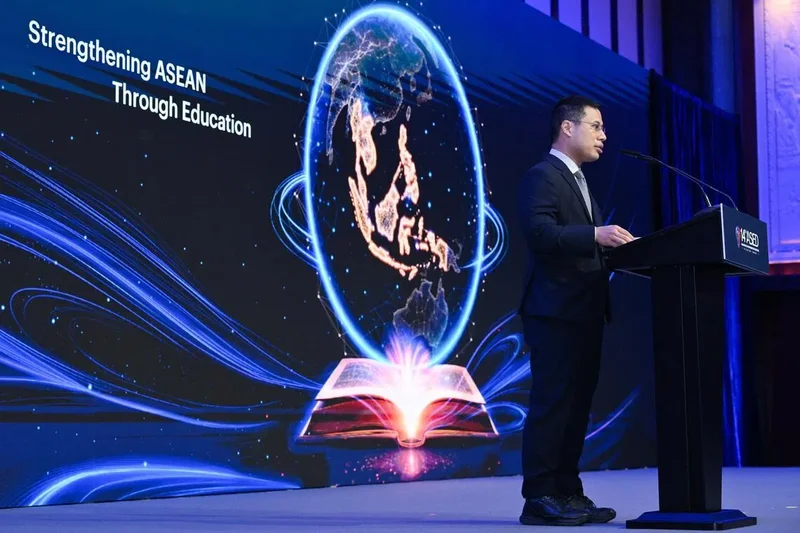
SINGAPORE – Singapore has identified artificial intelligence (AI), STEM, and holistic student development as key focus areas for the region’s education systems under a new five-year education work plan.
The ASEAN Work Plan on Education, which will run from 2026 to 2030, was launched on July 22 by Education Minister Desmond Lee, together with other ASEAN education ministers.
“The work plan reflects our shared commitment to education systems that remain responsive to global and technological developments, while promoting equitable access to quality education, supporting student well-being and strengthening regional ties,” said Lee, speaking at the 14th ASEAN Education Ministers’ Meeting held at Shangri-La Hotel.
Singapore also hosted the 8th ASEAN Plus Three and 8th East Asia Summit Education Ministers’ Meetings from July 22 to 23.
The ASEAN Plus Three grouping brings together the 11 ASEAN member states with China, Japan and South Korea, while the East Asia Summit includes Australia, India, New Zealand, Russia and the United States.
The two-day meeting marks Singapore’s first as ASEAN Education Chair, a role it holds from 2026 to 2027. Delegates will visit local schools and institutes of higher learning, while Lee will hold bilateral meetings with his counterparts.
Overall, the work plan aims to build inclusive and future-ready education systems across the region, with safe and responsible use of AI and other digital tools helping to shape well-rounded students and a skilled workforce.
It also aims to strengthen a shared sense of identity among ASEAN countries.
It sets out six goals: providing fair access to education at every stage of life; keeping what students learn relevant to future jobs and economic needs; improving how well students learn and their well-being, with a focus on foundational learning; strengthening policy decisions and implementations, system governance and accountability; encouraging ASEAN countries to work together and pool resources; and building a stronger sense of shared identity among students, teachers and other stakeholders across the region.
Within this broader agenda, Lee proposed three priorities, as the region’s education systems need to adapt to shifting geopolitics, economic transformation, and the growing impact of AI.
“We cannot wait for AI’s impact to fully unfold before we adapt our curricula, pedagogy, and assessment approaches,” he said.
Beyond AI, Lee pointed to STEM education as key to helping the region’s workforce adapt to technological disruption, and holistic development – including character, empathy and sound judgement – as increasingly vital as AI becomes more pervasive in daily life.
To this end, Singapore will roll out several regional programmes, Lee said. Singapore is the ASEAN education chair.
Programmes span from forums to camps, including the ASEAN Plus Three STEM Camp for Youth in May 2027, where youth from member states and other international schools will collaborate on STEM education and learn to apply knowledge to real-world contexts.
Another programme, ASEAN Student Adventure Camp in November 2027 will also be organised, to develop participants’ resilience, teamwork and adaptability.
Both camps will be held in Singapore.
The Singapore Centre for Character and Citizenship Education will lead a new educator network to strengthen holistic education, said Lee. The regional research network will bring together ministry officials to share how values education is designed and practised.
Through the work plan, the region is taking practical steps to prepare its people for the future and strengthen bonds between ASEAN, said Lee.
“Together, let us invest in our people, nurture our shared values, and keep learning from one another, so that ASEAN remains resilient, cohesive and forward-looking for generations to come.”