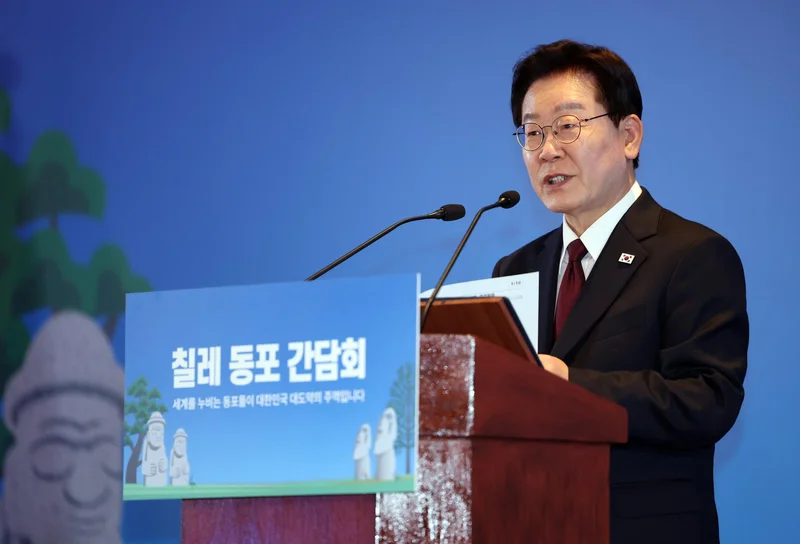
President Lee Jae Myung underscored Chile's significance as Korea's first-ever free trade agreement (FTA) partner, saying the South American nation recognized Korea's potential long before it gained global prominence.
Speaking at a dinner meeting with members of the Korean community in Santiago Wednesday (local time), the president's remarks came during his three-nation South America tour this week, which also includes Brazil and Argentina.
Lee is seeking to expand trade and investment with Mercosur, a South American trade bloc, by capitalizing on the complementary nature of the two economies — Mercosur in agriculture, food production, energy and critical minerals, and Korea in advanced manufacturing, digital technologies, shipbuilding and batteries.
"Chile was not only the first Latin American country to recognize the Republic of Korea in 1949, a year after our government was established, but also Korea's first FTA partner," Lee said.
The bilateral FTA took effect in April 2004, years before Korea's FTAs with major trading partners such as the United States, which entered into force in March 2012, and China in December 2015.
The president described Chile as "a country that recognized our potential and extended a helping hand at a time when the world knew little about Korea," saying that it became "one of our most valued partners" when Korea began opening its economy to the world.
"The relationship between our two countries has always been built more on trust than distance, and it has always placed greater value on the future than the present,” he said.
The president lauded the Korean community as "at the heart of this special bond" between the two countries, pledging to listen closely to the diverse voices of overseas Koreans and expand government support.
"Your remarkable efforts in serving as a strong bridge between our two countries will not be in vain," he said.
Lee is the first Korean president to visit Chile in 11 years.
According to Cheong Wa Dae, the visit is expected to elevate bilateral ties and deepen forward-looking cooperation in areas that directly benefit people and businesses, including public security, defense, infrastructure, maritime affairs and culture.