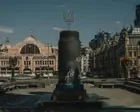
Since 2013 the plinth at the bottom of Taras Shevchenko Boulevard in Kyiv has been eerily empty. The scruffy monument is daubed in white paint and graffiti. Someone has stuck a Ukrainian trident where Lenin once stood, gazing down during the years of Soviet communism. A crowd toppled the sculpture during Ukraine’s Maidan revolution, which ousted the pro-Russian government, and smashed it with sledgehammers.
In June, Volodymyr Zelenskyy proposed putting a new figure on the plinth: Ivan Mazepa, a Cossack military and political leader, who broke with Moscow and fought for Ukraine’s independence. “I am certain that where Lenin fell, Mazepa will stand firm,” Zelenskyy said. He spoke next to a bust of Mazepa in the Pechersk Lavra, an ancient Kyiv monastery hit by Russian missiles.
The proposed swap of Lenin for Mazepa has triggered a lively debate about monuments and what they say about changing national identity. After winning independence in 1991, Ukraine removed large numbers of Soviet-era statues and renamed streets as part of “decommunisation”. The process sped up in 2014 when Russia seized Crimea and fighting began in the Donbas, and moved even faster after Vladimir Putin’s 2022 full-scale invasion that aimed to scrub Ukraine from Europe’s map.
Nataliia Kryvda, a professor of the history of culture at Taras Shevchenko National University in Kyiv, said Ukraine was going through an unfinished period of decolonisation. “The USSR absorbed national cultures. It tried to make a single nation of Soviet citizens. Russia today looks at Ukraine and says we are one people. It isn’t true. We have our own mindset, historical destiny, beliefs and dreams. Our identity is a dynamic process,” she said.
Standing next to the ex-Lenin plinth, Kryvda said she was in favour of a Mazepa monument. “Why not? He’s our leader. Each culture needs to mark its space with memorials. They objectify memory,” she said. She described Mazepa as a “contradictory personality” and not an “ideal hero”.
“He really was a friend and political partner of Russia, right up until the moment he dramatically changed his life and history,” she added.
As hetman, or head, of Cossack Ukraine, Mazepa sought to balance the demands of neighbouring Moscow and Warsaw. In 1708, the Russian emperor Peter the Great refused to protect Ukrainian territory from invading Swedes. Mazepa abandoned the tsar and formed an alliance with the Swedish King Charles XII, an act that ended in defeat and led the Bolsheviks to call modern Ukrainian patriots “Mazepists”.
“Mazepa was the architect of European Ukraine,” Kryvda said.
In his speech at the Pechersk Lavra, Zelenskyy said Russia had smeared Mazepa for centuries, depicting him as a traitor. Their goal, he said, was to make Ukrainians “view their own history through the eyes of others”.
Alim Aliev, a writer and Crimean Tatar campaigner, said Ukraine was belatedly recovering its identity. “We are reclaiming our own voices and names,” he said. He cited the example of the 20th-century Ukrainian poet and dissident Vasyl Stus, whose image will appear in September on a new 2,000 Hryvnia note. Stus studied in Donetsk, the eastern Donbas city occupied by Russia, and led Ukraine’s national revival. He died in 1985 in a Soviet prison camp.
In Aliev’s view, Ukraine was now speaking about its past “without mediators” and said it was appropriate that statues of the 19th-century Russian poet Pushkin had been taken down across the country. “He had a totally imperial view of Crimea,” Aliev said, citing Pushkin’s narrative poem, The Fountain of Bakhchisarai. “He exoticises Crimean Tatars and describes us from a colonial perspective.” Of the Mazepa statue, he added: “I don’t think it’s a controversial idea.”
Last month workmen took away a monument to another Russian literary giant Mikhail Bulgakov. It had stood since 2007 outside the house where Bulgakov lived, in one of Kyiv’s most attractive streets, St Andrew’s Descent. Kyiv’s city council voted to remove it. Other plaques to Bulgakov, born in Kyiv to a Russian family when it was part of the Russian empire, have already been taken down, including one outside the university where he studied medicine. Bulgakov’s museum – housed in the writer’s home – remains open.
The museum’s director, Liudmyla Habianuri, said she was not opposed to the sculpture’s removal and dismissed a petition to keep it as “bland”. She acknowledged that Bulgakov had written negatively about Ukrainian nationalist forces in his Kyiv novel The White Guard, set in the winter of 1918-19, amid revolution and war. She stressed, however: “Bulgakov was a witness to his times. And a satirist. He didn’t like anybody. That included communists and priests.”
Habianuri said Russia’s war had prompted Ukrainians to ask: “‘Who am I?’ It’s a very painful question,” she said. “If I speak Russian and watch Russian films and the Russians are killing me then I must give all that up. Then I’m Ukrainian. And if I’m Ukrainian, I must become Ukrainian as quickly as possible.”
This has led people to join the struggle for identity, she said, either via social media or by attacking monuments.
Bulgakov, she said, was a frequent subject of such struggles. “Right now there is a table with only two columns: plus or minus. As a Russian, who didn’t write from the perspective of Ukraine’s defenders, Bulgakov can’t get a plus sign.”
Habianuri said a process of “simplification” was under way but was delighted when demonstrators pulled down the Lenin statue, saying: “The man was an enemy of humanity itself.” Mazepa, she said, was a “unique person” who had inspired a notable poem by Lord Byron. But she questioned whether the plinth was a fitting spot for a memorial.
“I understand it’s a quick jab at Russia. But it’s not the right place for a hero,” she said. “The Germans hanged people there during the second world war.”
Unlike Lenin, the Bulgakov statue was carefully packed up and returned to the family of its late sculptor, Mykola Rapay. His daughter, Kateryna, declined a request from the Guardian for the work to be photographed at its new location. She said she had given official guarantees that the monument would remain “out of public space”.
“These are not my whims,” she said. “The sculpture is not my property. I am the guarantor of its preservation.”
Over at the Pechersk Lavra tourists walked past the new Mazepa bust, which has been erected in front of a fountain and a pleasant shady garden. It sits next to the complex’s 11th-century Dormition Cathedral, used in medieval times for the burial of prominent figures. Last week a boy photographed his father next to the new monument.
Mazepa, a patron of the arts, donated money to pay for the cathedral’s baroque renovation. In June, a Russian drone crashed into its roof, causing a fire, and blackening external pictures of saints. Other icons and religious artefacts were rescued.
One Ukrainian visitor, Olena Polishchuk, said she had come to the Lavra from the UK, where she has lived since Putin’s big invasion. What did she think of Mazepa? “He’s a famous man. I’m glad he’s being commemorated. He’s an important part of our history,” she said.