The government’s recurring policy response is to deal with institutional failures as software problems. The assumption is that securing the platform, digitising the database and centralising management under technocrats will solve social problems. Therefore, let us bring in the master engineer to re-code the system.
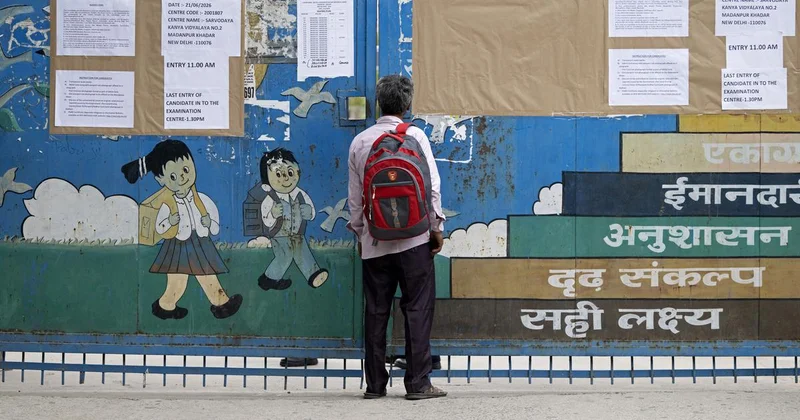
Similarly, the government has now constituted a “high-powered task force” headed by Infosys co-founder Nandan Nilekani to recommend examination reforms. It follows nearly two months of protests by students and youngsters against the leak of the National Eligibility-cum-Entrance Test for admission to undergraduate medical courses.
This approach conflates logistical efficiency with social equity.
It is a manifestation of a deep, chronic flaw in the ruling establishment’s imagination that socio-political crises can be engineered away through top-down, technocratic management.
Lessons from Aadhaar
India’s Aadhaar experiment supplies ample empirical evidence of why a purely technocratic approach to education and examinations is dangerous. In 2009, when Nilekani was brought in to build Aadhaar, the promise was similar: a frictionless, fraud-proof, digital architecture that would eliminate corruption and streamline the welfare state.
Instead, it was a classic case of technocratic hubris. Aadhaar’s real-world implementation subordinated human rights to digital server uptime while storing vast amounts of personal data in leaky systems.
Economists Reetika Khera and Jean Drèze have pointed out that welfare systems are vulnerable to two types of errors: inclusion errors (fake/duplicate beneficiaries) and exclusion errors (genuine beneficiaries being turned away). Technocratic solutions are obsessively engineered to catch the former while ignoring the catastrophic damage of the latter.
Research and reporting by civil society groups like Rethink Aadhaar have documented thousands of cases where elderly citizens, manual labourers with worn fingertips, or rural households in connectivity blindspots were denied basic rations and pensions because an Electronic Point of Sale machine failed to authenticate their identity. In the government’s dashboard, these were recorded as “savings” or “elimination of ghost beneficiaries.” In reality, as Drèze and Khera demonstrated, these were often cases of forced starvation and state denial of legal rights.
Technocratic solutions shift the burden of proof onto the vulnerable.
When digital systems fail, citizens are forced to stand in endless queues, lose pay to visit Aadhaar centres and authenticate their identity multiple times. The State abdicates responsibility by blaming the “system”.
The core flaw of the Nilekani doctrine is its ideological blindness. It views human, social, and political relationships as plain transactional data pipelines. But when you consider citizens as data points, you build systems that are technologically sleek yet socially brutal. To unleash this exact philosophy onto the country’s education and examination ecosystem is to misdiagnose the disease entirely.
What is an exam in India?
To the urban elite and technology executives, an examination is a logistical exercise, a mechanism to sort and filter candidates using secure algorithms.
But for India’s large population of poor and socially disadvantaged, examinations are a ladder of social mobility. Indian society is fractured by caste, class, and regional inequality. Public competitive exams represent one of the few spaces where a poor child can legitimately dream of climbing out of historical marginalisation.
In that context, an examination paper leak breaks the fragile social contract between the republic and its youth. The crisis of Indian examinations is much more than a failure of encryption and server security: it is a crisis driven by three political and socio-economic factors:
The first is the hyper-centralisation of education and exams. This is seen in the collapse of diverse, state-level educational contexts into monolithic, all-India mega-exams managed by an opaque, bureaucratic apparatus – the National Testing Agency).
The second is the wild west of commercial coaching. This multi-billion-dollar shadow education industry feeds on student anxiety, colludes with corrupt officials and demands – often exorbitant – payment for access to practice question papers.
The third is institutional erosion. Over the years, there has been a systematic destruction of university autonomy, the politicisation of educational appointments, while public education has been hollowed out. In the midst of this, millions of students gamble their youth and future on a single three-hour test.
Can encryption solve the predatory pressure of coaching hubs? Can an algorithm restore the shattered autonomy of state universities? Can a technocrat understand the desperation of a student sleeping on a cot in a cramped room in the coaching hub of Kota?
Main stakeholders missing
The high-powered task force is populated by tech billionaires, rocket scientists, intelligence chiefs and senior bureaucrats.
Conspicuously absent are primary stakeholders from the very sector that the committee is tasked with reforming: education. Where are the educationists who understand pedagogy, child psychology and the philosophy of assessment? The university professors who teach in non-elite, tier-2 and tier-3 colleges? Where are scholars who understand how caste, gender and other disparities shape exam outcomes?
The assembled panel reveals the prime minister’s worldview where India’s youth are not partners in a democratic dialogue, but potential suspects in a security operation. Instead of humanising or democratising education, the goal is to police it better.
What would democratic reform look like?
Fixing India’s examination system and restoring trust must start with abandoning technocratic solutions and embracing a democratic and pedagogical reimagining of Indian education, as experts, scholars and activists have been saying for years.
Instead of technocracy, reform must be through inclusion. Rather than a closed committee of bureaucrats and technocrats, the government should institute a commission comprising veteran educationists, public university faculty, student representatives, state-level examination board heads and civil society advocates.
Policy must be drafted through public hearings across different states, listening to the experiences of students and parents. Reform must make public institutions and office bearers accountable to Parliament.
Decentralisation must be the next focus. The policy of “One Nation, One Exam” has failed spectacularly. The concentration of power and control over question papers in a single central body has created obvious risks of a single point of failure while inviting massive corruption. Federal balance must be restored by empowering state universities and regional education boards to conduct assessments tailored to local contexts and reduce the stakes and panic surrounding national mega-tests.
Finally, there must be a pedagogical overhaul moving away from rote learning and marks-based ranks. India’s education system puts a premium on rote memorisation, which makes question papers prone to being easily leaked.
Assessment needs to shift toward continuous evaluation, critical thinking, open-book frameworks and multi-stage qualitative evaluation that cannot be gamified by coaching centres and bought through leaked answer keys.
Bringing a technocrat to solve a social problem is a mistake. Nilekani may be a brilliant manager of corporate systems and digital infrastructure, but education is not a software platform.
This moment should instead be used to take education out of the hands of technocrats and return it to the democratic conscience of the nation and its future – the youngsters and students who protested on the streets of India demanding fairness and dignity.
Pius Fozan is a photojournalist and an advisor at the Political Tech Summit.
Pius Fozan is a photojournalist and an advisor at the Political Tech Summit.
We welcome your comments at letters@scroll.in.