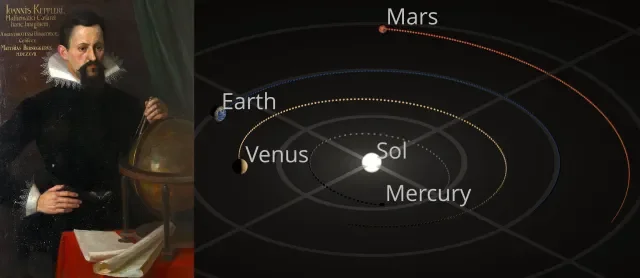
For a great many people in the world, the hardest words to say are simply these three: “I was wrong.” It’s as though simply admitting you were mistaken about something — even though the only way we learn is by making an attempt, often resulting in a sub-optimal outcome, especially when you’re doing it for the first time or with incomplete knowledge — is somehow a personal failing, or even an admission of defeat. Even if the evidence is overwhelmingly decisive that your idea or conception is unsupported, most people will instead find a way to discount or ignore that evidence and stick to their guns. People’s minds are notoriously resistant to change, and the greater their own personal stake in the outcome of the issue under debate, the less open they are to even the possibility that they might not be 100% in the right. Although it’s often asserted that science is the exception to this general rule, that’s only true of science as a collective enterprise. On an individual basis, scientists are just as susceptible to confirmation bias — overweighting all supporting evidence and discounting any evidence to the contrary — as any other human in any other walk of life. In particular, the greatest difficulties lie in store for those who themselves have formulated ideas and invested tremendous efforts, often amounting to years or even decades worth of time and effort, into hypotheses that simply cannot explain the full suite of data that humanity has amassed. This applies even to the greatest minds in all of history. Albert Einstein could never accept quantum indeterminism as a fundamental property of nature, but his philosophical preference — for locally real theories — has been demonstrated to be invalid. Arthur Eddington could never accept quantum degeneracy as the source of the pressure that held white dwarfs up against gravitational collapse, but it is, in fact, the reason. Newton could never accept the experiments that demonstrated the wave nature of light, including interference and diffraction, but his corpuscular theory cannot, in fact, explain those phenomena. And Fred Hoyle could never accept the Big Bang as the correct story of our cosmic origins, even nearly 40 years after the critical evidence, in the form of the cosmic microwave background, was discovered. He died without ever coming around to reality. But one person stands above the rest as an exemplar for how to behave when the evidence comes in against your brilliant idea: Johannes Kepler, who showed us the way more than 400 years ago. Here’s the story of his scientific evolution, which serves as an example that we should all strive to emulate. This chart, from around 1660, shows the signs of the zodiac and a model of the solar system with Earth at the center. For decades or even centuries after Kepler clearly demonstrated that not only is the heliocentric model valid, but that planets move in ellipses around the Sun, many refused to accept it, instead hearkening back to the ancient idea of Ptolemy and geocentrism. Credit: Johannes Van Loon, Andreas Cellarius Harmonia Macrocosmica, 1660/61 For thousands of years, humans assumed that the Earth was a static, stable, and unchanging point in the Universe, and that the entirety of the heavens literally moved around us. Observations seemed to support this: there was no detectable motion occurring on our surface that supported an Earth that either rotated on its axis or revolved around the Sun through space. (The Foucault pendulum and a direct observation of stellar parallax both wouldn’t arrive until the 19th century.) Instead, there were three key observations that had been made that helped people determine what our best model of the Universe would be. The entire sky appeared to rotate a full 360 degrees over the course of 24 hours, most evident at night, as the stars rotated about either the northern or southern celestial pole. The stars themselves appeared to remain fixed in their relative position to one another from night-to-night, and even over much longer timescales: years, decades, and centuries. However, there were a few objects that did move relative to one another from night-to-night or day-to-day: the planets, or “wanderers” of the sky. Additionally, the Sun and Moon shifted over time across the skies as well, as did the entire canopy of stars over extremely long periods of time. (As the shapes of constellations, recorded over millennia, have been documented to change.) However, it was the first observation, of the rotating canopy of stars on a nightly basis, that led to the static, stable, unchanging conception of the Universe. This timelapse view of the night sky from Hyatt Lake shows the sky as it appeared just after the summer solstice on June 21, 2020. The apparent motion of the objects in Earth’s sky could either be explained by the Earth rotating beneath our feet or by the heavens above rotating about a fixed Earth. Simply by watching the skies, we cannot tell these two explanations apart. (Credit: Bureau of Land Management OR & WA/Kyle Sullivan) Think about the above observation: that everything in the sky appears to rotate a full 360 degrees over the span of a 24-hour day. This could be caused by one of two potential explanations. Either the Earth itself was rotating about some axis, and that our world completed a full rotation once per 24 hours, or the Earth was stationary and everything in the heavens was rotating around it, also once per 24 hours. How, physically, could we tell these two situations apart? The answers were twofold. First, it should be possible, if the Earth were rotating, to note a curved trajectory to falling objects. The higher they fell from, the greater the curve would be. Yet no curve was ever observed; in fact this effect wouldn’t be measured until the aforementioned demonstration of the Foucault pendulum in the middle of the 19th century. Second, a rotating Earth would lead to a difference in the relative positions of the stars from dusk until dawn. The Earth was big, and its diameter had been measured precisely by Eratosthenes in the 3rd century B.C.E., so if any of the stars were closer than most of them, a parallax would appear: similar to holding your thumb out and watching it shift relative to the background as you alternated which eye you used to view it. But no parallax could be seen; in fact this wouldn’t be observed until the middle of the 19th century as well! The stars that are closest to Earth will appear to shift periodically with respect to the more distant stars as the Earth moves through space in orbit around the Sun. Before the heliocentric model was established, we weren’t looking for “shifts” with a ~300,000,000 kilometer baseline over the span of ~6 months, but rather a ~12,000 kilometer baseline over the span of one night: Earth’s diameter as it rotated on its axis. The distances to the stars are so great that it wasn’t until the 1830s that the first parallax, with a 300 million km baseline, was detected. Today, we’ve measured the parallax of over 1 billion stars with ESA’s Gaia mission. Credit: ESA/ATG medialab In science, we can only draw conclusions based on what’s observable and measurable. Because we could formulate tests that could reveal an Earth-in-motion, but that failed to reveal it to the limits of what we could observe and measure, we had no evidence to support the assertion that the Earth did, indeed, move. From a scientist’s perspective, it’s easy to see, based on what we knew and could observe at the time, how we’d conclude that the Earth was static and fixed, while the heavenly bodies all moved around us. However, there were still additional observations that required an explanation: why did the stars remain fixed relative to one another while the planets appeared to “wander” through the sky? It was quickly modeled that the planets, as well as the Sun and the Moon, must be closer to Earth than the stars were, and that these bodies must be in motion relative to one another. With a fixed, static Earth, that meant that it must be the planets themselves that were in motion. The motion must have been incredibly complex, however. While the planets overwhelmingly appeared to move in one direction relative to the backdrop of stars on a night-to-night basis, every once in a while, the planets would: slow down in their usual motion, come to a complete stop, reverse their motion to move opposite their original direction (a phenomenon known as retrograde motion), would then slow and stop again, and finally would continue on in their normal (prograde) direction of motion. This phenomenon was the most challenging aspect of planetary motion: not only to model, but to attempt to understand from a physical point-of-view. Mars, like most planets, normally migrates very slowly across the sky in one predominant (known as prograde) direction. However, a little less than once a year, Mars will appear to slow down in its migration across the sky, stop, reverse directions, speed up and slow down, and then stop again, resuming its original motion. This retrograde (west-to-east) period stands in contrast to Mars’s normal prograde (east-to-west) motion, and presented a scientific challenge for centuries. Credit: E. Siegel/Stellarium The prevailing assumption, since the Earth had already been deemed (albeit incorrectly) to be static, was that the planets themselves each typically moved in circular paths around the Earth, but atop those circles were smaller circles known as “epicycles” that they moved about, simultaneously, as well. When the motion through the smaller circle proceeded in the opposite direction from the main motion through the larger circle, the planet would appear to reverse course for a brief while: a period of retrograde motion. Once the two motions lined up in the same direction again, prograde motion would resume. Although epicycles did not start with Ptolemy — with whose name they are now synonymous — Ptolemy did make the best, most successful model of the Solar System that incorporated those earlier epicycles. In his model, the following occurred. Each planet’s orbit was dominated by a “great circle” that it moved along, moving around the Earth. Atop each great circle, a smaller circle (an epicycle) existed, with the planet moving along the outskirts of that small circle, with the center of the small circle always moving along the larger one in the same, uniform direction. And the Earth, rather than being at the center of the great circle, was offset from that center by a particular amount, with the specific amount differing for each planet. That was the Ptolemaic theory of epicyclic motion, leading to a geocentric model of the Solar System. One of the great puzzles of the 1500s was how planets moved in an apparently retrograde fashion. This could either be explained through Ptolemy’s geocentric model (left), or Copernicus’ heliocentric one (right). However, getting the details right to arbitrary precision was something neither one could do. Both models have little predictive power; they could not detail the orbital properties of a hypothetical additional planet the way a more concrete physical theory, like Newtonian or Einsteinian gravity, would later do. Credit: E. Siegel/Beyond the Galaxy Going all the way back to ancient times, there was some evidence — from early scientists such as Archimedes and Aristarchus, among others — that a Sun-centered model for planetary motion was also considered as an alternative to geocentrism. But once again, the lack of any detectable motion for the Earth or of any detectable parallax for the stars failed to provide the corroborating evidence: a necessary set of criteria for changing one’s conclusion. The idea of heliocentrism, in all of its forms, languished in obscurity for centuries, but was finally revived in the 16th century by Nicolaus Copernicus. The great idea of Copernicus was that if the planets moved in circles around the Sun, then during most times, the inner planets would orbit more quickly than the outer ones. From the perspective of any one planet, the others would appear to migrate relative to the fixed stars. But whenever an inner planet passed by and overtook an outer planet, then what appeared to be “retrograde motion” from our perspective would occur, as the normal prograde direction-of-motion would appear to reverse. Copernicus realized this and, based on geometric arguments, put forth his theory of a Sun-centered Solar System, or a heliocentric (rather than geocentric) one, offering it up as an exciting and possibly superior alternative to Ptolemy’s older Earth-centered model. In Newton’s theory of gravity, orbits make perfect ellipses when they occur around single, large masses. The presence of other masses, like the other planets, cause these elliptical orbits to precess. However, in general relativity, there is an additional precession effect due to both the curvature of spacetime and the fact that the planets are in motion with respect to the Sun, and this causes the orbit to shift over time, in a fashion that is sometimes measurable. Mercury exhibits the largest such effect within our Solar System, precessing at a rate of an extra 43″ (where 1″ is 1/3600th of one degree) per century due to this additional effect. Credit: dynamicdiagrams.com, 2011, now defunct However, in science, we always have to follow the evidence, even if we loathe the path it leads us down. It’s not aesthetics, elegance, naturalness, or personal preference that decides the issue, but rather the success of the model in predicting what can be observed. Leveraging circular orbits for both the Ptolemaic and the Copernican models, Copernicus was frustrated to discover that his model gave less successful predictions when compared against Ptolemy’s. The only way Copernicus could devise to equal Ptolemy’s successes, in fact, relied on employing the same ad hoc fix: by adding epicycles, or small circles, atop his heliocentric planetary orbits! The final copy of Copernicus’s work, published only after his death, held no further insights beyond this. In the decades following Copernicus, others took interest in the Solar System. Tycho Brahe, for example, constructed the best naked eye astronomy setup in history, measuring the planets as precisely as human vision allows: to within one arc-minute (1/60th of a degree) during every night that planets were visible toward the end of the 1500s. While Tycho’s models fell out-of-favor almost immediately, offering no improvement over Copernicus or Ptolemy, his data was top notch. Taking advantage of it, his assistant, Johannes Kepler, attempted to make a glorious, beautiful model that fit the data more precisely than ever. Given that there were six known planets (if you included the Earth as one of them), and exactly five (and only five) perfect polyhedral solids — the tetrahedron, cube, octahedron, icosahedron, and dodecahedron — Kepler constructed a system of nested spheres that supported the Solar System: a model he called the Mysterium Cosmographicum. Kepler’s original model of the Solar System, the Mysterium Cosmographicum, consisted of the 5 Platonic solids defining the relative radii of 6 spheres, with the planets orbiting around the circumferences of those spheres. As beautiful as this is, it couldn’t describe the Solar System as well as ellipses could, or even as well as Ptolemy’s model could. (Credit: Johannes Kepler, 1597) In this model, each planet orbited along a circle defined by the circumference of one of the spheres. Inside each sphere, one of the five Platonic solids was inscribed, with the sphere touching each of the faces in the centers of their faces. Outside of each Platonic solid, another sphere was circumscribed, with the sphere touching each of the solid’s vertices, with the circumference of that sphere defining the orbit of the next planet out. With a total of six spheres, one for each of the six planets, and five solids, one to “nest” inside the five outer spheres and to serve as a home to the five inner spheres (with the four “middle” planets being connected to two solids apiece), Kepler put forth this model where “invisible spheres” held up the Solar System. This model would, then, account for the orbits of each of the six planets: Mercury, Venus, Earth, Mars, Jupiter, and Saturn. Kepler formulated this model in the 1590s, and Brahe boasted about the quality of his own work: that only his observations could put such a model to the test. But no matter how Kepler did his calculations, not only did disagreements with observation remain, but Ptolemy’s geocentric model still made superior predictions. In the face of this unsuccessful confrontation with the data, what do you think Kepler did? Did he tweak his model, attempting to save it? Did he distrust the critical observations, demanding new, superior ones? Did he make additional postulates that could explain what was truly occurring, even if it was unseen, in the context of his model? That’s what most of us, when we find ourselves in a similar situation, typically resort to by default. But, much to his credit, Kepler did none of these. Instead, he did something revolutionary: he put his own ideas and his own favored model aside, and looked at the data to see if there was a better explanation that could be derived, while demanding that any model needed to agree — and agree better than Ptolemy’s prevailing model did — with the full suite of observational data. Even before we understood how the law of gravity worked, we were able to establish that any object in orbit around another obeyed Kepler’s second law: it traced out equal areas in equal amounts of time, indicating that it must move more slowly when it’s farther away and more quickly when it’s closer. At every point in a planet’s orbit, Kepler’s laws dictate at what speed that planet must move. Credit: Gonfer/Wikimedia Commons, using Mathematica If only we could all be so brave, so brilliant, and at the same time, so humble before the Universe itself! Kepler calculated that ellipses, not circles, would better fit the data that Brahe had so painstakingly acquired. Although it defied his intuition, his common sense, and even his personal preferences for how he felt the Universe ought to have behaved — indeed, he had previously stated that the Mysterium Cosmographicum was a “divine epiphany” that had revealed “God’s geometrical plan for the Universe” to him — Kepler was successfully able to abandon his notion of “circles and spheres” and instead used what seemed to him to be an imperfect solution: ellipses. It cannot be emphasized enough what an achievement this is for the good of science. Yes, there are many reasons to be critical of Kepler. He continued to promote his Mysterium Cosmographicum even though it was clear ellipses fit the data better. He continued to mix astronomy with astrology, becoming the most famous astrologer of his time. And he continued the long tradition of apologetics: claiming that ancient texts meant the opposite of what they literally said in order to reconcile the acceptability of the new knowledge that had emerged. But it was through this revolutionary action, of abandoning his model for a new one that he himself devised to explain the observations more successfully than ever before, that Kepler’s laws of motion became elevated to scientific canon. Tycho Brahe conducted some of the best observations of Mars prior to the invention of the telescope, and Kepler’s work largely leveraged that data. Here, Brahe’s observations of Mars’s orbit, particularly during retrograde episodes, provided an exquisite confirmation of Kepler’s elliptical orbit theory. Kepler put forth his 1st and 2nd laws of planetary motion in 1609, with his 3rd law coming 10 years later: in 1619. Copernicus, Kepler, and Galileo were among the most important figures in launching our modern scientific revolution. Credit: Wayne Pafko Even today, more than four full centuries after Kepler, we all learn his three (still correct and valid) laws of planetary motion in school. Planets move in ellipses around the Sun, with the Sun at one of the ellipse’s two focal points. Planets sweep out equal areas, with the Sun at one focus, in equal amounts of time. And planets orbit in time periods proportional to their semimajor axes (half of the longest-axis of the ellipse) to the 3/2 power. Kepler, himself, performed the first calculations that advanced the science of astronomy beyond the stagnated realm of Ptolemy, and they paved the way for Newton’s theory of universal gravitation, which transformed these laws from simple descriptions of how motion occurred to one that was physically motivated. By the end of the 17th century, all of Kepler’s laws could be derived straightforwardly from the single universal law of Newtonian gravity. But the greatest achievement of all came on the day Kepler threw out his own idea of a Mysterium Cosmographicum — an idea that he was arguably more emotionally attached to than any other — in order to follow the data, no matter how far from his preferred solution it led him. That brought him to elliptical orbits for the planets, which kicked off a revolution in our understanding of the physical universe around us: the revolution of the modern sciences of physics and astronomy, which continue to the present day. Like all scientific heroes, Kepler certainly had his faults, but the ability to admit when you’re wrong, to reject your insufficient ideas, and to follow the data wherever it leads are traits we should all aspire to. It’s one lesson that we should take to heart: not only in the realm of science, but in all aspects of our lives. This article was first published in September of 2022. It was updated in July of 2026. This article Johannes Kepler, not Newton or Einstein, is science’s best role model is featured on Big Think.
Johannes Kepler, not Newton or Einstein, is science’s best role model