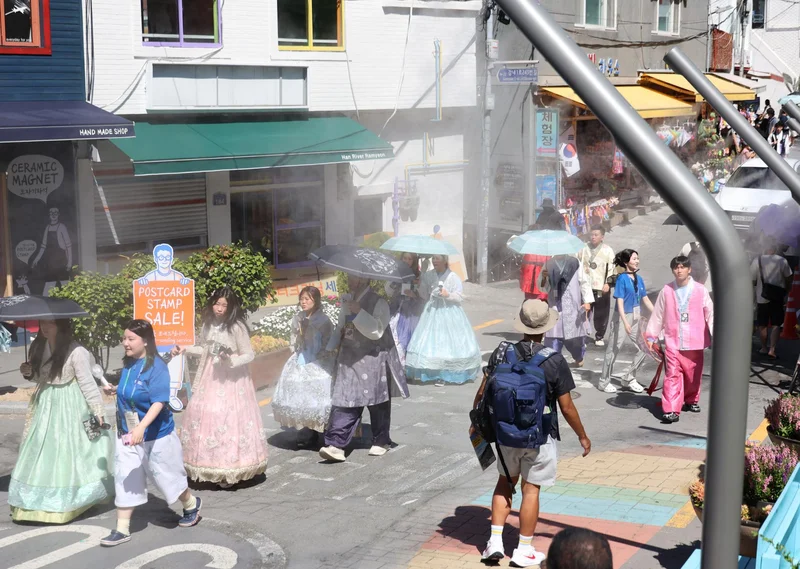
A sweltering heat wave is gripping most of Korea, with temperatures reaching up to 39 degrees Celsius in some areas, a day after Busan recorded its hottest day in 122 years on Wednesday.
Most of the country remains under heat wave alerts, with some areas under heat wave emergency warnings, as officials urged the public to avoid daytime outdoor activities. Extreme heat and sweltering nights are expected to persist into next week.
According to the Korea Meteorological Administration (KMA), morning lows are expected to range between 21 and 28 degrees Celsius, while daytime highs climb to between 32 and 39 degrees, with temperatures projected to stay above average in the days ahead.
In particular, the southeastern part of the country — including parts of Busan and South Gyeongsang Province's Yangsan, Changwon, Gimhae, Miryang, Uireong and Changnyeong — faces the most severe conditions, with daytime sensible temperatures expected to exceed 38 degrees and air temperatures reaching 39 degrees. As of 11 a.m. Thursday, temperatures had already reached 35.8 degrees in Yangsan and 32.9 degrees in Busan.
Most of Korea remains under heat wave alerts, with peak heat index values continuing to hover above 33 degrees Celsius nationwide and topping 35 degrees in the southern part. As of 11 a.m. Thursday, a heat wave emergency warning was in effect for the southeastern region, including western and central Busan, Yangsan, Changwon, Gimhae, Miryang, Uireong and Changnyeong — issued when the highest perceived temperature reaches 38 degrees Celsius or higher, or the maximum daily temperature reaches 39 degrees or higher. Heat wave alerts remained active across most other parts of the country.
Tropical nights are also expected to continue nationwide. The phenomenon occurs when overnight temperatures remain at or above 25 degrees Celsius between 6:01 p.m. and 9 a.m. the following day.
Overnight into Thursday, Gangneung in Gangwon Province recorded a low of 28.7 degrees Celsius, the highest in the region. Nearby areas also saw temperatures stay at or above the tropical night threshold, with Donghae at 28.2 degrees and Sokcho at 26.2 degrees.
Tropical nights were also observed across southeastern region, where a heat wave emergency warning remains in effect. Yangsan recorded 28.1 degrees, followed by Ulleung Island at 27.6 degrees and Busan and Bukchangwon at 27.4 degrees. Ulsan has now logged 13 tropical nights consecutively.
According to the KMA, the dual high-pressure system currently blanketing the peninsula — formed by the North Pacific High and the Tibetan High — will remain unchanged for the time being, meaning the heat waves are expected to continue into next week. However, a shift in wind direction to easterlies will raise temperatures in the capital region and west side of Korea.
Sunny and dry conditions will hold through next weekend, with afternoon highs persisting in the 33 to 39 degrees Celsius range.