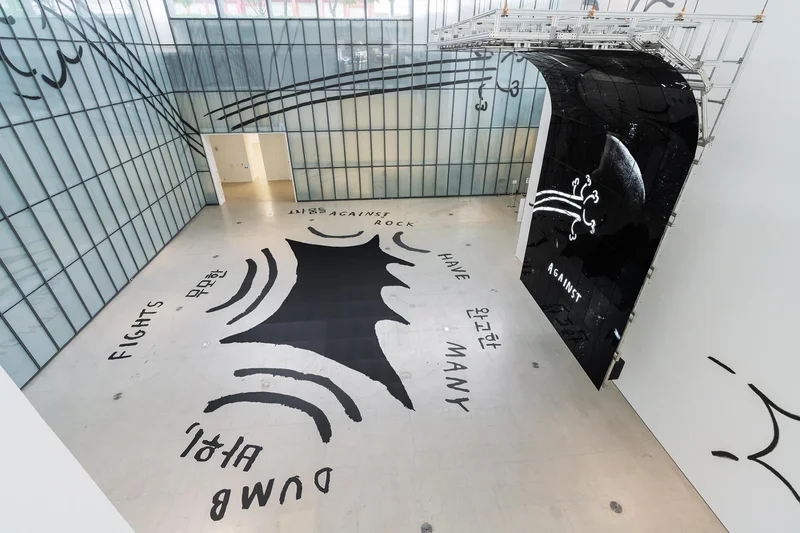
Christine Sun Kim, a Berlin-based Korean American Deaf artist who has become one of the most talked-about names in contemporary art, is presenting her first large-scale, site-specific commission at the National Museum of Modern and Contemporary Art, Korea (MMCA) in Seoul.
Titled “Have Many Dumb Fights Against Rock,” the MMCA x LG OLED Series 2026 exhibition transforms the soaring 16.6 meter-high atrium into an immersive black-and-white environment where animation, mural-scale drawing, sound and text flows across walls, glass and the floor, anchored by a massive curved LG OLED screen composed of 72 individual displays.
For Kim, who was born in Orange County, California, and has lived in Berlin for 13 years, the project is deeply personal.
“This moment is very personal for me because I’ve seen my halmeoni (grandmother) and harabeoji (grandfather) leave Korea, come to the U.S. and create a life for their family there,” she said.
“I have moved to Germany and now I’m back in Korea. This is an opportunity for me to be able to pay respect to my family and to my ancestry,” she said, speaking through an American Sign Language (ASL) interpreter and Korean-English translator at press preview, Thursday.
The exhibition builds on Kim’s recent efforts to push drawing on an architectural scale, turning language into something viewers physically walk through. On the floor and walls, thick motion lines derived from classic comics and the movement of ASL sweep through the space.
At the heart of the installation is the towering curved OLED screen, where a single-channel animation of rocks, lines and signs repeatedly colliding, dissolving and reforming visualizes the title of the exhibition, expressed in ASL.
Her practice, rooted in the experiences of Deaf communities, centers on questions of accessibility and communication, visualizing how different senses, languages and translations coexist with social hierarchy in everyday discourse.
“Right now, I feel like the world that we’re living in is full of battles,” Kim said. “People have obsessions with power, ownership … it feels as though you’re fighting against something as stubborn as rock because it’s the same fights and the change never happens. I don’t see any results from all of this fighting.”
The titular “rock” stands for more than an unyielding opponent, she added. It also captures entrenched social structures and even ourselves when we are locked inside our own certainties.
“Why I use black and white is asked often, and I think my best answer is because I’m coming from a place of fear,” she said. Existing in a world where the dominant transmission of information is through sound and speech, she said, spoken language is treated as superior to sign language.
“This world is not designed for me, so naturally there is a lot of tension, miscommunication, lack of full understanding, and all of that impacts how I make decisions. Because of this existence, I try to be as clear as possible — as clear as black and white.”
For Kim, the “dumb fights” are not something to be neatly resolved but an ongoing process in which differing languages, senses and perspectives clash, negotiate and sometimes find new forms of coexistence.
“The work shows that communication is not about reaching perfect agreement,” curator Kim Youn-ok said, “but about the continual process through which different languages, senses and positions keep colliding and being adjusted.”
In 2025, Kim was ranked 34th on British art magazine ArtReview’s “Power 100,” list of the most influential figures in the contemporary art world.
She recently presented a major solo exhibition at the Whitney Museum of American Art in New York, which traveled to the Walker Art Center in Minneapolis in 2026, and has shown at institutions such as Mori Art Museum in Tokyo, the Gwangju Biennale and the Berlin Biennale.
The exhibition runs from Friday to Nov. 29 at MMCA Seoul’s Seoul Box.