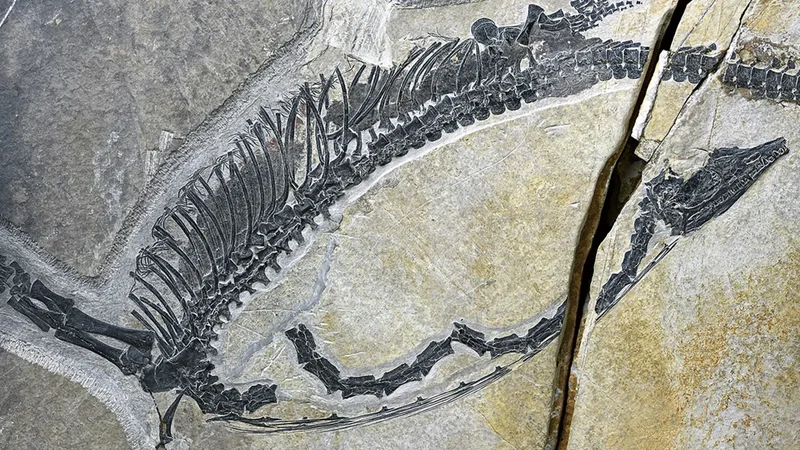
Triassic fish for lunch? Chinese fossil reveals oldest preserved reptile stomach
Specialised features of preserved 240 million-year-old skeleton suggest water-dwelling archosaurs existed earlier than originally thought
A Chinese-led team has analysed a 240 million-year-old fossil with the oldest known preserved stomach, liver and intestinal soft tissue in reptiles.
The fossil of the Austronaga minuta from the Early Triassic period also offers a “unique opportunity” to study how Triassic reptiles made the vital evolutionary transition from land to sea.
“We report on a well-preserved Triassic reptile representing the earliest stem-archosaur to evolve unequivocal aquatic specialisations,” the Chinese Academy of Sciences (CAS)-led team said in a paper published in the peer-reviewed journal Science Advances on Thursday.
“The fossil exhibits the oldest known stomach, liver and intestinal preservations in reptiles.”